
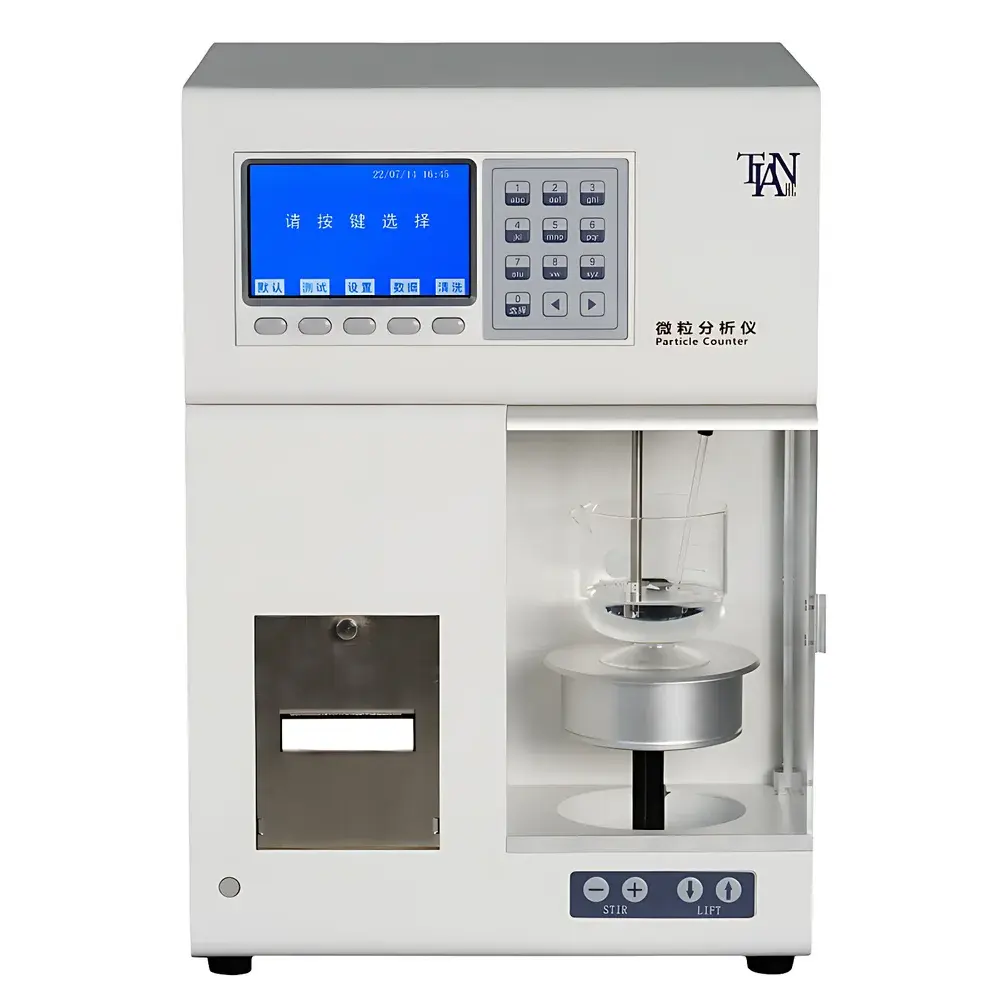
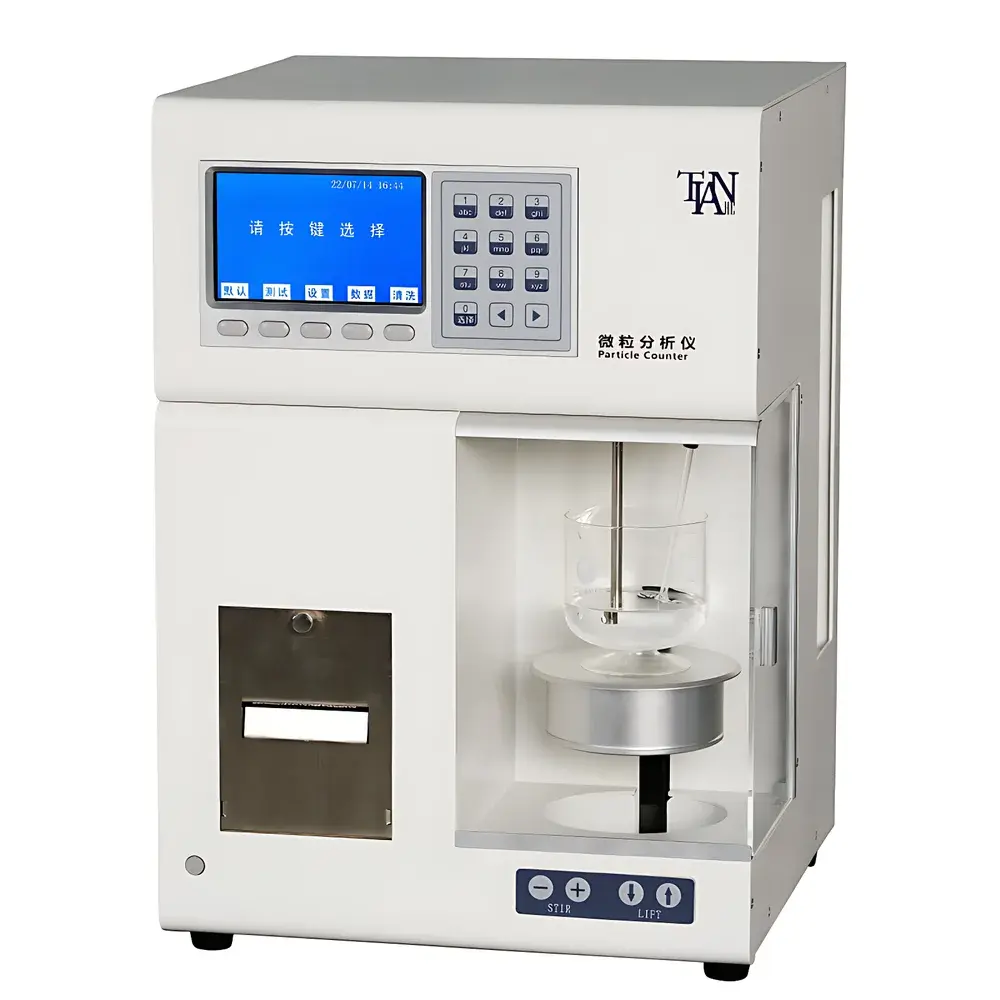
Tianhe GWF-7JA Insoluble Particle Analyzer
| Brand | Tianhe |
|---|---|
| Origin | Tianjin, China |
| Manufacturer Type | Authorized Distributor |
| Product Category | Domestic |
| Model | GWF-7JA |
| Pricing | Available Upon Request |
| Light Source | High-Performance Laser |
| Detection Principle | Light Obscuration (LO) |
| Sample Compatibility | Colorless & Colored Clear Liquids, Organic Solvents, Oil-Based Formulations |
| Sample Volume Range | 1–6000 mL (0.1 mL incremental step) |
| Volume Accuracy | ≤ ±0.5% (2–1000 mL) |
| Syringe Options | 5 mL, 10 mL, 25 mL |
| Flow Rate | 5–160 mL/min (user-adjustable) |
| Particle Size Channels | 2–3 µm, 3–4 µm, 4–6 µm, 5–6 µm, ≥5 µm, ≥10 µm, 15–25 µm, ≥25 µm, 25–50 µm, 51–100 µm, >100 µm, 20 µm |
| Customizable Channel Range | 1–500 µm (segmented selection) |
| Count Range | 0–999,999 particles per sample |
| Counting Accuracy | < ±5% of certified reference value |
| RSD | < 1.5% (for standard particles ≥1000 counts) |
| Coincidence Error | < 5% at 10,000 particles/mL |
| Stirring Mechanism | Frictionless Propeller-Type Agitator, 0–2000 rpm (adjustable) |
| Display | Large Backlit LCD with Multi-Channel Real-Time Data & Histogram Overlay |
| Preloaded Database | >300 USP/ChP-Listed Pharmaceuticals & Medical Devices |
| Compliance | GB 8368–2018, Chinese Pharmacopoeia (2020 Edition), ISO 21501-4, USP <788>, USP <789>, EP 2.9.19 |
| Connectivity | RS232 Interface for LIMS/Lab Platform Integration |
| Power Supply | AC 220 V ±10%, 50 Hz, <100 W |
| Operating Temperature | 10–40 °C |
| Wetted Materials | 316L Stainless Steel + PTFE (for syringe, slit, and fluidic path) |
Overview
The Tianhe GWF-7JA Insoluble Particle Analyzer is a precision light obscuration (LO)-based instrument engineered for quantitative detection and size-resolved enumeration of extraneous particulate matter in parenteral pharmaceuticals, medical devices, and related sterile liquid products. Designed to meet stringent regulatory requirements—including the Chinese Pharmacopoeia (2020 Edition), GB 8368–2018 for infusion sets, USP and , European Pharmacopoeia 2.9.19, and ISO 21501-4—the GWF-7JA delivers trace-level particle counting with high reproducibility and low coincidence error. Its optical architecture integrates a stabilized laser diode and wide-dynamic-range photodetector system, enabling direct analysis of both colorless and colored clear solutions without mandatory dilution or saline wash steps—reducing procedural variability and consumable cost. The instrument operates on first-principle LO detection: particles passing through a precisely defined sensing zone attenuate incident laser light proportionally to their cross-sectional area, generating pulse signals that are digitized, classified into user-defined size bins, and statistically accumulated.
Key Features
- High-fidelity light obscuration detection with calibrated sensitivity across 1–500 µm (segmented channel selection)
- Programmable high-precision syringe pump with selectable volumes (5/10/25 mL) and flow control (5–160 mL/min), ensuring consistent aspiration regardless of sample viscosity or ambient pressure (e.g., high-altitude laboratories)
- Frictionless propeller-type agitator (0–2000 rpm) with non-contact drive design—eliminates wear-induced artifact particles and ensures homogeneous suspension of irregularly shaped or high-density particulates
- Chemically inert fluidic path constructed from electropolished 316L stainless steel and PTFE—validated for compatibility with organic solvents (e.g., ethanol, isopropanol), lipid emulsions, and oil-based injectables
- Multi-channel real-time display showing simultaneous histogram distribution, cumulative counts per bin, and statistical summary (mean, SD, RSD) on a high-resolution backlit LCD
- Built-in pharmacopeial database containing >300 preconfigured entries for injectables, infusion sets, anesthesia kits, and primary packaging materials—enabling one-touch method recall and audit-ready reporting
- Full RS232 serial interface supporting bidirectional communication with LIMS, ELN, or centralized lab platforms; supports automated data export, timestamped logging, and electronic signature-ready output
Sample Compatibility & Compliance
The GWF-7JA accommodates a broad spectrum of sample types relevant to pharmaceutical quality control and device validation: aqueous IV solutions, lyophilized reconstitution fluids, ophthalmic preparations, silicone oil–lubricated syringes, PVC and non-PVC infusion tubing extracts, and polymer-based drug delivery systems. Its wetted components comply with USP material safety criteria and exhibit no detectable leachables under accelerated extraction conditions. Regulatory alignment includes full traceability to ChP Appendix IX H (Particulate Matter in Injections), USP (Subvisible Particles), USP (Visible Particles), and ISO 21501-4 (Determination of particle size distribution—Light scattering methods). Instrument qualification documentation supports IQ/OQ/PQ execution per ASTM E2500 and FDA Guidance for Industry (Process Validation: General Principles and Practices). Data integrity conforms to ALCOA+ principles and enables 21 CFR Part 11-compliant audit trails when integrated with validated laboratory software environments.
Software & Data Management
Embedded firmware provides granular control over acquisition parameters—including channel gating, trigger threshold, background suppression, and volume normalization—without requiring external PC software. All measurement sessions are automatically timestamped, assigned unique batch IDs, and stored locally with checksum verification. Raw pulse data, binned histograms, and summary statistics are exportable via RS232 in CSV or XML format, preserving metadata (operator ID, calibration date, sensor status, ambient temperature/humidity). Optional PC-based analysis suite (sold separately) extends functionality with trend charting, SPC control charts (X̄/R, CUSUM), multi-instrument fleet monitoring, and customizable PDF report generation compliant with GLP/GMP Annex 11 requirements. User access levels (administrator, analyst, reviewer) enforce role-based permissions for method editing, result approval, and audit log review.
Applications
- Final container testing of small-volume parenterals (SVPs) and large-volume parenterals (LVPs) per USP
- Extractable particulate evaluation of polymeric medical devices (e.g., catheters, syringes, IV sets) per GB 8368–2018 and ISO 10993-12
- Filter integrity verification and downstream particulate challenge studies
- Stability-indicating assessment of protein therapeutics prone to aggregation (e.g., mAbs, fusion proteins)
- QC release testing of ophthalmic solutions and nasal sprays where sub-10 µm particles impact tolerability
- Investigational analysis of manufacturing process deviations linked to visible or subvisible particle excursions
FAQ
Does the GWF-7JA require calibration with NIST-traceable particle standards?
Yes—annual calibration using ISO 11171-certified polystyrene latex (PSL) suspensions is recommended. Built-in calibration verification routines support daily system suitability checks per USP .
Can the instrument differentiate between intrinsic and extrinsic particles?
No—LO-based detection identifies all optically opaque particles within the sensing zone but does not provide chemical identification. Complementary techniques (e.g., FTIR, Raman microscopy) are required for root cause attribution.
Is method transfer supported between GWF-7JA units across different sites?
Yes—standardized hardware configuration, firmware version control, and identical channel definitions enable robust inter-instrument comparability when qualified per ICH Q5C and ASTM E2878.
What maintenance intervals are recommended for the fluidic system?
Daily rinse with filtered deionized water; quarterly inspection of syringe seals and slit aperture cleanliness; annual replacement of optical window gaskets and pump tubing per manufacturer’s service bulletin.





