
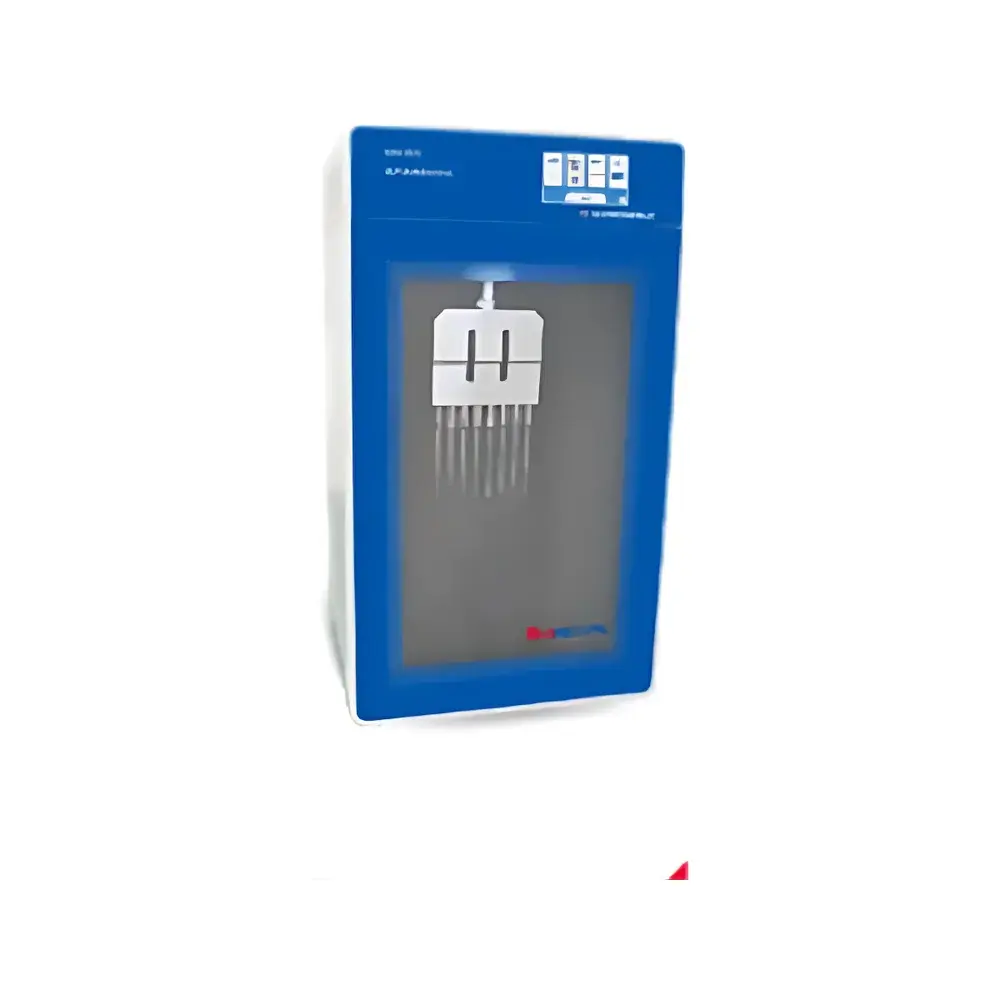
SHUMEI KBC-24TD Multi-Channel Ultrasonic Cell Disruptor
| Brand | SHUMEI |
|---|---|
| Origin | Jiangsu, China |
| Manufacturer Type | Direct Manufacturer |
| Product Category | Domestic |
| Model | KBC-24TD |
| Instrument Type | General-Purpose |
| Ultrasonic Frequency | 20 ± 0.5 kHz |
| Ultrasonic Power Output | 2500 W |
| Power Adjustment Range | 0–100% |
| Time Adjustment Range | 1 min – 99 h 59 min |
| Transducer Material | Ti-6Al-4V Titanium Alloy |
| Probe Options | Φ3 mm or Φ6 mm (optional) |
| Channel Capacity | 24-position |
| Sample Volume per Channel | 0.5–5 mL |
| Pulse Mode | Adjustable (1 s – 59 min 59 s) |
| User Memory Presets | 9 groups |
| Display | LCD Touchscreen Interface |
Overview
The SHUMEI KBC-24TD Multi-Channel Ultrasonic Cell Disruptor is an engineered solution for high-throughput, reproducible sample lysis in molecular biology, biochemistry, and pharmaceutical R&D laboratories. It operates on the principle of high-intensity ultrasonic cavitation—where rapid pressure fluctuations in a liquid medium generate transient microbubbles that collapse violently, producing localized shear forces, shockwaves, and thermal effects sufficient to disrupt cellular membranes and subcellular structures. Unlike single-probe sonicators, the KBC-24TD integrates 24 synchronized titanium alloy (Ti-6Al-4V) probes driven by a shared high-efficiency piezoelectric transducer array, enabling simultaneous, uniform energy delivery across all channels without cross-contamination or positional bias. Designed for scalability and consistency, it supports direct processing of standard 24-well plates or custom tube racks, eliminating manual probe repositioning and reducing inter-sample variability—critical for applications requiring statistical rigor, such as RNA-seq library prep, protein extraction, or microbial inactivation studies.
Key Features
- 24-channel parallel processing architecture with independent amplitude control per channel via centralized power modulation (0–100% continuous adjustment)
- Ti-6Al-4V titanium alloy probes (Φ3 mm standard; Φ6 mm optional) offering superior acoustic impedance matching, corrosion resistance, and fatigue life under prolonged duty cycles
- Motorized vertical stage with programmable descent speed and endpoint detection, ensuring consistent probe immersion depth and minimizing operator-induced variability
- Integrated LED illumination system for real-time visual monitoring of cavitation activity and sample homogeneity during operation
- LCD touchscreen interface with intuitive navigation, multilingual support (English, Chinese), and 9 user-definable protocol presets stored locally with timestamped execution logs
- Comprehensive safety architecture including automatic overload cutoff, thermal shutdown (with optional PT100 sensor), and emergency stop circuitry compliant with IEC 61010-1 safety standards
- Pulse mode functionality (1 s – 59 min 59 s on/off intervals) to mitigate sample heating and preserve thermolabile biomolecules
Sample Compatibility & Compliance
The KBC-24TD accommodates diverse biological matrices—including mammalian cells, bacterial cultures (E. coli, Bacillus spp.), yeast, plant tissues, viral suspensions, and subcellular fractions—within volume ranges of 0.5–5 mL per well. Its sealed probe design prevents aerosol generation and enables use in biosafety cabinets (Class II A2/B2). All wetted components meet USP Class VI biocompatibility requirements. The instrument supports GLP/GMP-aligned workflows through audit-trail-capable operation logging (when connected to external USB storage) and complies with ISO 13485 manufacturing quality systems. While not FDA 510(k)-cleared, its design aligns with ASTM F2734-21 (Standard Guide for Ultrasonic Disruption of Microorganisms) and ISO 11137-1:2018 (sterilization validation principles applicable to ultrasonic inactivation studies).
Software & Data Management
The embedded firmware records operational metadata—including date/time stamp, selected protocol ID, actual power output (%), elapsed time, pulse cycle parameters, and motor position—for each run. Data export is supported via USB 2.0 to CSV format for integration into LIMS or ELN platforms. No proprietary cloud service or vendor lock-in is required. Optional RS-232 or Ethernet interfaces (hardware upgrade kit) enable remote triggering and status polling in automated lab environments. All firmware updates are delivered as signed binary packages with SHA-256 checksum verification to ensure integrity and traceability.
Applications
- High-yield nuclear extraction and chromatin shearing for ChIP-seq
- Simultaneous lysis of replicate clinical isolates for antimicrobial susceptibility profiling
- Preparation of nanoemulsions and liposome dispersions in formulation development
- Rapid cell disruption prior to qPCR or digital PCR template preparation
- Accelerated solvent-free extraction of secondary metabolites from botanical matrices
- Deagglomeration and surface functionalization of metal oxide nanoparticles (e.g., TiO₂, ZnO)
- Ultrasonic cleaning of microfluidic chips and MEMS devices prior to bonding or assay loading
FAQ
Is the KBC-24TD suitable for cryogenic sonication?
No. This system is designed for ambient-temperature operation. For low-temperature applications, external cooling jackets or dry ice/ethanol baths must be used with appropriate probe insulation and thermal monitoring.
Can I use non-SHUMEI probes with this instrument?
Only SHUMEI-certified Ti-6Al-4V probes are guaranteed to maintain acoustic coupling efficiency and mechanical resonance at 20 kHz. Third-party probes may cause impedance mismatch, reduced energy transfer, or transducer damage.
What maintenance is required for long-term reliability?
Monthly inspection of probe threads and O-rings, quarterly calibration of power output using a calibrated calorimetric load, and annual verification of motorized stage repeatability (±0.1 mm) are recommended per the manufacturer’s service schedule.
Does the instrument comply with electromagnetic compatibility (EMC) directives?
Yes. It meets EN 61326-1:2013 for laboratory equipment and passes radiated/conducted emission tests per CISPR 11 Group 1, Class B limits.
How is consistency validated across all 24 channels?
SHUMEI provides a factory-issued performance verification report detailing channel-to-channel power deviation (≤ ±3.5% RMS at 100% setting) and frequency stability (20.00 ± 0.05 kHz) measured per IEC 60601-2-37 Annex DD protocols.



