
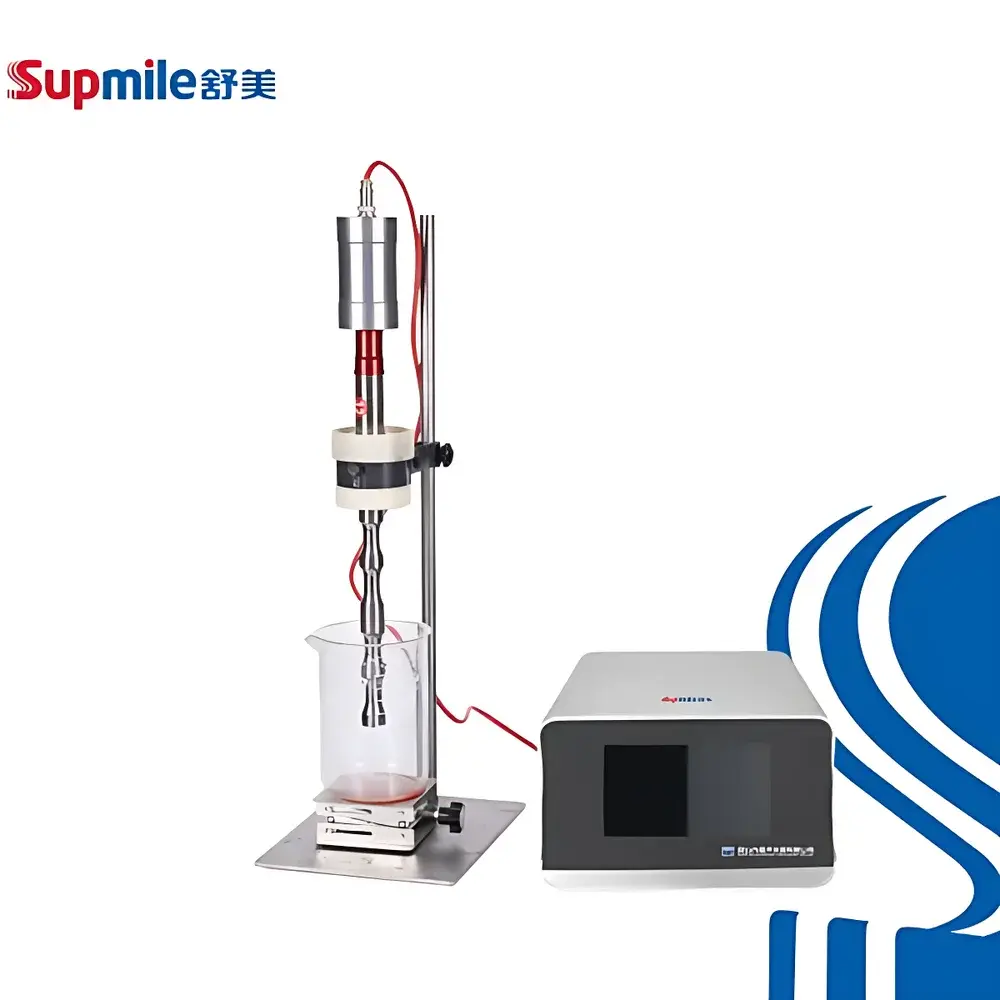
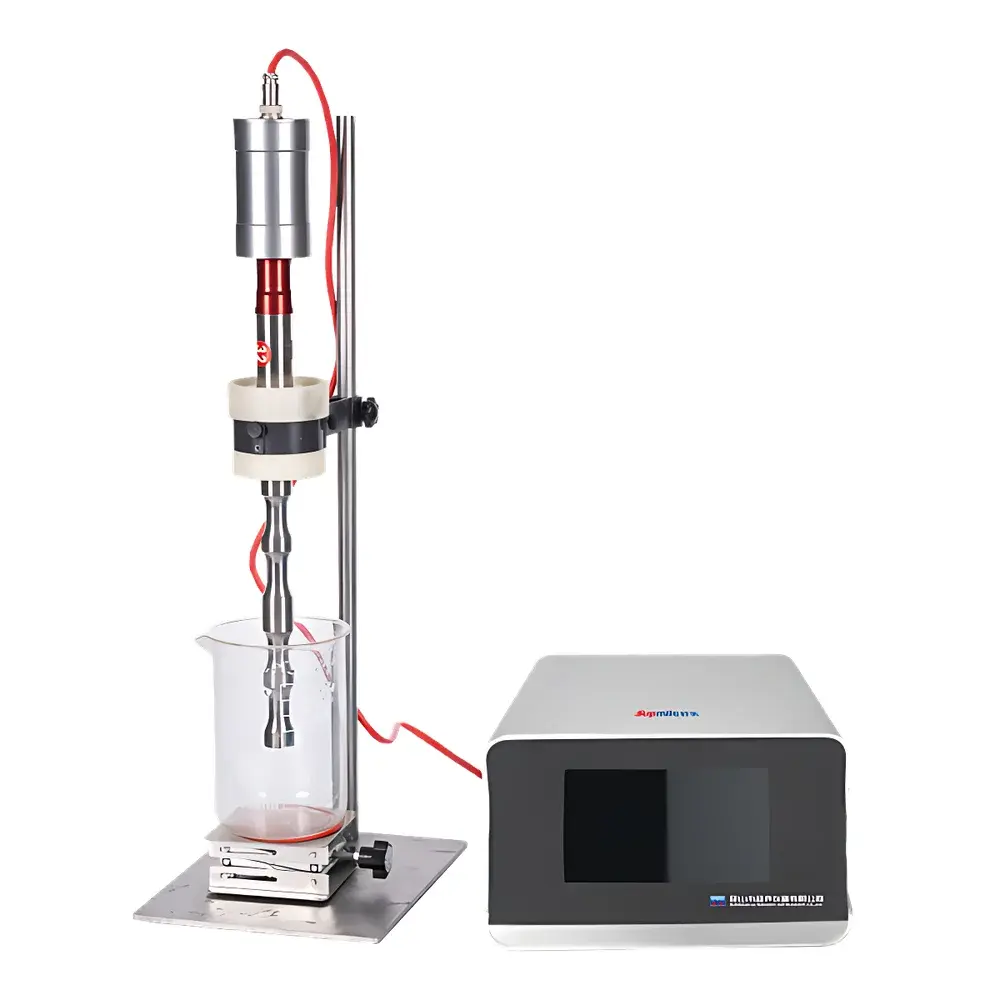
Shumei KBC-1000D High-Power Immersion Ultrasonic Processor (Probe-Type)
| Brand | Shumei |
|---|---|
| Origin | Jiangsu, China |
| Manufacturer Type | Direct Manufacturer |
| Origin Category | Domestic (China) |
| Model | KBC-1000D |
| Price | USD 5,580 (FOB Jiangsu) |
| Generator Dimensions | 348 × 275 × 175 mm |
| Ultrasonic Frequency | 20 kHz (auto-tracking range: 19–26 kHz) |
| Output Power | 1000 W (adjustable 0–100%) |
| Processing Volume | 0.1–3 L |
| Timer Range | 1 min – 99 h 59 min |
| Pulse Duration | 1 s – 59 min 59 s |
| Standard Horn Diameter | Φ25 mm |
| Horn Material | Ti-6Al-4V titanium alloy |
| Transducer Material | CV33 piezoceramic with PZT (lead zirconate titanate) |
| Control Interface | Color industrial touchscreen |
| Communication | RS-485 (optional) |
| Safety Features | Overload, overtemperature, and fault auto-protection (optional) |
Overview
The Shumei KBC-1000D High-Power Immersion Ultrasonic Processor is an industrial-grade probe-type sonicator engineered for demanding laboratory and pilot-scale applications requiring controlled, high-intensity ultrasonic energy delivery. It operates on the principle of piezoelectric transduction: electrical energy is converted into mechanical vibration via a PZT-based ceramic stack (CV33 grade), amplified through a resonant titanium alloy horn (Ti-6Al-4V), and transmitted directly into liquid samples via immersion. With a nominal output power of 1000 W at 20 kHz—and dynamic frequency tracking across 19–26 kHz—the system maintains optimal acoustic coupling under variable load conditions, including changes in viscosity, temperature, or volume. Its immersion architecture eliminates chamber wall attenuation and enables direct energy transfer to heterogeneous suspensions, emulsions, cell lysates, and nanoparticle dispersions—making it suitable for applications where reproducible cavitation intensity and spatial localization are critical.
Key Features
- Industrial color touchscreen interface with intuitive navigation and real-time parameter visualization
- Auto-frequency tracking (19–26 kHz) ensures continuous resonance alignment during process drift caused by sample heating or compositional change
- Intelligent energy compensation algorithm dynamically adjusts drive amplitude and frequency to sustain peak cavitation efficiency across varying sample impedances
- Dual operating modes: continuous ultrasonication and programmable pulse mode (pulse-on/off durations independently adjustable from 1 second to 59 minutes 59 seconds)
- Three-dimensional exponential horn geometry enhances acoustic energy distribution and reduces mechanical fatigue compared to conventional cylindrical designs
- Up to nine user-defined protocols stored onboard for rapid recall and repeatable execution
- Optional RS-485 serial interface supports integration into automated lab systems and SCADA environments for centralized control and data logging
- Comprehensive safety architecture includes thermal cutoff, current-limiting circuitry, and real-time impedance monitoring; optional overload/overtemperature alarm modules provide audible and visual fault indication
Sample Compatibility & Compliance
The KBC-1000D accommodates sample volumes ranging from 100 mL to 3 L in standard glass or stainless-steel vessels. Its Φ25 mm titanium horn is optimized for medium-viscosity aqueous and organic media, while optional horns (Φ40 mm, Φ50 mm) extend capability to higher-volume or higher-viscosity processing. The system complies with IEC 61000-6-3 (EMC emission standards) and IEC 61000-6-2 (immunity). While not certified for GMP manufacturing, its programmable parameters, protocol storage, and optional audit-trail-capable RS-485 interface support GLP-aligned documentation practices. Users performing regulated work (e.g., USP for particle size analysis of lipid emulsions or ASTM E2810 for sonochemical reaction monitoring) may configure the device to meet traceability requirements via external data acquisition systems.
Software & Data Management
No proprietary PC software is bundled; however, the RS-485 interface (optional) enables communication using Modbus RTU protocol. This allows integration with third-party platforms such as LabVIEW, MATLAB, or custom Python-based controllers for time-stamped parameter logging, remote start/stop, and synchronized multi-device operation. All user settings—including power level, timer duration, pulse sequence, and frequency offset—are retained in non-volatile memory and accessible directly via the touchscreen without external tools. Audit-ready operation is supported when paired with external timestamped data loggers compliant with FDA 21 CFR Part 11 requirements (electronic signatures, record integrity, and change control).
Applications
- Cell disruption and subcellular fractionation in microbiology and molecular biology workflows
- Nanomaterial dispersion and deagglomeration for graphene oxide, carbon nanotubes, and metal oxide nanoparticles
- Emulsification of pharmaceutical oil-in-water formulations and cosmetic microemulsions
- Accelerated solvent extraction (ASE) of bioactive compounds from botanical matrices
- Sonochemical synthesis of metal-organic frameworks (MOFs) and catalytic nanoparticles
- Homogenization of tissue homogenates and polymer blends prior to rheological or spectroscopic analysis
- Ultrasonic cleaning and surface activation of substrates in pre-coating preparation
FAQ
What is the maximum recommended operating temperature for the titanium horn?
The Ti-6Al-4V horn is rated for continuous operation up to 80 °C ambient liquid temperature; prolonged exposure above this threshold may accelerate fatigue and reduce service life.
Can the KBC-1000D be used in explosion-proof environments?
No—this unit is not ATEX or IECEx certified. For hazardous area use, consult Shumei’s engineering team regarding custom intrinsically safe enclosure options.
Is calibration traceable to NIST or other national standards?
Power output is factory calibrated against reference hydrophone measurements per IEC 61828; full metrological traceability documentation is available upon request for QA/QC validation.
How often does the horn require replacement under typical usage?
With proper maintenance (avoiding dry operation, excessive torque, or corrosive media), the Φ25 mm horn typically achieves 1,500–2,000 hours of cumulative operational life before measurable amplitude degradation occurs.
Does the system support external trigger input for synchronization with analytical instruments?
Yes—via optional digital I/O module (sold separately), enabling TTL-level start/stop signals synchronized with UV-Vis spectrometers, pH meters, or particle analyzers.



