
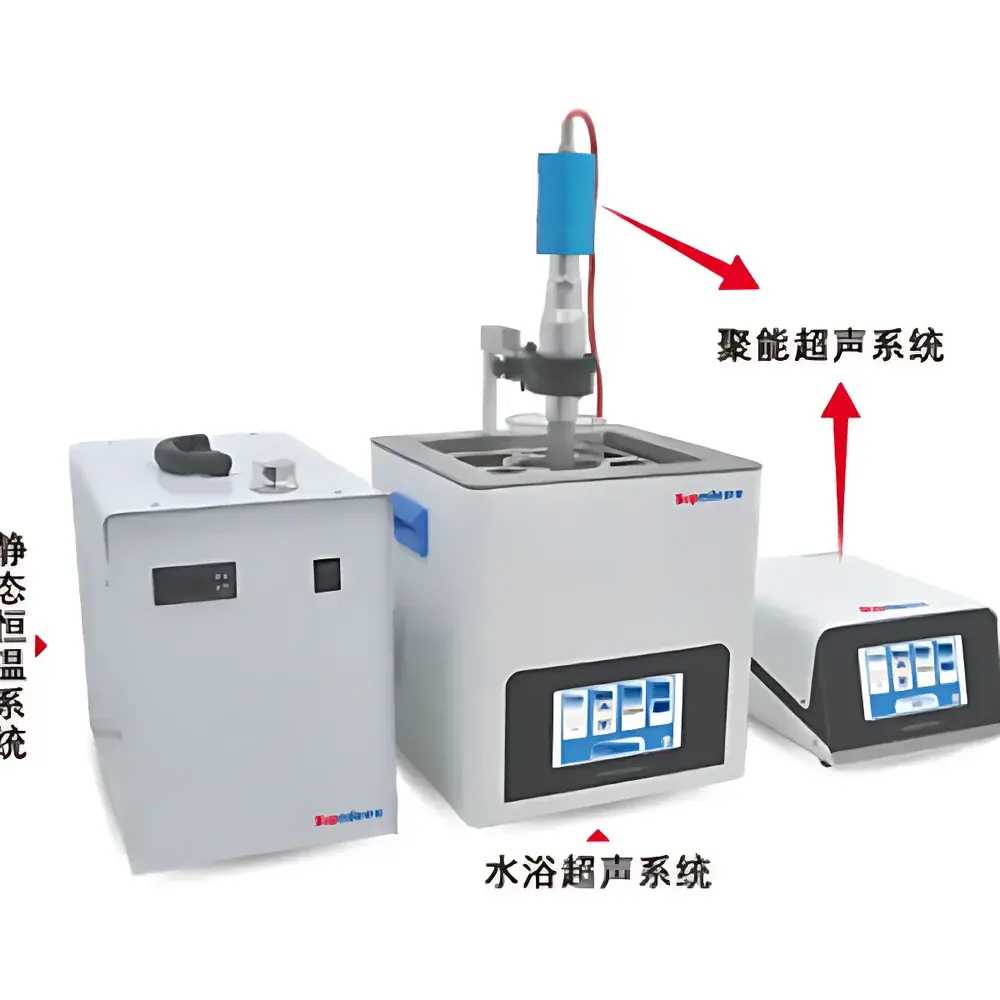
SHUMEI KBC-400G Tri-Mode Ultrasonic Processing System (Static Temperature Control + Water Bath Ultrasonication + Probe Sonication)
| Brand | SHUMEI |
|---|---|
| Origin | Jiangsu, China |
| Manufacturer Type | OEM Manufacturer |
| Product Category | Domestic |
| Model | KBC-400G |
| Instrument Type | General-Purpose |
| Tank Capacity | 15 L |
| Ultrasonic Frequency | 20 ± 1 kHz |
| Ultrasonic Power Output | 400 W |
| Power Adjustment Range | 0–100% |
| Timer Range | 1 min – 99 h 59 min |
Overview
The SHUMEI KBC-400G Tri-Mode Ultrasonic Processing System is an integrated laboratory platform engineered for precise, reproducible, and multi-functional sample processing under controlled thermal conditions. It combines three physically distinct ultrasonic modalities—static temperature-controlled water bath sonication, immersion probe (horn-type) sonication, and independent thermal regulation—within a single, modular architecture. Unlike conventional ultrasonic cleaners that rely solely on tank-based cavitation, this system decouples thermal management from acoustic energy delivery: the static temperature control module employs a closed-loop circulating chiller-heater (±0.5 °C stability over 0–60 °C range) to maintain sample temperature without fluid agitation, while the water bath transducers operate at a fixed frequency of 20 ±1 kHz to generate uniform cavitation fields across the 15 L stainless-steel tank. The optional probe sonication module (KBC-1000F, included in KBC-400ZH configuration) delivers focused, high-intensity acoustic energy via titanium alloy probes (Φ13 mm standard), enabling direct energy coupling into viscous or low-volume samples. This tri-modal design addresses fundamental limitations in conventional ultrasonics—thermal drift during prolonged treatment, non-uniform energy distribution in heterogeneous suspensions, and inefficient energy transfer in high-viscosity media—making it suitable for applications demanding strict process control, such as GMP-aligned extraction protocols or ISO 17025-compliant method validation.
Key Features
- 7-inch TFT capacitive touchscreen interface with real-time display of temperature, power output, elapsed time, and fault diagnostics (over-temperature, over-current, over-voltage alerts)
- Corrosion-resistant electrostatically coated stainless-steel housing rated IP44 for lab environment durability
- Independent operational modes: water bath sonication only, probe sonication only, or synchronized dual-mode operation with concurrent temperature stabilization
- High-efficiency piezoelectric transducer array with >85% electroacoustic conversion efficiency; minimal reactive power loss
- Static temperature control system featuring 10 L/min coolant circulation, 600 W refrigeration capacity, and 3000 W heating capacity for rapid thermal equilibration
- Programmable pulse modulation (1 s–59 min 59 s intervals) and duty cycle control for probe sonication to minimize sample overheating and degradation
- Modular design compliant with IEC 61000-6-3 (EMC emissions) and IEC 61010-1 (safety requirements for laboratory equipment)
Sample Compatibility & Compliance
The KBC-400G accommodates a broad range of sample formats—including glass vials (15–1000 mL), centrifuge tubes, beakers, and custom reaction vessels—without requiring fixture adaptation. Its water bath chamber (320 × 320 × 150 mm internal dimensions) supports simultaneous processing of multiple samples under identical acoustic and thermal conditions. For probe-based applications, the system accepts standard Φ13 mm titanium horns compatible with ASTM E2810-11 (standard guide for ultrasonic cleaning verification) and USP (guidance on ultrasonic energy measurement). All electronic subsystems are designed to meet GLP data integrity requirements: audit trails record operator ID, parameter changes, start/stop timestamps, and system error logs. Firmware complies with FDA 21 CFR Part 11 for electronic records when paired with validated LIMS integration.
Software & Data Management
The embedded controller stores up to 100 user-defined protocols with full parameter recall (temperature setpoint, power level, timer duration, pulse sequence). USB export enables raw log file retrieval in CSV format for traceability and statistical process analysis. Optional Ethernet connectivity supports remote monitoring via Modbus TCP or HTTP API, facilitating integration into centralized lab automation frameworks. Calibration certificates for temperature sensors (NIST-traceable Pt100) and power meters (IEC 60601-2-37 compliant) are provided with each unit. Software updates are delivered via signed firmware packages with SHA-256 verification to ensure cryptographic integrity.
Applications
- Cell lysis and nucleic acid extraction (e.g., chromatin immunoprecipitation—ChIP—with temperature-controlled shearing)
- Environmental analysis: accelerated solvent extraction (ASE) of soil-bound organic pollutants (PAHs, PCBs) per EPA Method 3545A
- Phytochemical isolation: ultrasound-assisted extraction (UAE) of thermolabile compounds from herbal matrices under sub-boiling conditions
- Nanomaterial processing: deagglomeration of metal oxide nanoparticles (TiO₂, ZnO) in aqueous and organic dispersions
- Emulsion formulation: preparation of stable oil-in-water nanoemulsions for pharmaceutical delivery systems
- Wastewater treatment research: sonochemical degradation kinetics studies of COD and emerging contaminants (e.g., pharmaceuticals, microplastics)
- Catalyst synthesis: controlled hydrolysis and condensation reactions in sol-gel processes
FAQ
Can the water bath and probe sonication modules operate simultaneously?
Yes—the system supports concurrent operation with independent parameter control for each module. Thermal feedback from the bath sensor modulates the chiller/heater output without affecting probe power delivery.
Is the temperature control system capable of sub-ambient cooling?
Yes—the static temperature module achieves temperatures as low as 0 °C using tap water or external coolant; for sub-zero operation, a recirculating chiller with ethylene glycol mixture is recommended.
What safety certifications does the KBC-400G hold?
It conforms to IEC 61010-1 (Ed. 3.1) for electrical safety, IEC 61326-1 for EMC, and carries CE marking under the EU Low Voltage and EMC Directives.
How is acoustic power calibrated and verified?
Each unit undergoes calorimetric power calibration per ASTM E2810-11 using a calibrated aluminum calorimeter; a certificate of conformance is supplied with documented uncertainty (<±3.5%).
Does the system support automated protocol sequencing across multiple steps?
Not natively—the controller executes single-step protocols. However, external PLC or LabVIEW-based orchestration is supported via digital I/O and Modbus TCP interfaces.



