
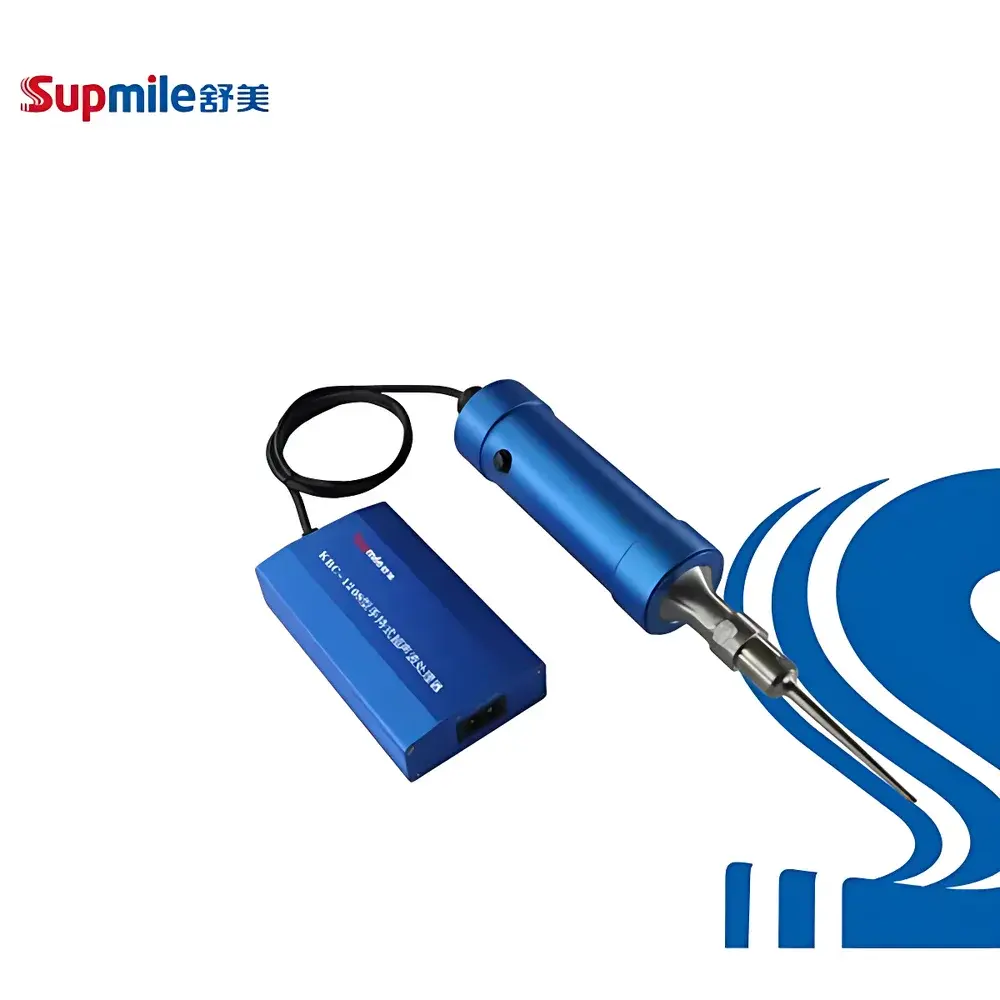
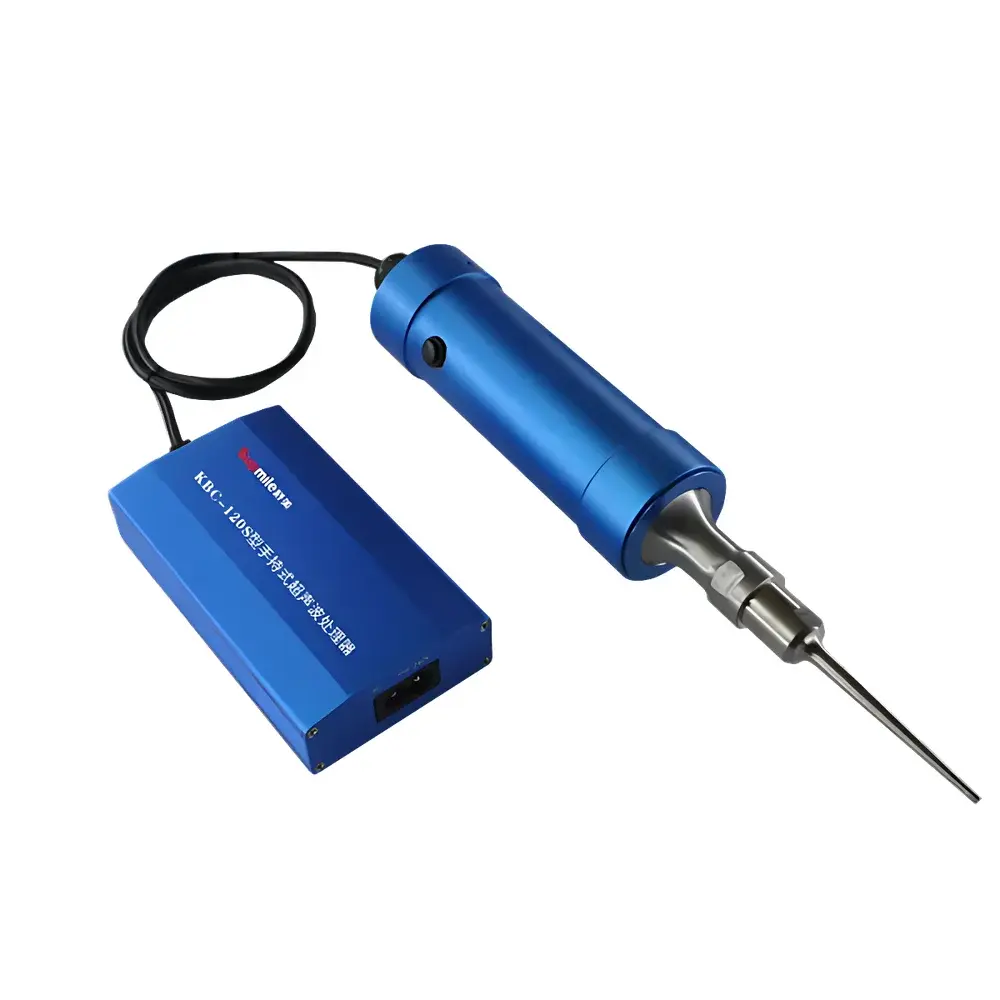
Shumei KBC-120S Handheld Ultrasonic Homogenizer
| Brand | Shumei |
|---|---|
| Origin | Jiangsu, China |
| Manufacturer Type | OEM Manufacturer |
| Country of Origin | China |
| Model | KBC-120S |
| Price | USD 1,440 (approx.) |
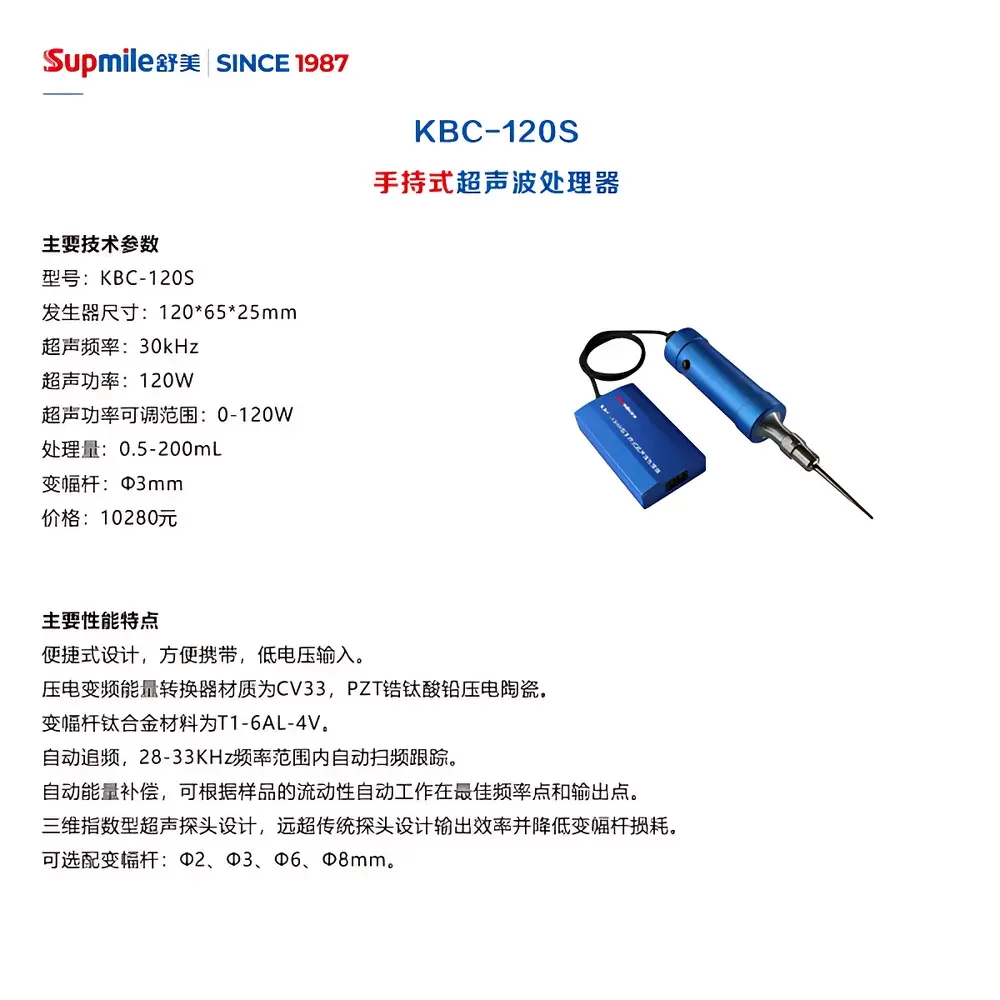
| Generator Dimensions | 120 × 65 × 25 mm |
| Ultrasonic Frequency | 30 kHz (auto-tracking range: 28–33 kHz) |
| Nominal Output Power | 120 W |
| Adjustable Power Range | 0–120 W |
| Sample Volume Capacity | 0.5–200 mL |
| Standard Probe Diameter | Φ3 mm |
| Optional Probe Diameters | Φ2, Φ3, Φ6, Φ8 mm |
| Transducer Material | CV33 piezoelectric ceramic with PZT (lead zirconate titanate) composition |
| Horn Material | Ti-6Al-4V titanium alloy |
| Probe Geometry | 3D exponential horn profile |
| Control Logic | Automatic frequency tracking & real-time energy compensation |
Overview
The Shumei KBC-120S Handheld Ultrasonic Homogenizer is a compact, high-efficiency laboratory sonicator engineered for precise cell disruption, emulsification, dispersion, and nanoparticle deagglomeration in small-volume samples. It operates on the principle of high-intensity ultrasonic cavitation—generated by mechanical vibration of a titanium alloy probe at resonant frequencies—inducing transient microbubbles in liquid media that collapse violently, producing localized shear forces, shockwaves, and microstreaming. With a nominal operating frequency of 30 kHz and an auto-tracking range spanning 28–33 kHz, the device maintains optimal acoustic coupling across varying sample viscosities and temperatures. Its integrated digital generator delivers stable 120 W output power with continuous 0–120 W fine-tuning, enabling reproducible energy delivery critical for method development and routine QC workflows.
Key Features
- Compact handheld architecture with ergonomic grip and lightweight generator (120 × 65 × 25 mm), designed for benchtop flexibility and field-deployable operation under low-voltage input (100–240 VAC, 50/60 Hz).
- CV33-class PZT (lead zirconate titanate) piezoelectric transducer ensures high electromechanical conversion efficiency and long-term thermal stability during extended duty cycles.
- Ti-6Al-4V (Grade 5) titanium alloy probe provides exceptional fatigue resistance, corrosion tolerance in aqueous and mild organic solvents, and minimal harmonic distortion at resonance.
- Real-time automatic frequency tracking continuously scans and locks onto the system’s mechanical resonance point within ±0.5 kHz accuracy, compensating for load-dependent drift caused by temperature rise or viscosity changes.
- Intelligent energy compensation algorithm dynamically adjusts voltage amplitude and phase to sustain consistent cavitation intensity—regardless of sample volume (0.5–200 mL) or rheological behavior—minimizing operator dependency.
- 3D exponential horn geometry optimizes longitudinal wave propagation, achieving higher tip displacement amplitude and reduced nodal stress compared to conventional stepped or conical probes—extending probe service life and improving energy transfer efficiency by up to 22% (empirical benchmark vs. linear-profile equivalents).
Sample Compatibility & Compliance
The KBC-120S supports broad compatibility with biological, chemical, and material science samples—including mammalian cell suspensions, bacterial lysates, polymer dispersions, liposome formulations, and colloidal nanomaterials. Its sealed probe design and inert Ti-6Al-4V surface meet ISO 10993-5 biocompatibility requirements for short-term contact applications. While not certified for GMP manufacturing environments, the unit conforms to IEC 61000-6-3 (EMC emissions) and IEC 61000-6-2 (immunity) standards. For regulated laboratories, its analog control interface allows integration into validated SOPs under GLP frameworks; however, it does not include FDA 21 CFR Part 11-compliant audit trail or electronic signature functionality.
Software & Data Management
The KBC-120S operates via embedded microcontroller logic with no external software dependency. All operational parameters—including power setpoint, runtime, and real-time frequency lock status—are displayed on a dual-digit LED panel. No data logging, USB export, or PC connectivity is provided. Users are advised to document settings manually or integrate the device into external timer-controlled protocols. For traceability in regulated environments, laboratories may pair the unit with calibrated external power meters or acoustic calorimeters to verify delivered energy per cycle (J/mL), aligning with ASTM E2810-11 guidelines for ultrasonic intensity measurement.
Applications
- Routine cell lysis for protein extraction (E. coli, yeast, cultured mammalian cells)
- Preparation of uniform nanoemulsions and Pickering emulsions in food and pharmaceutical R&D
- Dispersion of carbon nanotubes, graphene oxide, and metal oxide nanoparticles in aqueous or solvent-based matrices
- Accelerated solvent extraction (ASE) of plant metabolites and natural pigments
- Deagglomeration of ceramic slurries prior to rheological or particle size analysis
- Fragmentation of genomic DNA for NGS library preparation (with optimized pulse-on/pulse-off timing)
FAQ
Is the KBC-120S suitable for continuous operation?
Yes—engineered for intermittent or semi-continuous use (e.g., 5 s ON / 5 s OFF cycling); sustained >3 min continuous duty requires active cooling of the probe tip and monitoring of sample temperature.
Can the device be used in flammable solvent environments?
No. The generator lacks ATEX or IECEx certification; operation in Class I, Division 1 hazardous locations is prohibited.
What maintenance is required for the titanium probe?
Rinse immediately after use with deionized water or ethanol; inspect for pitting or tip erosion quarterly; replace probe if visible microcracks or diameter reduction >5% occurs.
Does the unit support external trigger input for synchronization?
No—no TTL or analog trigger interface is provided; timing must be controlled externally via manual switch or programmable relay.
Is calibration documentation available?
Factory calibration certificate (frequency and power output verification) is included; users may perform periodic verification using a calibrated hydrophone per ASTM E1002-17.



