
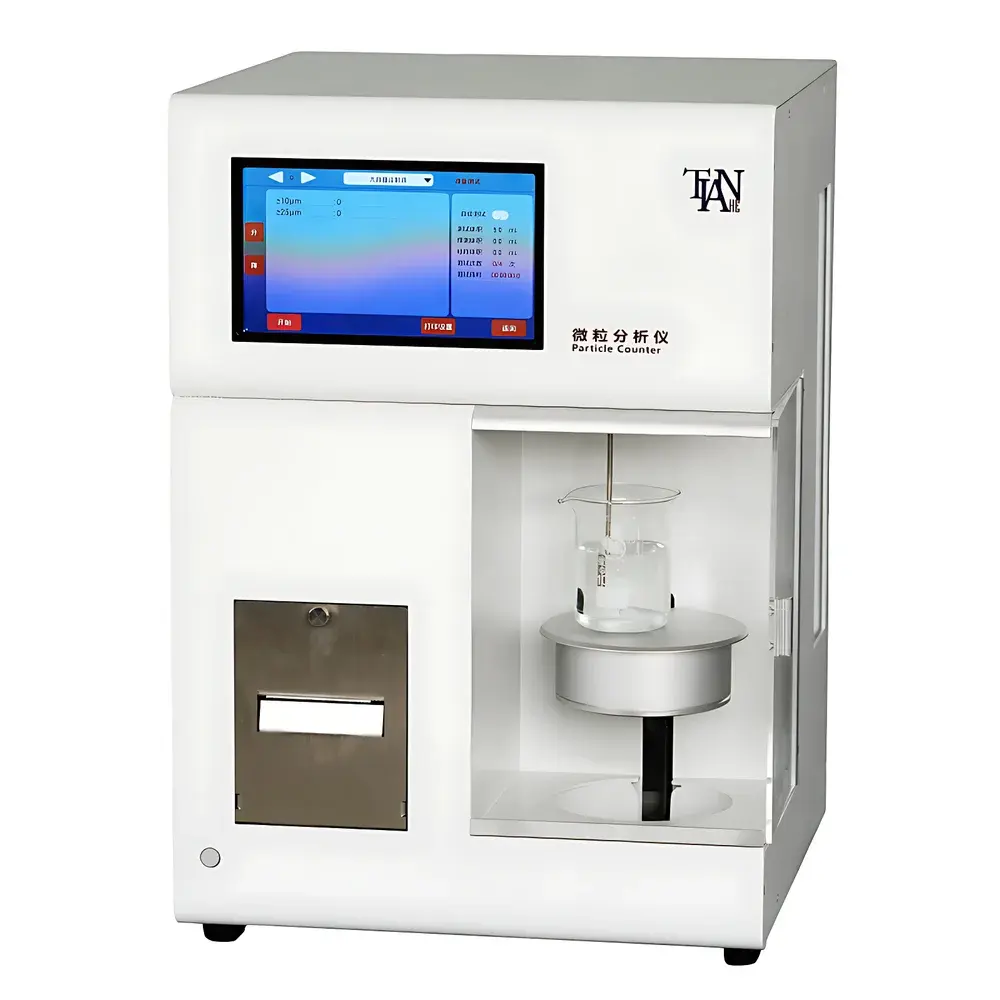
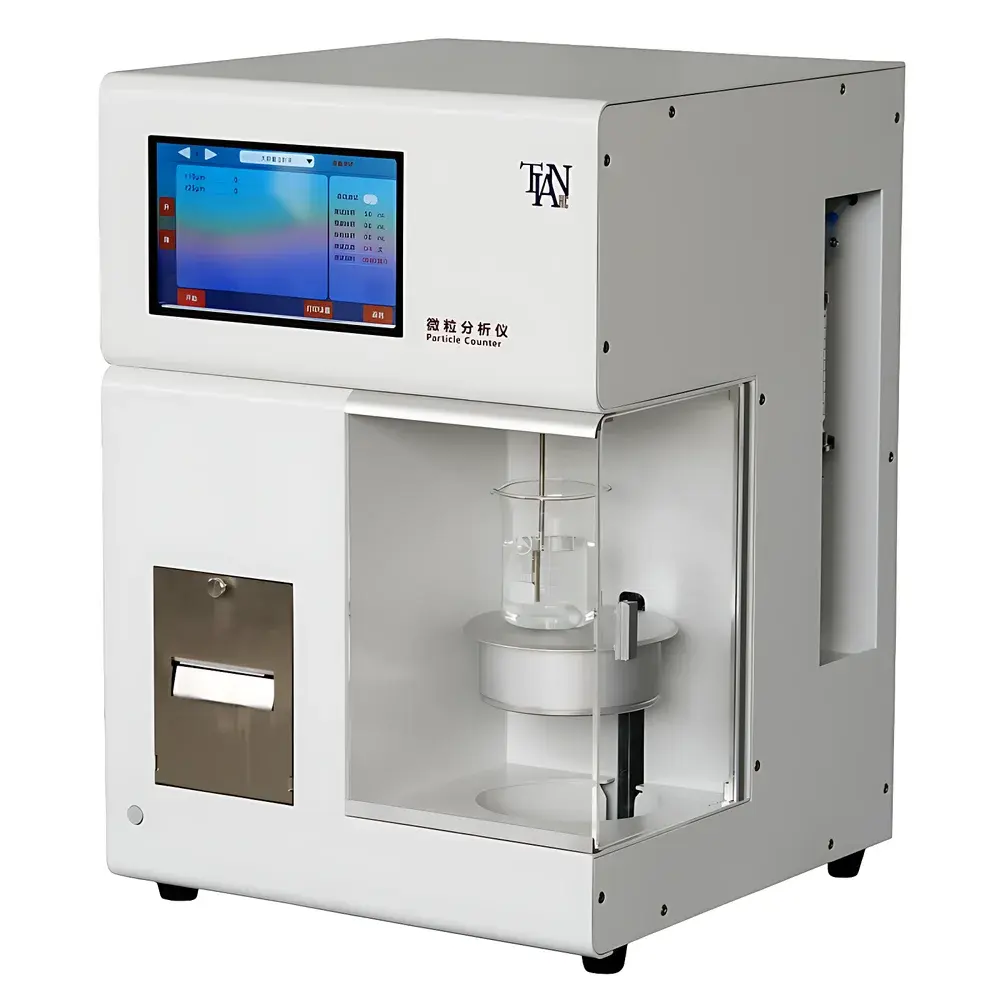

Tianhe GWF-D1 Optical Particle Counter for Insoluble Particulate Matter Analysis
| Brand | Tianhe |
|---|---|
| Origin | Tianjin, China |
| Model | GWF-D1 |
| Instrument Type | Optical Particle Counter |
| Operating System | Android-based embedded platform |
| Compliance Standards | Chinese Pharmacopoeia (ChP) 2020 Edition, USP <788> & <789>, ISO 21510:2018, GB 8368–2018 |
| Particle Detection Principle | Light Blockage (Obscuration) with Dual-Beam Laser Compensation |
| Sample Compatibility | Aqueous & non-aqueous solutions, oils, organic solvents, acidic/alkaline formulations |
| Material Contact Path | 316L stainless steel + PTFE fluidic pathway |
| Sample Volume Range | 0.2–1000 mL (±0.1 mL resolution) |
| Volumetric Accuracy | < ±0.5% |
| Flow Rate | 5–80 mL/min |
| Particle Size Channels | 64 fixed channels + user-definable up to thousands |
| resolution | 0.1 µm |
| Size Range | 1–500 µm |
| Counting Range | 0–9,999,999 particles per sample |
| Counting Accuracy | ±5% of reference value |
| Channel Resolution | >95% |
| RSD | <1.5% (for ≥1000 particles/mL standard suspension) |
| Max Detectable Concentration | 18,000 particles/mL |
| Stirring Speed | 0–1000 rpm |
| Ambient Operating Temperature | 10–40 °C |
| Power Supply | 100–240 VAC, 50/60 Hz, <80 W |
| Data Interfaces | RS232, USB host/device, thermal printer port |
| Data Storage | Onboard SQLite database with statistical analysis engine |
| Security | Role-based user authentication with audit trail logging |
| Enclosure | Sealed optical chamber with dust-proof sliding access door |
Overview
The Tianhe GWF-D1 Optical Particle Counter is a regulatory-compliant, laboratory-grade instrument engineered for quantitative detection and sizing of insoluble particulate matter in parenteral drugs, ophthalmic solutions, biologics, medical device rinsates, and pharmaceutical packaging extracts. It operates on the principle of light obscuration (also known as single-particle optical sensing), where particles suspended in a liquid medium pass through a precisely defined laser beam path, generating transient reductions in transmitted light intensity proportional to their cross-sectional area. The system employs a dual-beam stabilized laser source coupled with real-time photodiode signal compensation to maintain measurement fidelity across transparent, colored, and low-transmittance samples—including ethanol-based formulations, silicone oil, polyethylene glycol solutions, and weakly corrosive buffers. Designed to meet stringent pharmacopeial requirements, the GWF-D1 delivers traceable, repeatable, and auditable particle count data essential for quality control laboratories operating under GLP, GMP, or ISO/IEC 17025 frameworks.
Key Features
- Regulatory-ready architecture compliant with ChP 2020 (Appendix IX R), USP and , ISO 21510:2018, and GB 8368–2018 for infusion device testing.
- Optical fluid path constructed entirely from electropolished 316L stainless steel and chemically inert PTFE—validated for direct analysis of aggressive solvents, lipid emulsions, and pH 2–12 aqueous systems.
- Motorized vertical sample stage with programmable height adjustment, enabling precise alignment of irregularly shaped containers (e.g., ampoules, vials, IV bags, syringes) without manual repositioning.
- Dedicated ARM-based processor supporting 64 factory-calibrated size bins and user-defined channel mapping down to 0.1 µm increments—enabling granular distribution profiling beyond pharmacopeial binning requirements.
- Fully automated calibration routine using NIST-traceable polystyrene latex (PSL) standards; supports multi-point verification per USP Annex and ChP calibration protocols.
- Android 9.0-based HMI with capacitive touchscreen, intuitive workflow navigation, and context-sensitive help—designed for rapid operator training and minimal procedural deviation.
- Integrated database engine with encrypted local storage (>100,000 test records), time-stamped audit logs, and exportable CSV/Excel reports including batch ID, operator ID, instrument ID, and environmental metadata.
Sample Compatibility & Compliance
The GWF-D1 accommodates a broad spectrum of sample matrices without dilution or filtration—provided they are optically stable during aspiration. Validated use cases include sterile water for injection (WFI), saline, dextrose solutions, monoclonal antibody formulations, vaccine suspensions, silicone oil lubricants for syringe barrels, and extractables from rubber stoppers or plastic tubing. Its fluidic design eliminates dead-volume retention and minimizes carryover (<0.05%), verified per ISO 21510 Annex B. All calibration and verification procedures align with FDA-recommended practices for analytical instrument qualification (AIQ), including documented IQ/OQ/PQ protocols. The system supports 21 CFR Part 11-compliant electronic signatures when connected to validated LIMS environments via RS232 or USB CDC mode.
Software & Data Management
Embedded firmware includes a full-featured data acquisition suite with real-time histogram visualization, cumulative distribution plots, and pass/fail flagging against configurable acceptance criteria (e.g., “NMT 25 particles ≥25 µm per mL”). Data integrity safeguards include write-once audit trails, immutable timestamps synchronized to internal RTC, and role-based access control (Administrator, Analyst, Reviewer) with password complexity enforcement. Export options include direct thermal printing (with header/footer customization), USB mass-storage dump, and RS232 ASCII streaming to third-party SCADA or ELN platforms. Firmware updates are delivered via signed ZIP packages with SHA-256 checksum validation.
Applications
- Final container testing of injectables per USP and ChP General Chapter 0903.
- Extractable/leachable studies of primary packaging components (glass vials, elastomeric closures, polymer syringes).
- In-process monitoring of ultrafiltration/diafiltration steps in biomanufacturing.
- Stability-indicating assessment of protein aggregation kinetics under thermal or mechanical stress.
- QC release testing of ophthalmic solutions (USP ) and implantable drug delivery systems.
- Validation support for cleaning processes in multiproduct facilities (per EU Annex 15).
FAQ
Does the GWF-D1 comply with 21 CFR Part 11 for electronic records?
Yes—when deployed with configured user roles, audit trail activation, and external timestamp synchronization, it satisfies predicate rule requirements for closed-system electronic records.
Can the instrument analyze viscous samples such as hyaluronic acid gels?
Viscosity limits are governed by flow rate stability; samples up to 50 cP may be analyzed using reduced flow rates (5–15 mL/min) and extended sampling duration—method suitability must be demonstrated per ICH Q5C.
Is PTFE tubing replaceable by the end user?
Yes—the fluidic module uses standardized Swagelok-compatible fittings; replacement kits include pre-qualified PTFE capillary sets with lot-specific certification.
How is carryover addressed between high-load and low-load samples?
The system executes a three-stage rinse protocol (air purge → solvent flush → blank measurement) with programmable dwell times; residual particle counts are logged and flagged if exceeding 0.1% of prior sample’s total count.
What documentation is supplied for regulatory submissions?
Factory-issued IQ/OQ templates, metrology certificates for laser wavelength and volumetric pump calibration, and a complete Design Qualification (DQ) summary aligned with GAMP5 Category 3 classification.



