
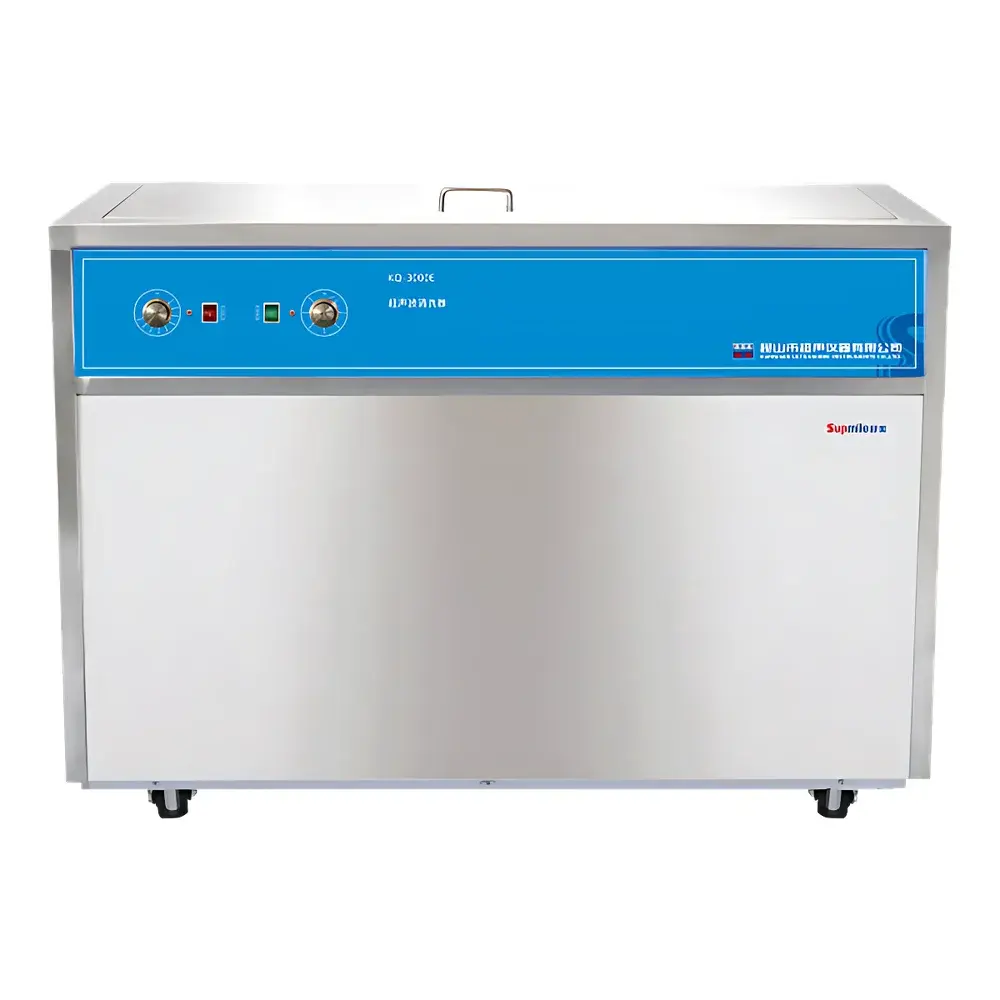
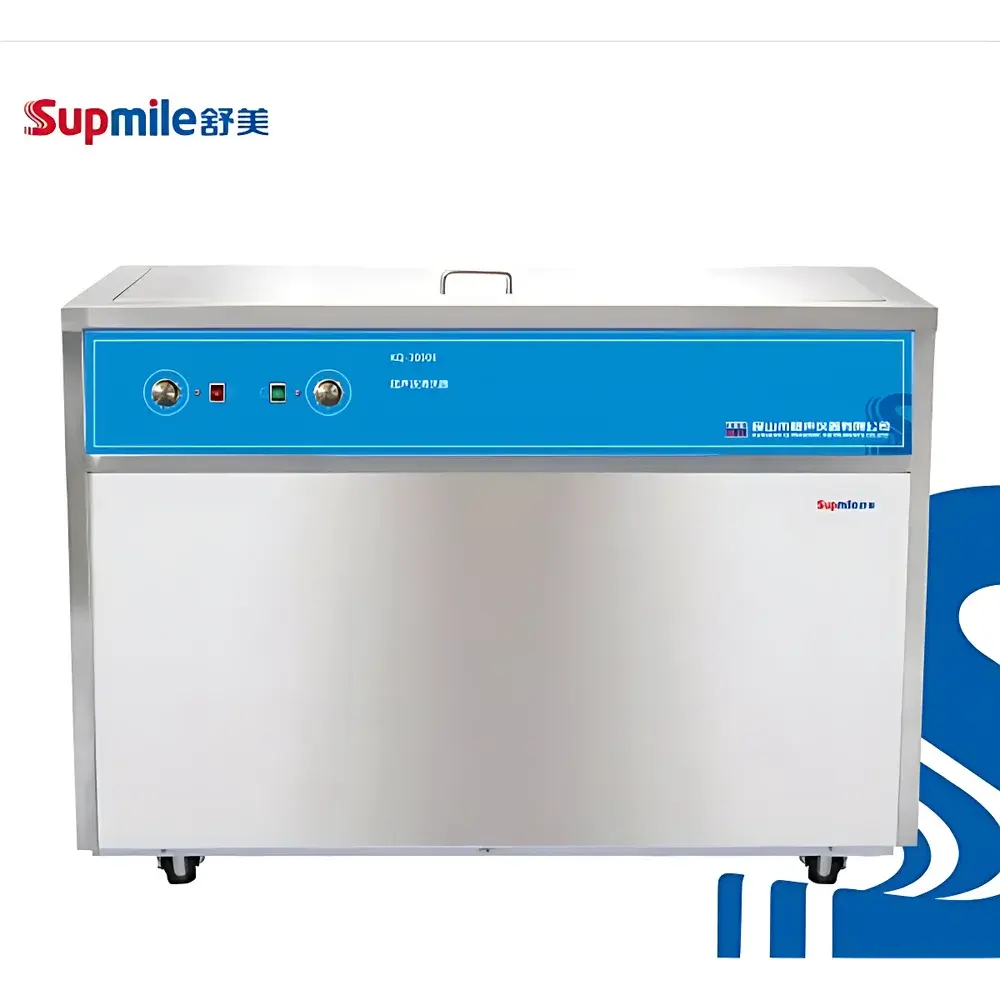
Supmile KQ-3000E Industrial Ultrasonic Cleaner
| Brand | Supmile |
|---|---|
| Origin | Jiangsu, China |
| Manufacturer Type | Direct Manufacturer |
| Product Category | Domestic |
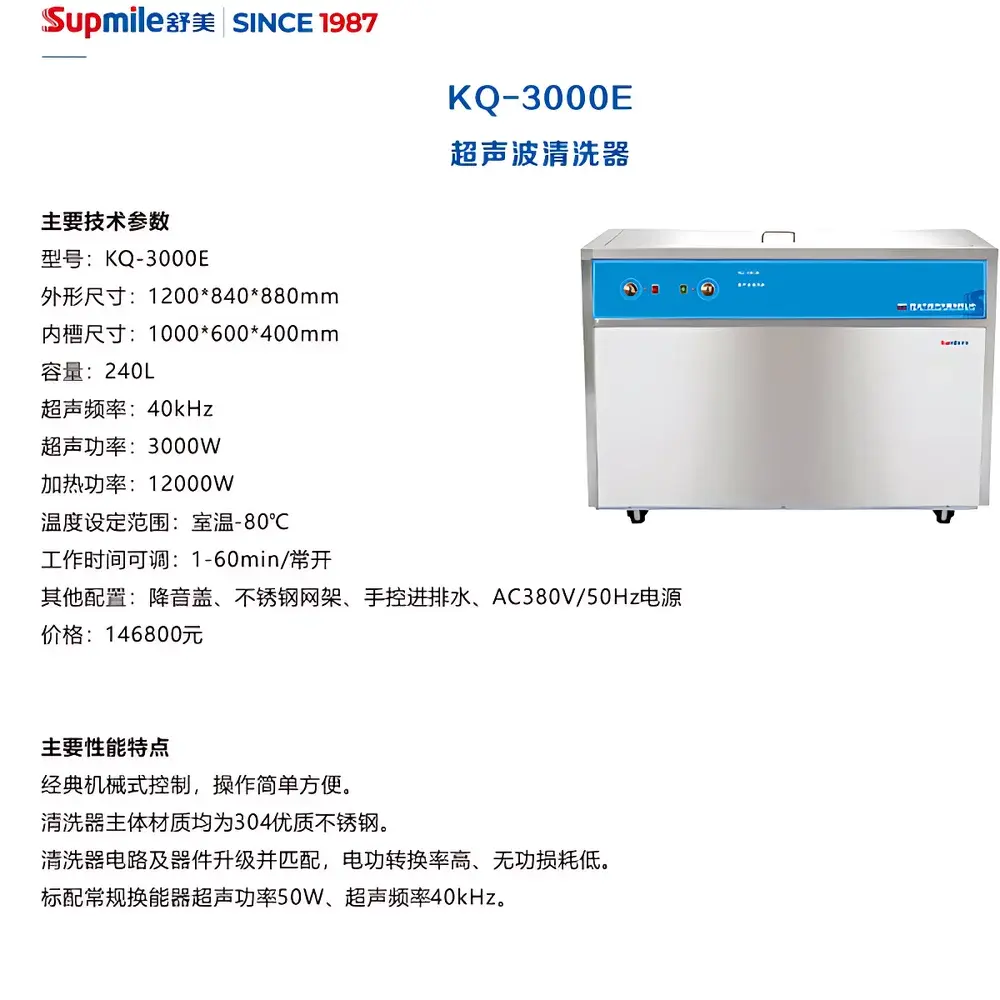
| Model | KQ-3000E |
| Instrument Type | General-Purpose Ultrasonic Cleaner |
| Tank Capacity | 240 L |
| Ultrasonic Frequency | 40 kHz |
| Ultrasonic Power Output | 3000 W |
| Heating Power | 12,000 W |
| Temperature Range | Ambient to 80 °C (adjustable) |
| Timer Range | 1–60 min or Continuous Mode |
| Sound-Dampening Lid | Included |
| Drain/Inlet | Manual Control |
| Power Supply | AC 380 V / 50 Hz |
| Tank Dimensions (L×W×H) | 1000 × 600 × 400 mm |
| External Dimensions (L×W×H) | 1200 × 840 × 880 mm |
| Construction Material | 304 Stainless Steel |
| Transducer Configuration | Standard 50-W per element, 40-kHz piezoelectric transducers |
Overview
The Supmile KQ-3000E is a heavy-duty, general-purpose industrial ultrasonic cleaner engineered for high-volume laboratory, quality control, and manufacturing environments requiring consistent, repeatable cleaning of large or multiple components. It operates on the principle of cavitation—where high-frequency acoustic energy (40 kHz) generates microscopic vacuum bubbles in the cleaning solution that collapse with localized energy release, dislodging particulate contaminants, oils, flux residues, and biofilms from surfaces without mechanical abrasion. Designed for continuous operation under demanding conditions, the KQ-3000E integrates a robust 304 stainless steel tank (1000 × 600 × 400 mm internal), 240-liter capacity, and thermally stable heating up to 80 °C—enabling optimized cleaning performance across aqueous, alkaline, and mild solvent-based solutions. Its 3000 W ultrasonic output—distributed across an array of standardized 50-W piezoelectric transducers—ensures uniform energy distribution throughout the bath volume, critical for reproducible results in validation-driven workflows.
Key Features
- Heavy-gauge 304 stainless steel construction for corrosion resistance, structural integrity, and compliance with ISO 13485 and GLP facility requirements.
- High-efficiency ultrasonic generation at 40 kHz with total nominal output of 3000 W—engineered for deep-cleaning of complex geometries including hollow parts, threaded components, and porous substrates.
- Integrated 12,000 W heating system enabling precise temperature control from ambient to 80 °C—supports accelerated cleaning kinetics and residue solubilization in accordance with ASTM D4941 and USP <1041> guidelines.
- Mechanical timer with 1–60 minute programmable range plus continuous mode—designed for operational simplicity and reduced operator error in routine QC laboratories.
- Sound-dampening lid included as standard equipment—reduces airborne noise to ≤75 dB(A) at 1 m distance, meeting OSHA 29 CFR 1910.95 workplace exposure limits.
- Manual inlet and drain valves with reinforced silicone gaskets—facilitates safe, controlled fluid handling and compatibility with closed-loop rinse systems.
- Three-phase 380 V / 50 Hz power input—optimized for industrial-grade electrical infrastructure and stable performance under variable load conditions.
Sample Compatibility & Compliance
The KQ-3000E accommodates a broad range of sample types—including metal surgical instruments, glassware, ceramic filters, printed circuit boards (PCBs), optical lenses, and polymer-based medical devices—without risk of surface etching or dimensional distortion when operated within recommended parameters. Its non-contact cleaning mechanism preserves surface finish and tolerances, making it suitable for pre-sterilization preparation per ISO 17664 and AAMI ST79 Annex C protocols. The unit complies with IEC 61000-6-3 (EMC emissions) and IEC 61000-6-2 (immunity), and its stainless steel wetted surfaces meet FDA 21 CFR Part 11 material eligibility criteria for indirect food contact applications. While not certified for Class A/B cleanroom use out-of-the-box, it may be integrated into ISO 14644-compliant facilities with validated cleaning procedures and documented maintenance logs.
Software & Data Management
The KQ-3000E utilizes a dedicated mechanical control interface—eliminating embedded microprocessors or digital displays—to maximize reliability, minimize firmware-related failure modes, and simplify qualification under GMP Annex 15 and EU GMP Chapter 4. All operational parameters (temperature setpoint, timer duration, power activation) are manually selected via calibrated dials and toggle switches, ensuring full traceability through procedural documentation rather than electronic audit trails. For laboratories requiring electronic data capture, optional external PLC integration or analog signal logging (0–10 V temperature output, relay status feedback) is supported via auxiliary terminals—enabling alignment with 21 CFR Part 11-compliant SCADA systems when paired with validated third-party data acquisition hardware and SOP-defined calibration intervals.
Applications
- Pre-assembly cleaning of precision machined components in aerospace and automotive supply chains.
- Removal of cutting oils, grinding slurry, and EDM residue from tooling and molds prior to metrology inspection.
- Decontamination of reusable surgical trays and laparoscopic instruments in hospital central sterile processing departments (CSPD).
- Residue clearance from HPLC columns, GC injectors, and sample vials in analytical chemistry labs.
- Surface preparation of substrates prior to coating, plating, or bonding in R&D and pilot-scale manufacturing.
- Validation support for cleaning process development (CPV) per PDA Technical Report No. 29 and ISPE Baseline Guide Vol. 4.
FAQ
Is the KQ-3000E suitable for cleaning delicate optics or MEMS devices?
Yes—when used with low-surface-tension, low-foaming aqueous solutions and reduced duty cycles (e.g., 20–30% power modulation via external attenuators), it has been successfully deployed for cleaning fused silica optics and silicon wafers. However, direct immersion of uncoated AR-coated lenses or cantilever-based sensors requires prior compatibility testing.
Does the unit include temperature calibration certification?
No factory-issued NIST-traceable calibration certificate is supplied standard. Users must perform initial verification using a calibrated PT100 probe per ASTM E74 and document deviations ≥±1.5 °C against setpoint.
Can the tank be retrofitted with filtration or degassing modules?
The tank design supports aftermarket installation of recirculating filtration housings (up to 20 µm) and vacuum-assisted degassing manifolds—provided modifications do not compromise structural weld integrity or electrical grounding continuity.
What maintenance intervals are recommended for sustained 24/7 operation?
Transducer performance should be verified quarterly via impedance spectroscopy; tank integrity inspected biannually for pitting or weld seam degradation; and heater elements tested annually for insulation resistance (>1 MΩ at 500 V DC).



