
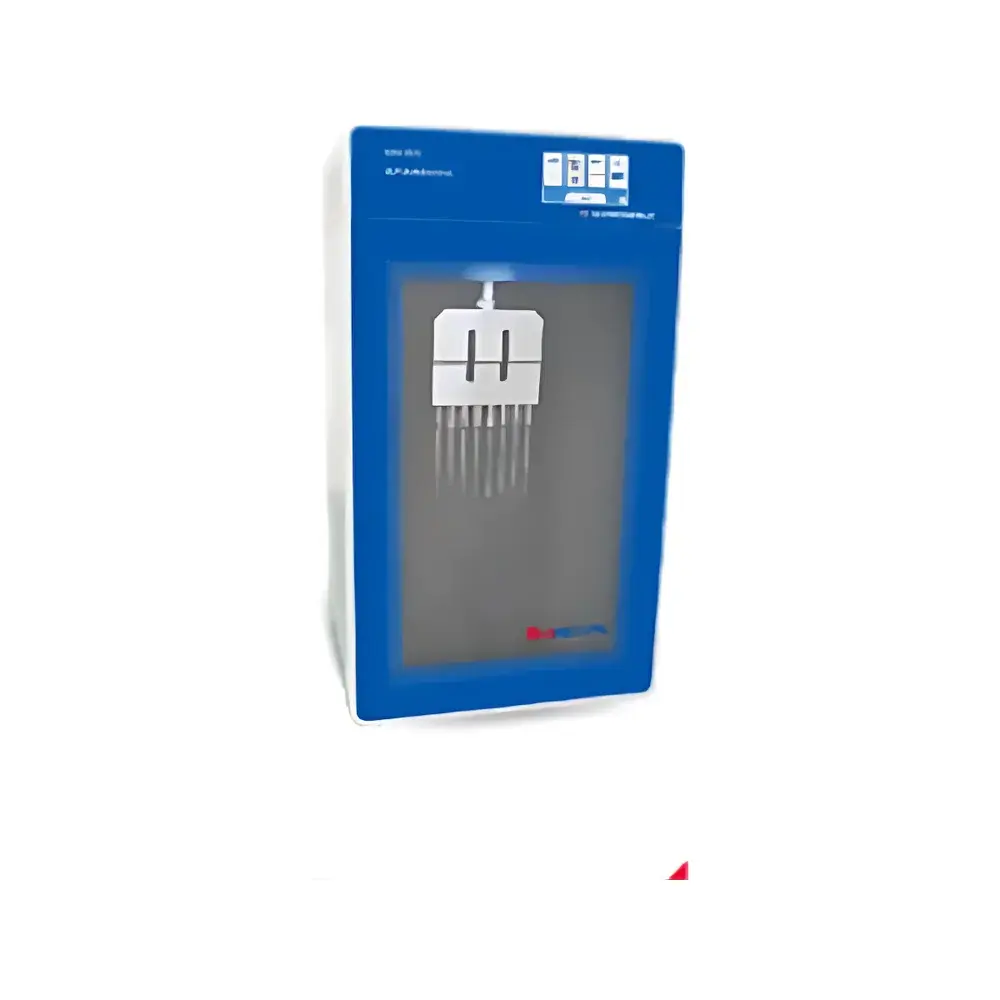
SHUMEI KBC-8TD Multi-Channel Ultrasonic Cell Disruptor
| Brand | SHUMEI |
|---|---|
| Origin | Jiangsu, China |
| Manufacturer Type | Direct Manufacturer |
| Product Category | Domestic |
| Model | KBC-8TD |
| Instrument Type | General-Purpose |
| Ultrasonic Frequency | 20 ± 0.5 kHz |
| Ultrasonic Power | 800 W |
| Power Adjustment Range | 0–100% |
| Time Adjustment Range | 1 min – 99 h 59 min |
| Transducer Material | Ti-6Al-4V Titanium Alloy |
| Probe Options | Φ3 mm or Φ6 mm |
| Number of Probes | 8 |
| Sample Vessel Compatibility | 0.3–20 mL per channel (optimized for 96-well deep-well plates) |
| Temperature Monitoring | Optional integrated PT100 sensor with over-temperature alarm |
| Safety Features | Motorized lift stage, LED illumination, overload protection, 9 programmable user protocols |
Overview
The SHUMEI KBC-8TD Multi-Channel Ultrasonic Cell Disruptor is an engineered solution for high-throughput, reproducible sample lysis and homogenization in life science laboratories. It operates on the principle of high-intensity ultrasonic cavitation—generating controlled microbubble formation and collapse within liquid media to deliver mechanical shear forces that disrupt cellular membranes, organelles, and extracellular matrices. Unlike single-probe sonicators, the KBC-8TD integrates eight independently driven titanium alloy (Ti-6Al-4V) probes synchronized at a stable frequency of 20 ± 0.5 kHz, enabling parallel processing of up to eight discrete samples under identical acoustic parameters. This architecture ensures inter-sample consistency critical for comparative genomics, proteomics, and quality-controlled bioprocessing workflows. The system is not intended for bulk cleaning applications; rather, it is purpose-built for low-volume (<20 mL), high-sensitivity biological sample preparation—including mammalian cells, bacterial cultures, yeast, plant tissues, viral particles, and subcellular fractions—where thermal management, probe-to-sample geometry control, and protocol repeatability are essential.
Key Features
- Eight-channel synchronized ultrasonic transduction with individually mounted Ti-6Al-4V probes (Φ6 mm standard, optional Φ3 mm) ensuring uniform energy delivery across all positions.
- Motorized vertical lift stage with precision height adjustment and integrated white LED illumination for real-time visual monitoring of probe immersion depth and sample agitation.
- Full-touch LCD interface supporting 9 user-defined protocols with storage of power %, duration, pulse-on/off timing (1 s–59 min 59 s), and temperature thresholds (when equipped with optional PT100 sensor).
- Overload and over-temperature protection circuits compliant with IEC 61010-1 safety standards; automatic shutdown triggered by abnormal current draw or sensor-exceeded thermal limits.
- Modular probe-mounting design allowing rapid exchange between Φ3 mm and Φ6 mm transducers without recalibration; all probes feature standardized M10 threading and hermetic sealing against solvent ingress.
- Acoustic output stability maintained via digital feedback-controlled generator—minimizing frequency drift and amplitude variation across extended operation cycles (≥8 h continuous duty).
Sample Compatibility & Compliance
The KBC-8TD accommodates standard microcentrifuge tubes (0.5–2 mL), PCR strips, and deep-well 96-well plates (0.3–0.5 mL/well configuration). Each channel supports independent volume ranges from 0.3 mL to 20 mL, with optimal efficiency observed between 2–10 mL when using Φ6 mm probes. The system complies with ISO 13485 design controls for medical device-related R&D environments and meets electromagnetic compatibility requirements per EN 61326-1. While not certified as a Class II medical device, its operational parameters align with common laboratory practices referenced in USP , ASTM E2718-19 (ultrasonic energy measurement), and CLSI EP17-A2 guidelines for analytical method robustness in sample prep. For GLP/GMP-regulated labs, audit-ready electronic logs (via optional RS-232/USB data export) support traceability of power settings, runtime, and temperature history per sample batch.
Software & Data Management
The embedded firmware supports timestamped protocol execution logging, including start/stop time, applied power level (%), total sonication duration, cumulative pulse count, and—if enabled—real-time temperature readings sampled every 2 seconds. Data exports as CSV files compatible with LIMS integration or statistical analysis platforms (e.g., JMP, GraphPad Prism). No proprietary software installation is required; configuration and review occur entirely via the front-panel touchscreen. Optional firmware upgrades are delivered via USB flash drive and validated against SHA-256 checksums to ensure integrity. All stored protocols retain full parameter metadata (operator ID, date stamp, version number), satisfying basic FDA 21 CFR Part 11 requirements for electronic records when paired with institutional access controls.
Applications
- High-fidelity genomic DNA and RNA extraction from fibrous plant tissues or Gram-positive bacteria requiring consistent mechanical lysis.
- Preparation of antigenic lysates for immunoassay development where protein conformational integrity must be preserved through controlled, non-thermal disruption.
- Nanoparticle dispersion stabilization in aqueous colloids (e.g., liposomes, polymeric micelles) prior to DLS or TEM characterization.
- Accelerated enzymatic digestion protocols—such as trypsinization of adherent cell monolayers—by enhancing reagent penetration without chemical additives.
- Homogenization of cryopreserved tissue biopsies for downstream metabolomic profiling, minimizing freeze-thaw-induced analyte degradation.
- Emulsification of oil-in-water formulations in pharmaceutical excipient screening, where droplet size distribution correlates directly with sonication energy input.
FAQ
Is the KBC-8TD suitable for sterilization or decontamination of labware?
No. This instrument is designed exclusively for sample disruption and homogenization—not for disinfection or sterilization. Its ultrasonic output lacks the sustained intensity and chamber geometry required for microbial inactivation validation per ISO 15883 or AAMI ST34.
Can I use this system with corrosive solvents like chloroform or DMSO?
Only with verified chemical compatibility of probe coatings and gasket materials. Standard Ti-6Al-4V probes resist aqueous buffers and mild organic solvents; prolonged exposure to halogenated or strongly acidic media requires custom passivation and is not covered under warranty.
Does the system support external trigger inputs for synchronization with other instruments?
Yes. A TTL-compatible BNC port allows external start/stop signaling and pulse synchronization with fluorescence readers, plate washers, or robotic liquid handlers.
What maintenance intervals are recommended for optimal transducer performance?
Visual inspection of probe tips for pitting or erosion every 200 operating hours; replacement advised after 1,000 h of cumulative use or upon detection of >5% amplitude reduction at nominal power setting.
Is validation documentation (IQ/OQ/PQ) available for regulated environments?
SHUMEI provides a factory-verified OQ report covering frequency stability, power linearity, timer accuracy, and temperature sensor calibration (when optioned). Site-specific IQ and PQ protocols must be developed per local SOPs and regulatory jurisdiction.



