
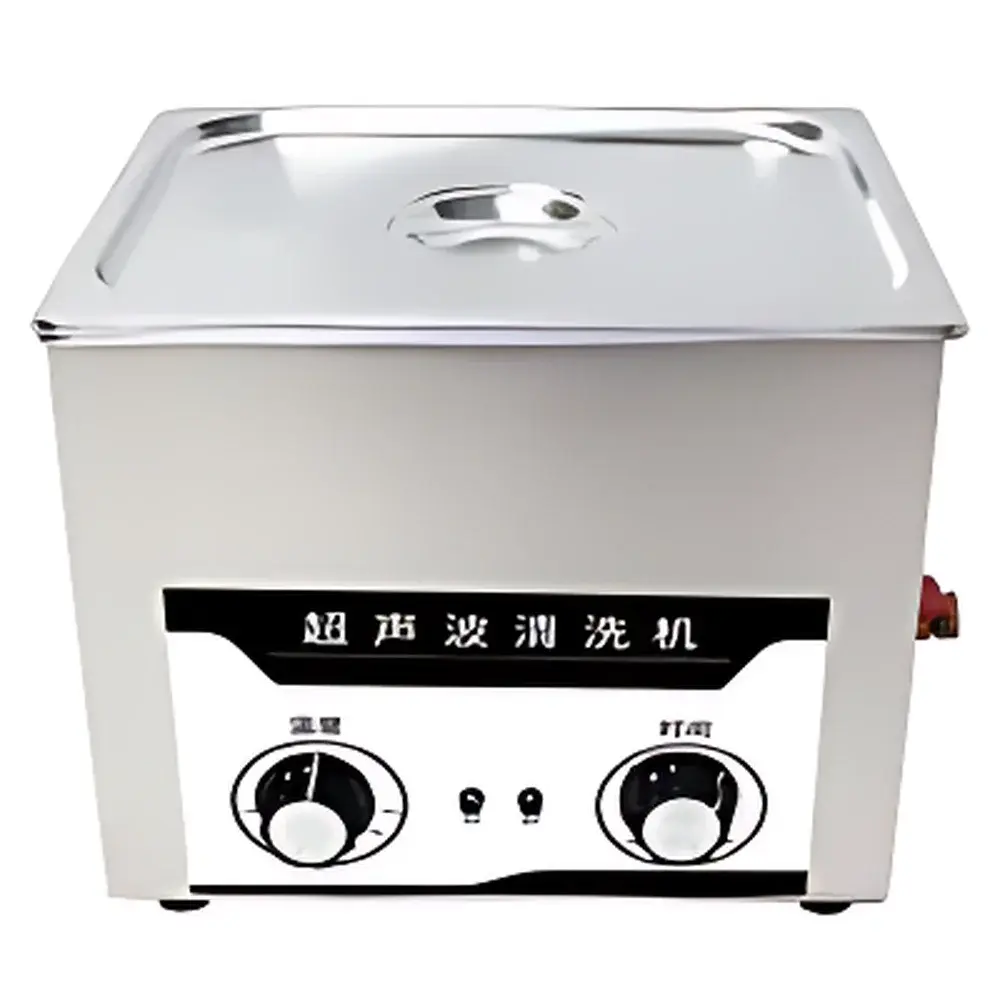
ZiQi ZQ-80H 22L Benchtop Mechanical Knob-Controlled Heated Ultrasonic Cleaner
| Brand | ZiQi |
|---|---|
| Origin | Shanghai, China |
| Manufacturer Type | Direct Manufacturer |
| Product Category | Domestic |
| Model | ZQ-80H |
| Instrument Type | General-Purpose |
| Capacity | 22 L |
| Ultrasonic Frequency | 40 kHz |
| Ultrasonic Power | 480 W |
| Adjustable Power | No |
| Adjustable Temperature | Yes (Room Temp to 80 °C) |
| Adjustable Timer | Yes (1–30 min) |
| Sound-Dampening Lid | Included |
| Drainage | Manual Control |
Overview
The ZiQi ZQ-80H is a robust, benchtop ultrasonic cleaner engineered for precision cleaning, degassing, and sample preparation in academic laboratories, industrial R&D facilities, and quality control environments. It operates on the principle of cavitation—high-frequency sound waves (40 kHz) generate microscopic vacuum bubbles in the cleaning solvent; their rapid collapse produces localized high-pressure shockwaves that dislodge contaminants from surfaces without mechanical abrasion. Integrated heating (up to 80 °C) enhances solubilization of organic residues and accelerates cleaning kinetics, while the 22-liter tank volume supports large components or high-throughput batch processing. Designed for operational reliability rather than digital complexity, the ZQ-80H employs fully mechanical controls—knob-based temperature and timer adjustment—eliminating electronic interface failure points and ensuring long-term stability under continuous use.
Key Features
- Stainless steel tank and outer housing (grades 304/316-compatible finish), fabricated via seamless deep-drawing to eliminate weld seams—minimizing corrosion risk and improving structural integrity.
- High-efficiency transducer array with imported piezoelectric elements, delivering uniform energy distribution across the entire 500 × 300 × 150 mm tank volume.
- Dual-function heating system (800 W) with mechanical thermostat calibrated to ±2 °C accuracy over the 20–80 °C range, enabling reproducible thermal conditioning for solvent-dependent protocols.
- Precision mechanical timer (1–30 minutes) with tactile feedback and fail-safe cutoff—designed for GLP-aligned manual documentation workflows.
- Integrated high-capacity cooling fan (active thermal management) prevents overheating during extended cycles, maintaining consistent acoustic output and extending transducer service life.
- Sound-dampening lid included as standard equipment—reducing ambient noise to ≤65 dB(A) at 1 m distance and containing solvent vapors per OSHA and EU Directive 2004/40/EC exposure guidelines.
Sample Compatibility & Compliance
The ZQ-80H accommodates a broad spectrum of sample geometries—including metal parts, glassware, ceramic substrates, printed circuit boards, and laboratory tools—without requiring custom fixtures. Its open-tank configuration allows immersion of irregularly shaped objects up to 480 mm in length. The unit complies with IEC 61000-6-3 (EMC emission standards) and IEC 61010-1 (safety requirements for electrical equipment used in laboratory settings). While not certified for sterile processing per ISO 13485 or FDA 21 CFR Part 820, it meets baseline requirements for non-sterile pre-cleaning steps referenced in ASTM D2601 (Standard Practice for Cleaning Metal Surfaces Prior to Coating) and ISO 14644-1 (cleanroom component preparation). All wetted surfaces are passivated stainless steel, compatible with aqueous alkaline, acidic, and mild organic solvents (e.g., isopropanol, ethanol, and low-concentration sodium hydroxide solutions).
Software & Data Management
As a mechanically controlled instrument, the ZQ-80H does not incorporate embedded software, microprocessors, or data logging capabilities. This architecture eliminates firmware vulnerabilities, calibration drift associated with digital sensors, and regulatory burdens related to electronic record integrity (e.g., 21 CFR Part 11 compliance). Users maintain full procedural traceability through manual logbook entries—recording bath temperature, cycle duration, solvent type, and lot number—aligned with traditional GLP documentation practices. Optional accessories—including stainless steel mesh baskets (304 grade), beaker holders, and rack inserts—are designed to maximize ultrasonic field exposure while preventing part-to-part contact and masking.
Applications
- Removal of machining oils, flux residues, and particulate debris from precision-engineered components prior to metrology or coating.
- Pre-analytical sample preparation for ICP-MS, AAS, and HPLC—ensuring contaminant-free vessels and standards containers.
- Cell lysis and tissue homogenization support in molecular biology labs where gentle, non-thermal disruption is required.
- Ultrasonic-assisted extraction of plant metabolites, polymers, or nanoparticles into polar/non-polar solvents under controlled thermal conditions.
- Degassing of casting resins, adhesives, and optical gels to eliminate void formation during curing.
- Routine cleaning of filtration membranes, syringe filters, and chromatography columns to restore flow characteristics and minimize carryover.
FAQ
Is the ZQ-80H suitable for cleaning delicate optics or MEMS devices?
Yes—when operated at lower temperatures (25–40 °C) and shorter durations (3–8 min) with low-surface-tension solvents (e.g., 2-propanol), the 40 kHz frequency provides effective particle removal without inducing micro-scratches or stiction-related damage.
Can the unit be used with flammable solvents?
No—this model lacks explosion-proof certification (ATEX/IECEx) and should only be used with non-flammable aqueous or high-flashpoint solvents (flash point > 60 °C).
Does the heater automatically deactivate when the timer ends?
Yes—the heating circuit is interlocked with the timer mechanism and cuts power simultaneously with ultrasonic shutdown.
What maintenance is required for long-term performance?
Monthly inspection of transducer mounting bolts, quarterly descaling of the tank interior using 5% citric acid solution, and annual verification of thermostat accuracy using a NIST-traceable thermometer.
Is drainage integrated or external?
Drainage is manually operated via a front-panel valve; no pump or auto-drain system is included. For continuous operation, users may connect an optional gravity-fed drain hose (ID 10 mm).



