
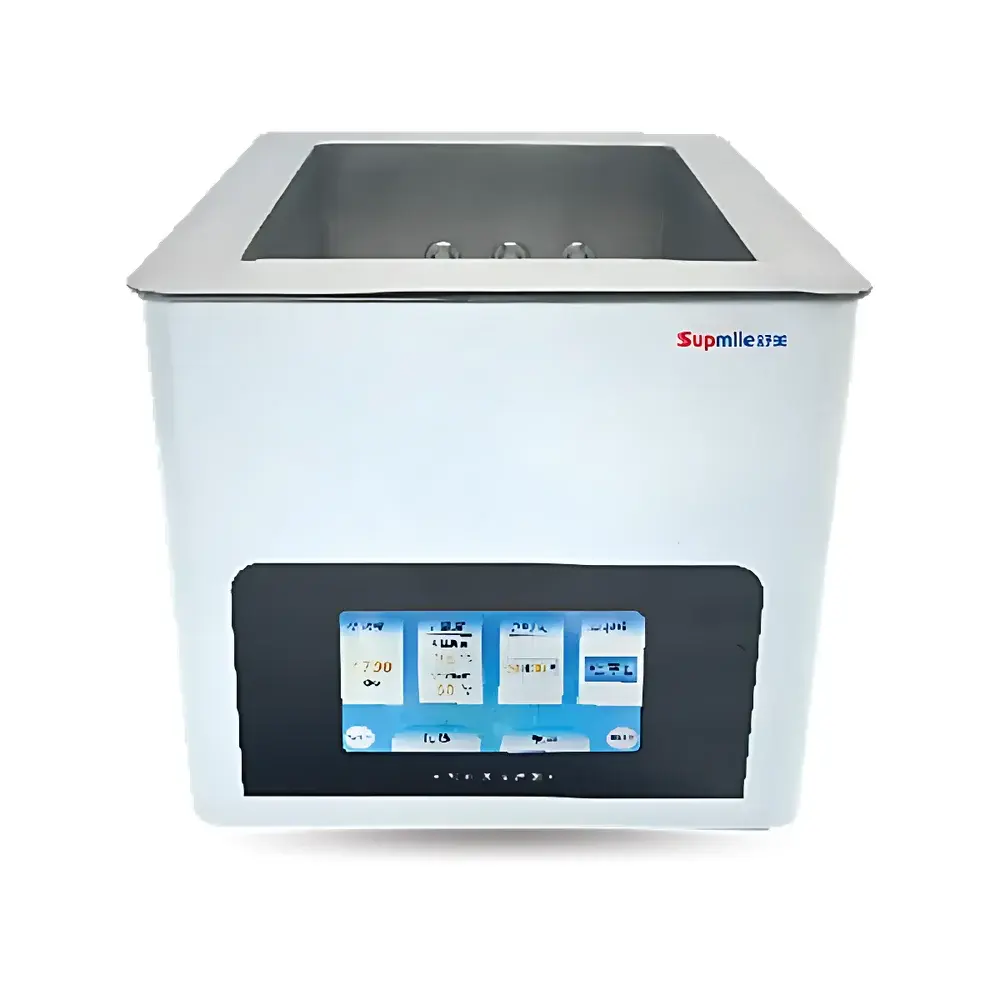
Shumei KQ-300MSE Benchtop Megasonic Cleaner
| Brand | Shumei |
|---|---|
| Origin | Jiangsu, China |
| Manufacturer Type | Direct Manufacturer |
| Product Category | Domestic |
| Model | KQ-300MSE |
| Instrument Type | General-Purpose |
| Tank Capacity | 10 L |
| Ultrasonic Frequencies | 0.5 MHz, 1.0 MHz, 1.7 MHz |
| Ultrasonic Power Output | 300 W |
| Temperature Control Range | Ambient to 80 °C |
| Timer Range | 1 min – 99 h 59 min |
| Drain Valve | Included |
Overview
The Shumei KQ-300MSE is a benchtop megasonic cleaner engineered for high-precision, non-destructive cleaning of microfabricated components and sensitive substrates in semiconductor fabrication, MEMS manufacturing, photomask handling, and advanced packaging environments. Unlike conventional ultrasonic cleaners that rely on cavitation-induced implosion for particle removal—often causing surface pitting or micro-scratching—the KQ-300MSE operates at megahertz-range frequencies (0.5, 1.0, and 1.7 MHz), generating acoustic streaming with minimal cavitation. This mechanism produces a thin, high-velocity acoustic boundary layer (<1 µm thickness) adjacent to the substrate surface, enabling shear-driven detachment of sub-micron and nanoscale contaminants—including metallic residues, photoresist residuals, organic films, and colloidal particles—without mechanical or thermal damage. Its static acoustic field design eliminates operational noise typically associated with low-frequency ultrasonics, supporting integration into vibration-sensitive cleanroom workstations and metrology labs.
Key Features
- Triple-frequency megasonic generation (0.5 / 1.0 / 1.7 MHz) selectable via intuitive 7-inch TFT capacitive touchscreen interface
- Nine user-programmable cleaning protocols stored locally with parameter recall for repeatable process execution
- Precision temperature control from ambient to 80 °C (±0.5 °C stability) using integrated PID-regulated heating system (500 W)
- Extended timer range (1 minute to 99 hours 59 minutes) supporting both rapid pre-cleaning and extended immersion protocols
- High-efficiency electroacoustic transducer architecture with >85% power conversion efficiency and low reactive power loss
- Stainless steel tank (304 grade) with powder-coated corrosion-resistant housing; drain valve included for controlled solvent or DI water disposal
- Comprehensive safety monitoring: real-time overtemperature, overvoltage, and overcurrent detection with visual alarm indicators
- Standard stainless steel mesh basket and adjustable rack for uniform part immersion and acoustic coupling
Sample Compatibility & Compliance
The KQ-300MSE is validated for use with silicon wafers (2″, 4″, 6″, 8″), photomasks, reticles, ceramic substrates, glass optics, GaAs/InP wafers, and thin-film coated sensors. It supports cleaning in deionized water, low-surface-tension solvents (e.g., IPA, acetone), and aqueous alkaline or acidic formulations compatible with semiconductor wet processing standards. The device conforms to IEC 61000-6-3 (EMC emission limits) and IEC 61000-6-2 (immunity requirements). While not certified to ISO 14644-1 Class 5 as a standalone unit, its low-noise, zero-vibration operation enables stable placement inside laminar flow hoods or Class 100 cleanrooms. Process documentation aligns with GLP/GMP traceability expectations when paired with external audit-ready data loggers.
Software & Data Management
The embedded control firmware provides full local parameter logging (time-stamped start/end times, frequency selection, temperature setpoint, actual bath temperature, and elapsed duration) stored internally for up to 1,000 cycles. Data export is supported via USB port (CSV format) for integration into laboratory information management systems (LIMS) or statistical process control (SPC) platforms. The interface supports multi-language display (English, Chinese, Korean, Japanese) and includes password-protected administrator mode for protocol modification and calibration access. No cloud connectivity or remote control is implemented—ensuring data sovereignty and compliance with internal IT security policies common in foundry and R&D environments.
Applications
- Pre-deposition wafer cleaning prior to epitaxy, CVD, or ALD to remove native oxide and hydrocarbon contamination
- Post-etch residue removal from high-aspect-ratio features without undercutting or sidewall erosion
- Photomask cleaning prior to inspection or stepper exposure to eliminate sub-100 nm particulates
- MEMS device cleaning after release etch to prevent stiction and preserve delicate cantilevers or diaphragms
- Chemical mechanical polishing (CMP) pad conditioning and post-CMP slurry removal
- Photoresist stripping and post-develop residue clearance in lithography tool qualification
- Microfluidic channel cleaning prior to bonding or functional testing
FAQ
What distinguishes megasonic cleaning from standard ultrasonic cleaning?
Megasonic cleaning uses frequencies ≥0.5 MHz to generate acoustic streaming rather than destructive cavitation. This enables particle removal via viscous shear forces, preserving surface integrity critical for advanced nodes (≤28 nm) and fragile structures.
Can the KQ-300MSE be used with aggressive chemistries such as SC1 or piranha solution?
Yes—when operated within manufacturer-recommended concentration and temperature limits. The 304 stainless steel tank and sealed transducer assembly are resistant to common semiconductor cleaning chemistries; however, prolonged exposure to concentrated HF or hot piranha requires optional quartz or PTFE-lined tank accessories.
Is the unit compliant with FDA 21 CFR Part 11 for electronic records?
The KQ-300MSE does not provide electronic signature capability or audit-trail generation natively. For regulated biopharma or medical device applications, external validation and integration with Part 11–compliant LIMS are required.
How is acoustic uniformity ensured across the 10 L tank volume?
Transducer placement follows finite-element modeled node distribution patterns; tank geometry and frequency selection are optimized to minimize standing wave interference. Recommended load volume is 6–8 L to maintain consistent energy density.
Does the system support automated integration into wet benches?
No built-in PLC I/O or SECS/GEM interface is provided. However, dry-contact relay outputs (start/stop/error) and analog temperature output (0–10 V) are available upon request for third-party automation integration.



