
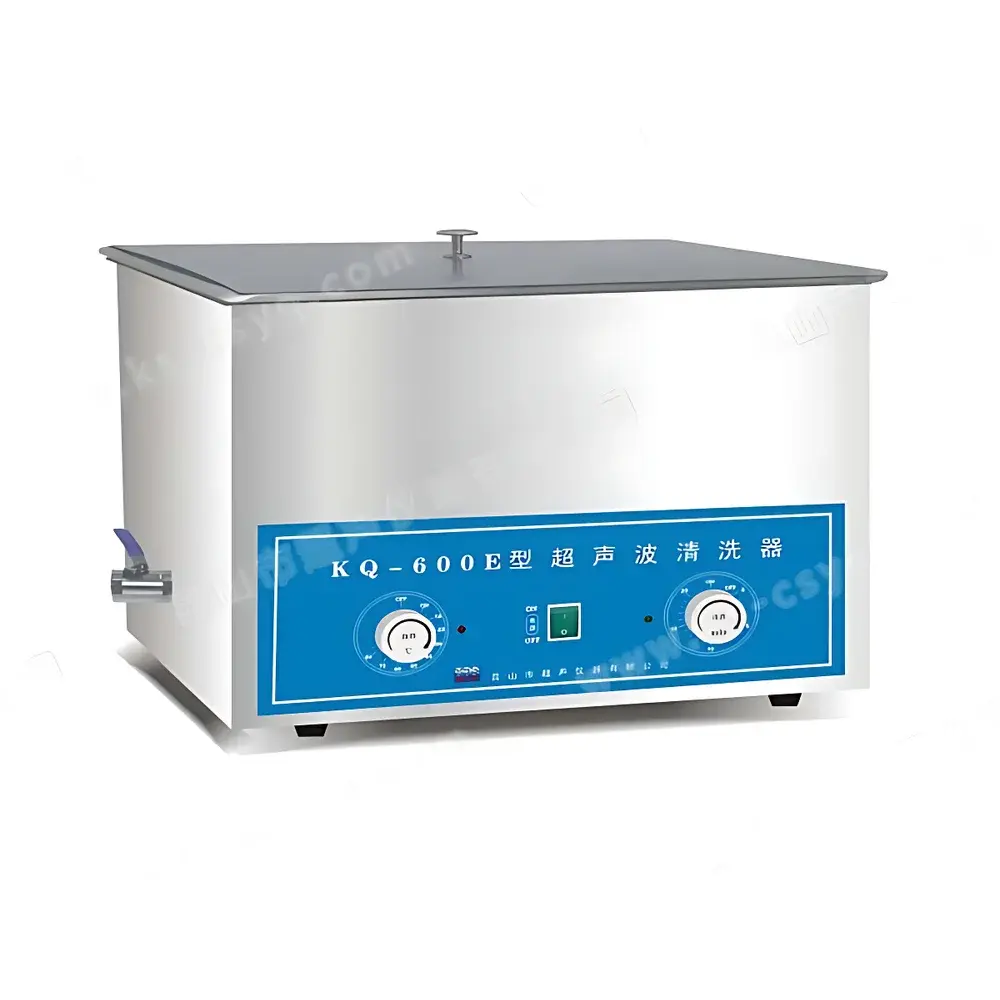
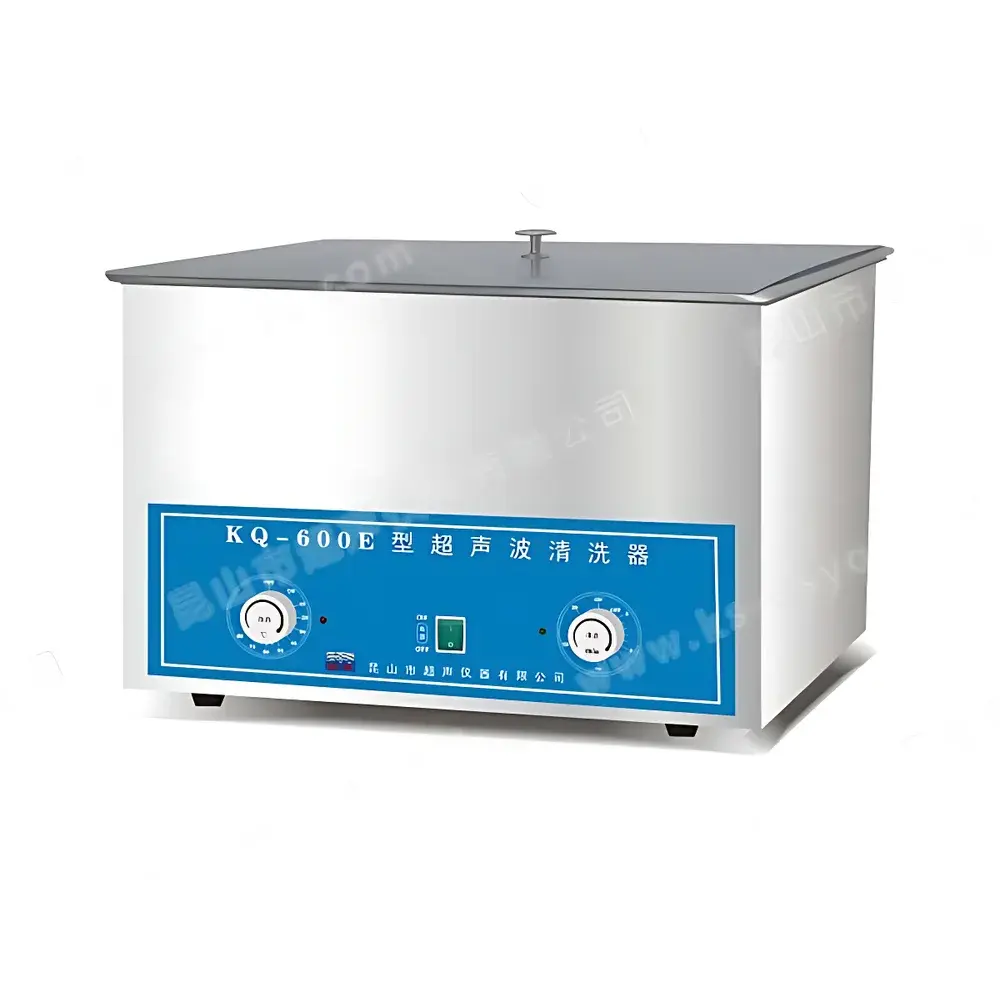
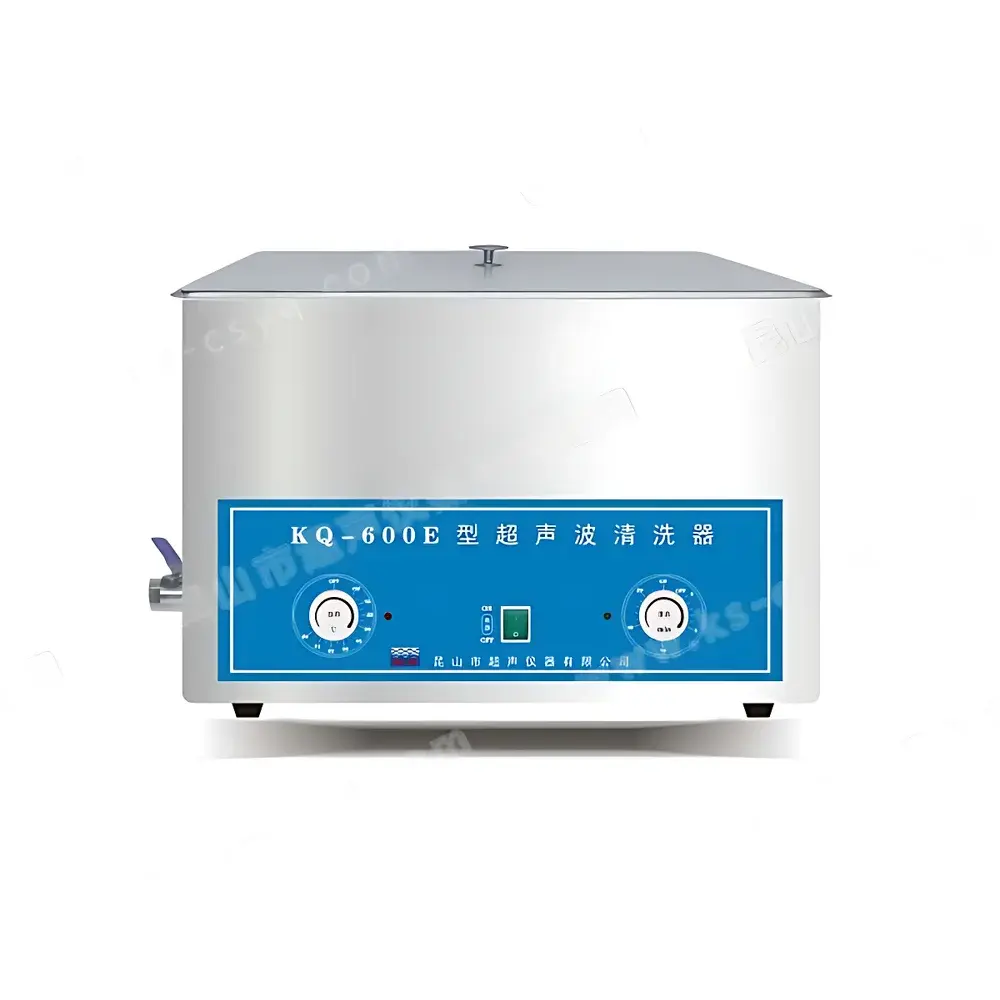
SHUMEI KQ-600E Benchtop Ultrasonic Cleaner
| Brand | SHUMEI |
|---|---|
| Origin | Jiangsu, China |
| Manufacturer Type | Direct Manufacturer |
| Equipment Type | General-Purpose Ultrasonic Cleaner |
| Model | KQ-600E |
| Tank Capacity | 22.5 L |
| Ultrasonic Frequency | 40 kHz |
| Ultrasonic Power Output | 600 W |
| Power Adjustment | Not Adjustable |
| Temperature Control Range | 0–80 °C |
| Timer Range | 1–20 min |
| Sound-Dampening Lid | Included |
| Manual Fill/Drain | Yes |
| Heating Power | 1000 W |
| Input Voltage/Frequency | 220 V / 50 Hz |
| Tank Dimensions (L×W×H) | 500 × 300 × 150 mm |
| External Dimensions (L×W×H) | 530 × 320 × 383 mm |
| Construction Material | 304 Stainless Steel |
| Heating Method | PTC Surface-Mounted Heater |
| Auto-Frequency Sweeping | Enabled |
| Transducer Configuration | Standard 50 W per element, 40 kHz |
Overview
The SHUMEI KQ-600E is a benchtop ultrasonic cleaner engineered for reproducible, non-destructive cleaning of laboratory glassware, precision components, surgical instruments, and small-volume sample containers. It operates on the principle of acoustic cavitation—where high-frequency sound waves (40 kHz) generate microscopic vacuum bubbles in aqueous or mild solvent-based cleaning solutions; upon collapse, these bubbles release localized energy sufficient to dislodge particulate contaminants, organic residues, and biofilm without mechanical abrasion. Designed for routine QC/QA labs, academic research facilities, and clinical support environments, the KQ-600E delivers consistent cleaning performance across standardized protocols while maintaining structural integrity of delicate substrates such as optical lenses, microfluidic chips, and calibration standards.
Key Features
- Robust 304 stainless steel tank construction ensures long-term corrosion resistance and compatibility with common laboratory cleaning agents including alkaline detergents, enzymatic solutions, and low-concentration ethanol/water mixtures.
- PTC (Positive Temperature Coefficient) surface-mounted heating system provides stable, uniform temperature control from ambient up to 80 °C—critical for enhancing detergent efficacy and reducing surface tension during cleaning cycles.
- Integrated auto-frequency sweeping circuitry minimizes standing wave formation and hot-spot accumulation, thereby improving cleaning uniformity across the entire tank volume (22.5 L).
- Mechanical timer with 1–20 minute adjustable range supports method-defined exposure durations compliant with ASTM D4791 (for particulate removal validation) and ISO 15883-5 (for washer-disinfector process development).
- Sound-dampening stainless steel lid reduces operational noise to <55 dB(A) at 1 m distance—meeting occupational health guidelines for continuous use in shared lab spaces.
- Manual fill-and-drain interface allows precise solution management without reliance on external plumbing, supporting GLP-compliant batch documentation via operator log entries.
Sample Compatibility & Compliance
The KQ-600E accommodates standard laboratory ware including volumetric flasks (up to 1 L), petri dishes, pipette tips, syringe filters, and metal instrument trays. Its open-tank architecture permits direct immersion of irregularly shaped parts or multi-tiered racks. All wetted surfaces comply with FDA-recommended materials for indirect food contact (21 CFR §177.1520), and the unit meets CE marking requirements under the EU Machinery Directive 2006/42/EC and EMC Directive 2014/30/EU. While not certified for sterilization, it supports pre-sterilization cleaning steps aligned with AAMI ST79:2017 Annex B and USP guidance for critical device preparation.
Software & Data Management
As a mechanically controlled platform, the KQ-600E does not incorporate digital firmware or network connectivity. All operational parameters—including time, temperature, and activation—are set manually via front-panel dials and switches. This architecture eliminates software validation overhead and supports audit-ready traceability when paired with paper-based or LIMS-integrated SOP logs. The absence of programmable memory or electronic data storage ensures full compliance with FDA 21 CFR Part 11 requirements for systems where electronic records are not generated.
Applications
- Cleaning of HPLC vials, GC autosampler inserts, and ICP-MS sample introduction components prior to trace-metal analysis.
- Removal of solder flux residues from PCBs and MEMS devices in electronics R&D labs.
- Decontamination of reusable biopsy forceps and dental handpieces in clinical reprocessing workflows.
- Preparation of quartz cuvettes and optical mirrors for UV-Vis and FTIR spectroscopy to minimize scattering artifacts.
- Supporting ASTM E2968-14 (Standard Practice for Ultrasonic Cleaning Validation) through repeatable parameter locking and visual verification of cavitation activity.
FAQ
What cleaning solutions are compatible with the KQ-600E?
Aqueous alkaline detergents, neutral pH enzymatic cleaners, and isopropanol/water (≤30% v/v) mixtures are recommended. Avoid halogenated solvents, strong acids, or undiluted oxidizers due to material compatibility and safety constraints.
Can the unit be used for degassing solvents?
Yes—operating at 40 kHz without heating for ≤5 minutes achieves effective degassing of HPLC mobile phases and cell culture media, though dedicated vacuum degassers offer higher throughput for large volumes.
Is the transducer array serviceable?
Transducers are factory-installed and potted for reliability; replacement requires authorized technical service and recalibration verification per ISO/IEC 17025 clause 6.4.2.
Does the KQ-600E meet ISO 13485 requirements for medical device manufacturing?
While the unit itself is not ISO 13485-certified, its design and documentation support integration into QMS-controlled cleaning processes when validated per manufacturer’s IQ/OQ protocols and referenced in risk assessments per ISO 14971.
What maintenance is required?
Monthly inspection of tank integrity, lid seal condition, and heater functionality is advised. Descale the tank every 200 operating hours if using hard water; use citric acid-based descalers only.



