
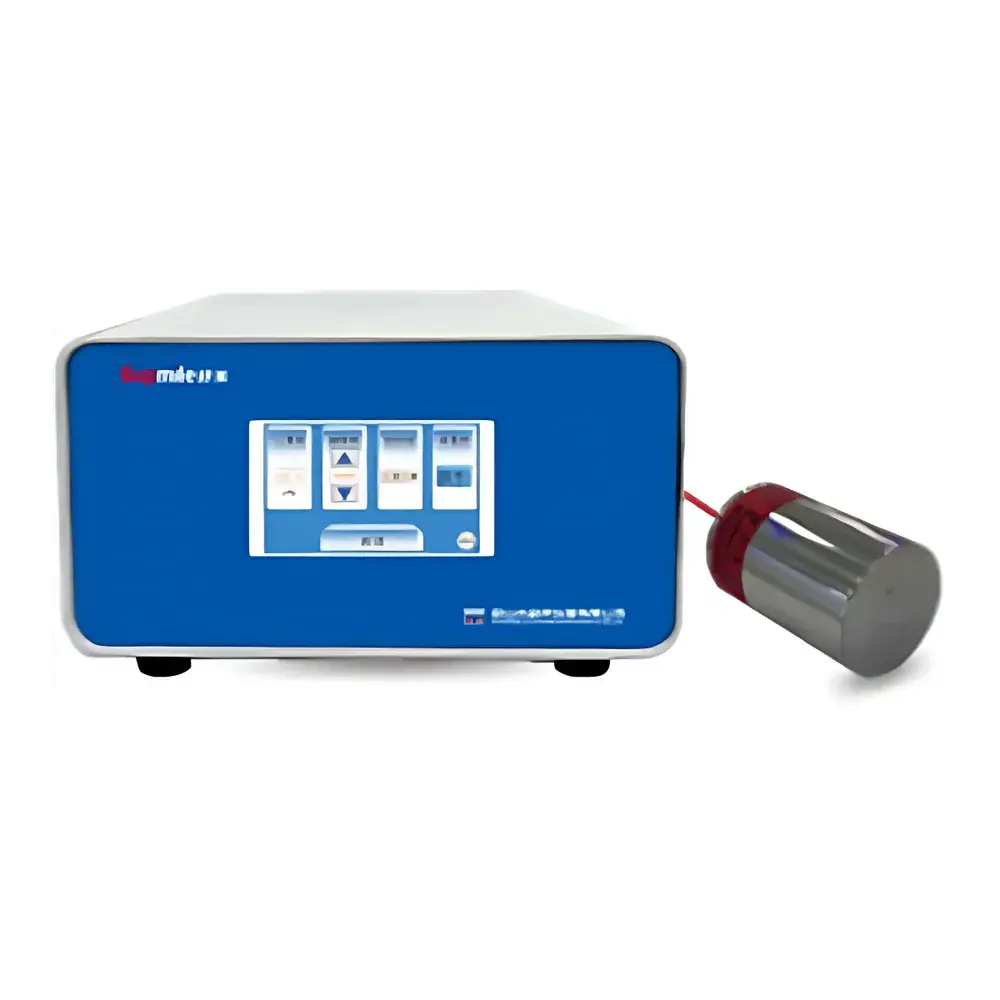
Shumei KBC-150SX Submersible Ultrasonic Algae Control System
| Brand | Shumei |
|---|---|
| Origin | Jiangsu, China |
| Manufacturer Type | Direct Manufacturer |
| Country of Origin | China |
| Model | KBC-150SX |
| Ultrasonic Frequency | 38 kHz ± 1 kHz |
| Ultrasonic Power Output | 150 W |
| Timer Range | 1 min – 99 h 59 min |
| Display | 4.3-inch TFT Touchscreen |
| Preset Programs | 9 User-Configurable Profiles |
| Transducer Dimensions | Φ60 × 100 mm |
| Generator Dimensions | 300 × 160 × 90 mm (L×W×H) |
| Interface | External Trigger Control Port |
| Customization | Field-Adaptable Mechanical Configuration |
Overview
The Shumei KBC-150SX Submersible Ultrasonic Algae Control System is an engineered solution for non-chemical, physics-based algae management in enclosed or semi-enclosed aquatic environments. It operates on the principle of low-frequency ultrasonic cavitation—specifically at 38 kHz—where acoustic pressure waves propagate through water, inducing transient microbubble formation, growth, and violent collapse (inertial cavitation). This process generates localized shockwaves (~1000 atm), microjets (>100 m/s), and transient hotspots (>5000 K), which mechanically disrupt algal cell walls, gas vesicles, and intracellular enzymatic structures without altering bulk water chemistry. Unlike chemical biocides or UV irradiation, this method imposes no residual toxicity, requires no consumables, and introduces no disinfection by-products (DBPs). The system is designed for continuous or intermittent operation in recirculating systems where biological stability and ecological compatibility are critical—such as public aquariums, ornamental ponds, municipal swimming pools, ballast water treatment pre-stages, and marine infrastructure antifouling support.
Key Features
- Submersible transducer assembly (Φ60 × 100 mm) with corrosion-resistant titanium alloy housing, rated IP68 for permanent underwater deployment.
- Dedicated 150 W high-efficiency piezoelectric generator with frequency stabilization circuitry ensuring ±1 kHz tolerance across load and temperature variations (10–40 °C ambient).
- Intuitive 4.3-inch capacitive TFT touchscreen interface supporting multi-language UI (English default), real-time parameter visualization (output power, frequency, elapsed/remaining time), and touch-enabled navigation.
- Nine programmable operating profiles stored locally in non-volatile memory—each configurable for duty cycle, duration, and power modulation to match algal species sensitivity and water volume dynamics.
- External trigger input port (TTL-compatible) enabling integration with SCADA, PLC, or environmental sensor networks (e.g., chlorophyll-a fluorescence monitors, turbidity sensors) for demand-driven activation.
- Modular mechanical architecture permitting custom transducer mounting brackets, cable gland configurations, and depth-rated housings per site-specific hydrostatic and flow conditions.
Sample Compatibility & Compliance
The KBC-150SX is validated for use in freshwater and low-salinity (<15 ppt) aquatic systems containing common bloom-forming species including Microcystis aeruginosa, Anabaena circinalis, and Chlorella vulgaris. It exhibits no measurable impact on fish hematological parameters (e.g., erythrocyte count, plasma cortisol), zooplankton viability (Daphnia magna 48-h LC50 > 10× operational intensity), or nitrifying biofilm integrity in recirculating aquaculture systems (RAS). While not a medical device, its design adheres to IEC 60529 (IP68), IEC 61000-6-3 (EMC emission limits), and GB/T 14710–2009 (Chinese environmental testing standards for electrical equipment). It supports GLP-aligned operational logging when paired with optional RS485-to-Ethernet gateways.
Software & Data Management
The embedded firmware enables timestamped event logging (start/stop cycles, fault codes, power deviations) stored onboard for up to 30 days. Optional data export via USB-C allows CSV-formatted reports compatible with LIMS platforms. No cloud dependency or proprietary software installation is required—configuration and diagnostics are fully accessible through the local touchscreen. Audit trails meet baseline requirements for ISO/IEC 17025 Clause 7.7 (control of records) when used in accredited laboratory support roles (e.g., pre-treatment conditioning of test water samples).
Applications
- Aquarium life-support systems: Preventing surface scum and benthic algal colonization on acrylic panels and live rock substrates.
- Swimming pool maintenance: Reducing chlorine demand by suppressing photosynthetic biofilm precursors on filtration media and skimmer walls.
- Marine vessel hull protection: Temporary deployment during dry-dock or alongside moored vessels to inhibit early-stage diatom and cyanobacterial adhesion.
- Research aquaculture: Controlled algal suppression in mesocosm studies evaluating trophic transfer or nutrient cycling without confounding chemical interference.
- Botanical water features: Maintaining clarity in architectural fountains and rooftop green walls where chemical discharge is prohibited.
FAQ
Is the KBC-150SX suitable for saltwater applications?
It is rated for salinities up to 15 ppt; prolonged exposure to full seawater (35 ppt) may accelerate transducer housing corrosion and is not recommended without third-party cathodic protection validation.
Does ultrasonic treatment affect beneficial nitrifying bacteria?
Independent studies confirm no statistically significant inhibition of Nitrosomonas europaea or Nitrobacter winogradskyi at operational intensities—cavitation energy is preferentially absorbed by gas-filled algal vesicles rather than dense bacterial aggregates.
Can multiple units be synchronized?
Yes—via the external trigger port using master-slave configuration; phase alignment is not required, as biological efficacy depends on spatial acoustic field overlap, not temporal coherence.
What maintenance is required?
Annual inspection of transducer pitting and O-ring integrity; no routine calibration is needed—the frequency and power output are factory-trimmed and drift-compensated in firmware.
Is regulatory approval required for installation in public facilities?
No FDA or EPA registration is mandated, as it is a physical control device—not a pesticide or biocide—though local health department notification may apply for pool or spa integration per ASTM F2347-22 (Standard Guide for Aquatic Facility Water Quality Management).



