
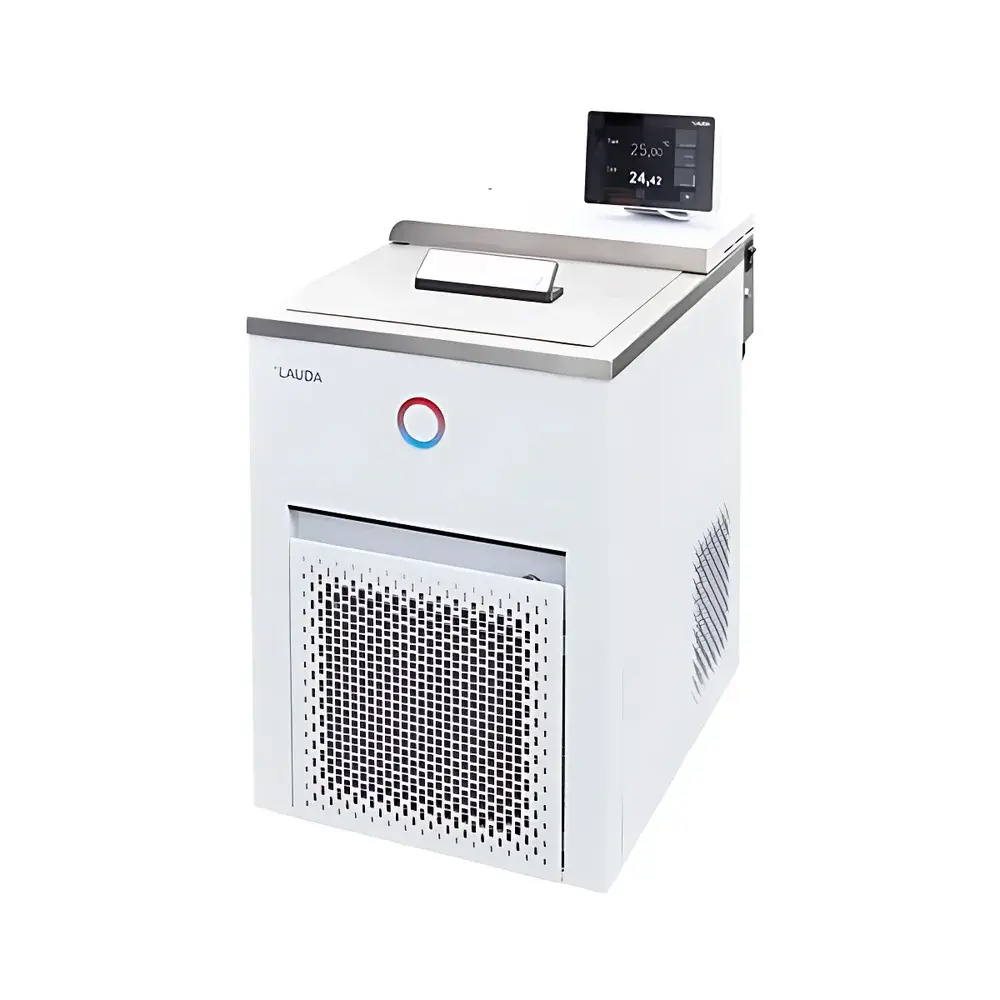
LAUDA PRO RP1090 Refrigerated Circulating Bath
| Brand | LAUDA |
|---|---|
| Origin | Germany |
| Model | RP1090 |
| Instrument Type | Refrigerated & Heated Circulating Bath |
| Temperature Range | −100 to 200 °C |
| Temperature Stability | ±0.01 K |
| Bath Volume | 30 L |
| Circulation Mode | Internal & External |
| Cooling Method | Compressor-based with optional auxiliary water cooling |
| Heating Power | 3.6 kW |
| Refrigeration Capacity (at 20 °C) | 0.86 kW |
| Pump | Integrated LAUDA Vario pump with 8 adjustable flow levels |
| Standard Interfaces | Ethernet, USB, Pt100 sensor input |
| Bath Edge Heating | Yes, integrated anti-frost heating |
| Dimensions (W×D×H) | 440 × 600 × 730 mm |
Overview
The LAUDA PRO RP1090 Refrigerated Circulating Bath is a high-precision, dual-mode temperature control system engineered for demanding laboratory and industrial applications requiring stable thermal environments across an exceptionally wide operating range—from −100 °C to +200 °C. Based on LAUDA’s proven closed-loop refrigeration architecture, the RP1090 employs a cascade compressor system combined with electric resistance heating and intelligent thermal management to achieve ±0.01 K temperature stability—critical for applications such as material property testing, reaction calorimetry, spectroscopic cell conditioning, and calibration of temperature-sensitive sensors. Its robust stainless-steel bath vessel and fully insulated housing minimize thermal drift and external heat exchange, while the integrated bath edge heating prevents condensation and ice formation at sub-ambient setpoints—a key reliability feature for long-duration low-temperature operation.
Key Features
- Ultra-wide temperature range: −100 °C to +200 °C, enabled by a multi-stage refrigeration circuit and high-efficiency heating elements
- Exceptional temperature stability: ±0.01 K at setpoint, verified under static and dynamic load conditions per ISO 17025-compliant validation protocols
- LAUDA Vario circulation pump with eight discrete flow-rate settings (0.5–22 L/min), allowing optimization of thermal homogeneity for diverse bath geometries and external loop configurations
- Dual cooling mode: Standard air-cooled condenser with optional auxiliary water-cooling connection (G¼” thread) for enhanced performance in elevated ambient temperatures or continuous high-load operation
- Integrated bath rim heater prevents surface frosting and moisture accumulation during cryogenic operation—eliminating manual de-icing and improving operational continuity
- Standard digital interfaces: Ethernet (for remote monitoring via LAUDA WebControl), USB (for firmware updates and local data export), and Pt100 input (enabling external probe feedback for cascade control)
- Compliance-ready design: Supports audit trails, user access levels, and parameter logging—facilitating alignment with GLP, GMP, and FDA 21 CFR Part 11 requirements when used with LAUDA’s optional software suite
Sample Compatibility & Compliance
The RP1090 accommodates a broad spectrum of sample formats and external equipment via its 30 L stainless-steel bath and dual internal/external circulation capability. It supports immersion of glassware (e.g., reaction flasks, cuvettes, viscometer sleeves), jacketed reactors, and analytical instrumentation requiring precise thermal coupling. The unit conforms to IEC 61010-1 (Safety Requirements for Electrical Equipment for Measurement, Control, and Laboratory Use) and carries CE marking for the European Economic Area. Its construction materials—including food-grade silicone tubing options and PTFE-compatible wetted surfaces—meet ASTM D471 and USP Class VI criteria for compatibility with organic solvents and pharmaceutical process fluids. For regulated environments, traceable calibration certificates (NIST-traceable Pt100 probes) and IQ/OQ documentation packages are available upon request.
Software & Data Management
The RP1090 operates natively with LAUDA’s WebControl web interface, accessible via standard browsers over Ethernet without proprietary client installation. Real-time parameters—including bath temperature, setpoint deviation, pump speed, compressor status, and external Pt100 readings—are logged at user-defined intervals (1 s to 60 min) and exportable in CSV format. Optional LAUDA LabSoft software extends functionality with multi-device synchronization, automated ramp/soak profiles, alarm escalation (email/SNMP), and electronic signature support for 21 CFR Part 11 compliance. All configuration changes and temperature events are time-stamped and stored locally with tamper-resistant audit logs—ensuring full traceability for quality assurance and regulatory submissions.
Applications
- Low-temperature polymer characterization (e.g., DSC sample stage conditioning, rheology at cryogenic shear rates)
- High-precision calibration of thermocouples, RTDs, and infrared thermometers across extended ranges
- Thermal conditioning of optical components (lenses, detectors) to suppress thermal lensing in laser systems
- Stabilization of HPLC columns, GC injectors, and mass spectrometer sources
- Controlled cooling/heating cycles in accelerated aging studies (ASTM D7566, ISO 11346)
- Support for jacketed reactor systems in fine chemical synthesis where exotherm management and reproducible crystallization kinetics are critical
FAQ
What is the minimum achievable temperature with the RP1090 using standard heat transfer fluids?
With LAUDA Ultra-Therm 300 silicone oil, the RP1090 reliably reaches −90 °C; for −100 °C operation, LAUDA Cryo-Optima fluid is recommended.
Can the RP1090 be integrated into a larger automated lab system?
Yes—the Ethernet interface supports Modbus TCP and OPC UA protocols, enabling seamless integration with LIMS, SCADA, and PLC-based control architectures.
Is external cooling water required for nominal operation?
No—air cooling is sufficient for most applications; water cooling is optional and recommended only for continuous operation above 80% refrigeration load or ambient temperatures exceeding 30 °C.
How is temperature uniformity validated within the bath?
LAUDA specifies axial and radial uniformity of ≤±0.02 K at 100 mm from bath walls, measured per DIN 12876-1 using nine calibrated Pt100 probes distributed in a 3×3 grid.
Does the RP1090 support external temperature feedback control?
Yes—via the standard Pt100 input, users can implement process temperature control (e.g., reactor jacket temperature) with automatic setpoint adjustment based on external sensor readings.
Related Products



