
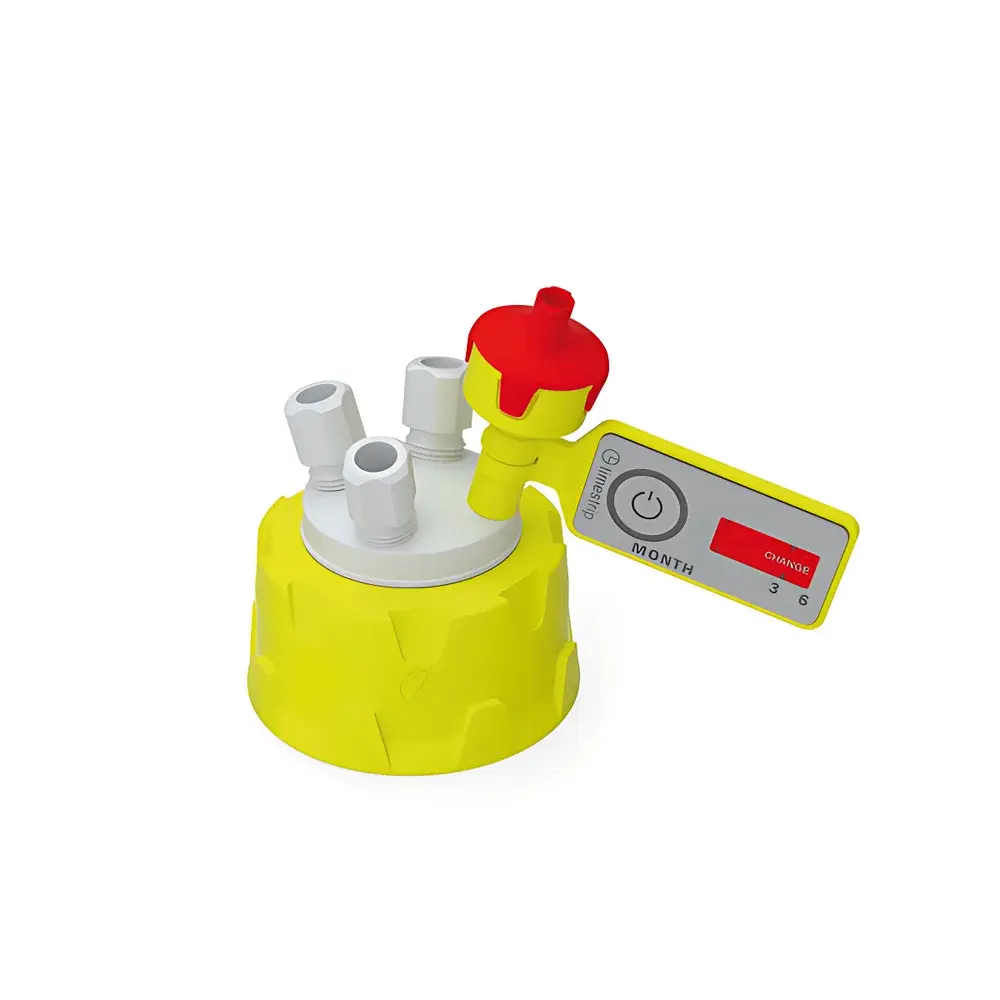
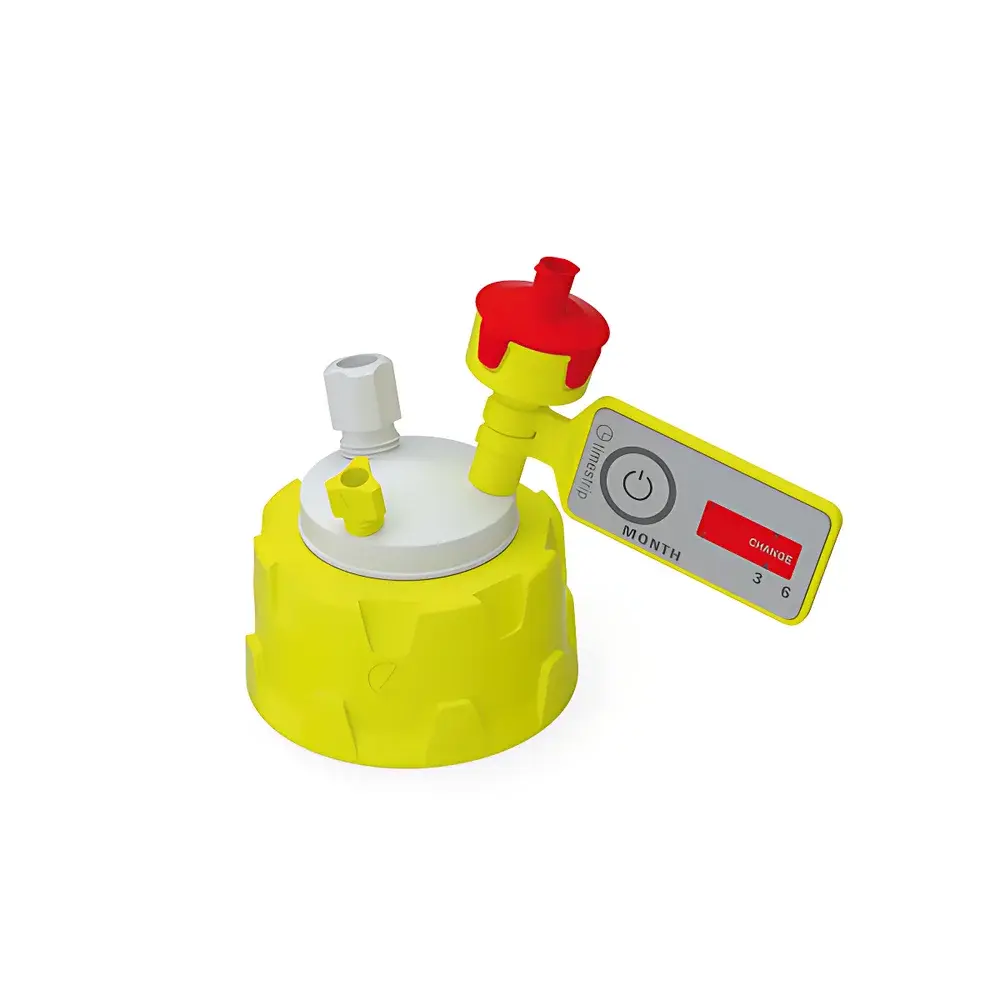
b.safe Preparative HPLC Solvent Bottle Sealing Cap
| Brand | b.safe |
|---|---|
| Origin | Germany |
| Product Type | Preparative HPLC Solvent Bottle Cap |
| Material | PPS Outer Housing + PTFE Inner Core |
| Temperature Resistance | –20 °C to +200 °C |
| Chemical Resistance | Excellent (Universal Grade) |
| Tube Compatibility | OD 4.0–6.35 mm (standardized for 6.35 mm PFA tubing) |
| Filtration | Integrated hydrophobic PTFE membrane (0.2 µm pore size), visual lifetime indicator (color transition to red), 6-month service life under standard lab conditions |
| Sealing System | Viton® flat gasket with PTFE sealing lip |
| Thread | UNF 1/4″ (angled for unobstructed tube insertion) |
| Sterilization | Autoclavable (121 °C, 20 min), dishwasher-safe |
| Ergonomics | Textured PPS surface, glove-compatible grip, rotatable white PTFE inner core for tool-free tightening |
Overview
The b.safe Preparative HPLC Solvent Bottle Sealing Cap is an engineered interface solution designed specifically for high-flow, high-purity solvent delivery in preparative liquid chromatography systems. Unlike generic bottle caps, this cap integrates fluidic integrity, vapor containment, and environmental protection into a single robust assembly. It operates on a dual-path principle: solvent delivery occurs through a precision-machined PFA push-fit connector that seals against the bottle interior wall, while controlled air ingress is managed via a pressure-balanced, flow-adaptive venting system. The cap maintains positive headspace pressure equilibrium during pump aspiration—preventing solvent evaporation, minimizing volatile organic compound (VOC) loss, and eliminating vacuum-induced foaming or cavitation in low-surface-tension solvents such as acetonitrile or ethyl acetate. Its design conforms to ISO 8573-1 (compressed air purity classes) and supports GLP-compliant solvent handling workflows where trace contamination control and documentation traceability are essential.
Key Features
- Patented angled UNF 1/4″ thread geometry ensures unimpeded access for tubing insertion and air valve mounting—eliminating kinking of 6.35 mm OD PFA lines during installation.
- Two-stage sealing architecture: Viton® flat gasket provides primary static seal against diverse bottle neck geometries; secondary PTFE sealing lip isolates the gasket from solvent vapors, extending gasket service life and chemical compatibility.
- Integrated 0.2 µm hydrophobic PTFE membrane filter housed within the air inlet path—meets ASTM F838-22 for bacterial retention and prevents particulate ingress from ambient lab air.
- Visual lifetime indicator: Embedded dye system transitions from neutral to vivid red upon full saturation, enabling immediate, operator-readable assessment of filter exhaustion without instrumentation.
- Autoclavable construction: PPS outer housing and virgin PTFE inner core withstand repeated steam sterilization (121 °C, 20 min, 100 kPa) and are compatible with laboratory dishwashers per DIN EN ISO 15883-1.
- Glove-friendly ergonomics: Textured surface pattern and rotational PTFE core allow secure, torque-consistent tightening without tools—even when wearing nitrile or latex gloves.
Sample Compatibility & Compliance
The cap is validated for use with common preparative HPLC solvents including hexane, dichloromethane, methanol, ethanol, isopropanol, THF, DMF, and aqueous buffers across pH 1–14. Its material set (PPS + PTFE + Viton®) complies with USP Class VI biocompatibility requirements and demonstrates no detectable leachables per ICH Q5C guidelines when exposed to solvents at 40 °C for 72 h. The design supports compliance with FDA 21 CFR Part 11 when used in conjunction with electronic logbook systems for filter replacement tracking. It meets mechanical stability requirements per ISO 9001:2015 Annex A.2 for reusable lab consumables subjected to ≥500 operational cycles.
Software & Data Management
While the cap itself is a passive mechanical component, its integrated visual indicator enables structured manual documentation aligned with ALCOA+ principles (Attributable, Legible, Contemporaneous, Original, Accurate, Complete, Consistent, Enduring, Available). Users may record filter replacement dates directly on the cap’s label field or integrate entries into LIMS via standardized SOP templates (e.g., “SOP-BC-007: Solvent Delivery System Maintenance Log”). Optional QR-code-labeled variants (not included in base model) support digital audit trails when scanned using mobile validation apps compliant with GAMP 5 Category 3 software classification.
Applications
- Preparative-scale purification of pharmaceutical intermediates and natural products under cGMP-aligned workflows.
- Long-duration gradient elution runs (>72 h) requiring stable solvent composition and minimal headspace oxygen ingress.
- Handling of moisture-sensitive or air-reactive solvents (e.g., anhydrous THF, pyridine) where inert gas sparging is impractical.
- Multi-solvent switching systems where cross-contamination risk must be minimized between reservoirs.
- Automated fraction collection setups where solvent bottle integrity directly impacts fraction purity and yield reproducibility.
FAQ
Can this cap be used with analytical HPLC systems?
Yes, though optimized for preparative flow rates (≥5 mL/min), it is fully compatible with analytical systems; however, the 6.35 mm tubing interface may require adapters for standard 1/16″ stainless steel lines.
Is the PTFE membrane replaceable separately?
No—the membrane is permanently integrated into the air valve assembly. Replacement requires full air valve module exchange (part number M 144-012, M 144-023, etc.).
Does the cap support nitrogen blanketing?
Not natively; it is designed for ambient air filtration. For inert gas overlay, a dedicated nitrogen purge adapter (b.safe accessory kit NK-01) must be installed in place of the standard air valve.
What is the maximum recommended operating pressure differential?
The cap maintains integrity up to ±0.5 bar differential pressure relative to ambient, sufficient for all standard HPLC pump configurations including dual-piston and syringe-driven systems.
How often should the visual indicator be checked during routine operation?
Daily visual inspection is recommended prior to system startup; color transition typically occurs gradually over 4–6 months depending on ambient humidity, airflow rate, and particulate load.



