
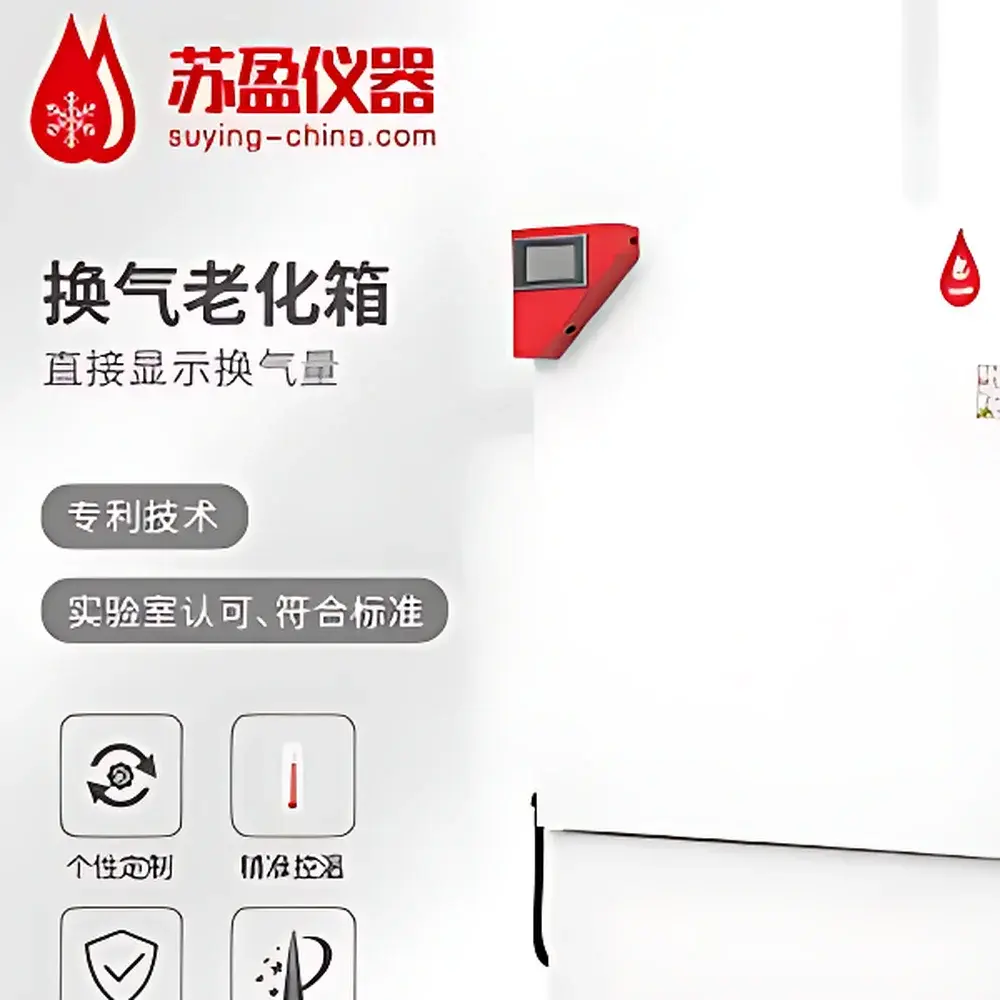
Suying HQ-500 Air Circulation Thermal Aging Chamber
| Brand | Suying |
|---|---|
| Origin | Shanghai, China |
| Model | HQ-500 |
| Temperature Range | RT+10°C to 250°C |
| Temperature Uniformity | ±2°C |
| Temperature Fluctuation | ±0.5°C |
| Air Exchange Rate | 3–20 air changes/hour (adjustable) |
| Internal Chamber Dimensions (W×H×D) | 800×900×700 mm |
| Control System | LED-display microcomputer PID controller with AT self-tuning and SSR output |
| Temperature Sensor | PT100 platinum resistance thermometer |
| Air Exchange Mechanism | Motorized, adjustable damper-based system (patented design ZL201721135485.0) |
| Safety Protections | Over-temperature, phase failure/reverse-phase, motor overheat, timer, and overload protection |
| Compliance | JB/T 7444, GB/T 3512–2014, ISO 188:2011, GB/T 2423.2–2001, GB/T 2423.3–1993 |
| Calibration Reference | JJF 1001–2003 (Temperature) |
Overview
The Suying HQ-500 Air Circulation Thermal Aging Chamber is an engineered environmental test system designed for accelerated thermal aging evaluation of polymeric materials, elastomers, electrical insulators, automotive components, and electronic assemblies under controlled high-temperature atmospheric conditions. Based on the principle of forced convection air circulation with precisely regulated exchange rates, the chamber subjects test specimens to defined thermal stress while maintaining consistent oxygen availability—mimicking long-term exposure to ambient air at elevated temperatures. This methodology enables quantitative assessment of degradation mechanisms including oxidation, chain scission, crosslinking, and surface embrittlement. Unlike static oven environments, the HQ-500 integrates a calibrated, motor-driven air exchange system that ensures reproducible oxidative kinetics across test cycles—critical for comparative aging studies and lifetime prediction modeling in R&D and quality assurance laboratories.
Key Features
- Forced-air thermal convection system with stainless-steel axial fan and low-noise, long-life AC motor for uniform heat distribution and minimal vibration transfer
- Patented active air exchange control (ZL201721135485.0) enabling precise adjustment from 3 to 20 complete air changes per hour via motorized damper and digital flow display
- High-stability temperature control architecture: LED-based microcomputer PID controller with auto-tuning (AT), SSR solid-state relay output, and 0.2 ms sampling interval
- Temperature accuracy maintained at ±0.1°C setpoint deviation; resolution of 0.1°C supported by class A PT100 platinum resistance sensors
- Double-wall insulated chamber construction: interior mirror-finish SUS304 stainless steel liner and exterior electrostatically sprayed carbon steel housing
- Comprehensive safety suite including independent over-temperature cutoff, phase monitoring (loss/reversal), fan overheat detection, programmable test timer (up to 999.9 h), and circuit overload protection
Sample Compatibility & Compliance
The HQ-500 accommodates standard test specimens per ISO 188:2011 (rubber—accelerated ageing), GB/T 3512–2014 (vulcanized rubber—hot air ageing test), and GB/T 2423.2–2001 (environmental testing—part 2: tests—test B: dry heat). Its 800 × 900 × 700 mm working volume supports multiple parallel samples—including ASTM D573 dumbbells, IEC 60811 cable insulation strips, and automotive gasket coupons—without compromising airflow integrity. The chamber meets national verification requirements per JJF 1001–2003 for temperature metrology and is fully traceable to national standards. It supports GLP-compliant operation when paired with external data loggers and audit-trail-enabled software (see Software & Data Management section).
Software & Data Management
While the HQ-500 operates via standalone microcontroller interface, it features RS485 communication capability for integration into centralized lab management systems. Optional PC-based logging software (sold separately) enables real-time acquisition of temperature, air exchange rate, and elapsed time with timestamped CSV export. All logged data includes operator ID, test ID, and calibration status metadata—supporting 21 CFR Part 11 readiness when deployed with user access controls and electronic signature modules. The system’s deterministic control logic and hardware redundancy ensure data integrity during extended unattended runs, making it suitable for qualification protocols requiring full traceability under ISO/IEC 17025 or IATF 16949 frameworks.
Applications
- Evaluation of thermal stability and oxidative resistance of elastomers, thermoplastics, and composite laminates
- Pre-compliance screening of wire & cable insulation per UL 1581 and EN 60811 series
- Accelerated life testing of adhesives, sealants, and potting compounds used in automotive ECUs and power electronics
- Material selection support for aerospace non-metallic components operating under sustained thermal load
- Quality control release testing of batch-manufactured rubber O-rings, bushings, and vibration dampers
- Research into Arrhenius-based degradation kinetics and activation energy estimation using multi-temperature aging arrays
FAQ
What standards does the HQ-500 explicitly comply with?
The chamber is designed and verified to meet JB/T 7444 (Chinese national standard for air thermal aging test chambers), GB/T 3512–2014, ISO 188:2011, GB/T 2423.2–2001, and GB/T 2423.3–1993. Full compliance documentation—including factory calibration reports and test certificates—is provided upon delivery.
Can the air exchange rate be validated independently?
Yes. The system allows manual verification using calibrated anemometry at the exhaust port. The damper position is linearly correlated with volumetric flow, and a reference curve is supplied for third-party validation against ASHRAE 110 or ISO 16000-23 methodologies.
Is customization available for non-standard chamber dimensions or control interfaces?
Suying offers OEM engineering services for custom internal volumes, enhanced temperature ranges (up to 300°C), Ethernet-enabled controllers, and integration with SCADA or MES platforms—subject to minimum order quantity and lead-time agreement.
Related Products



