
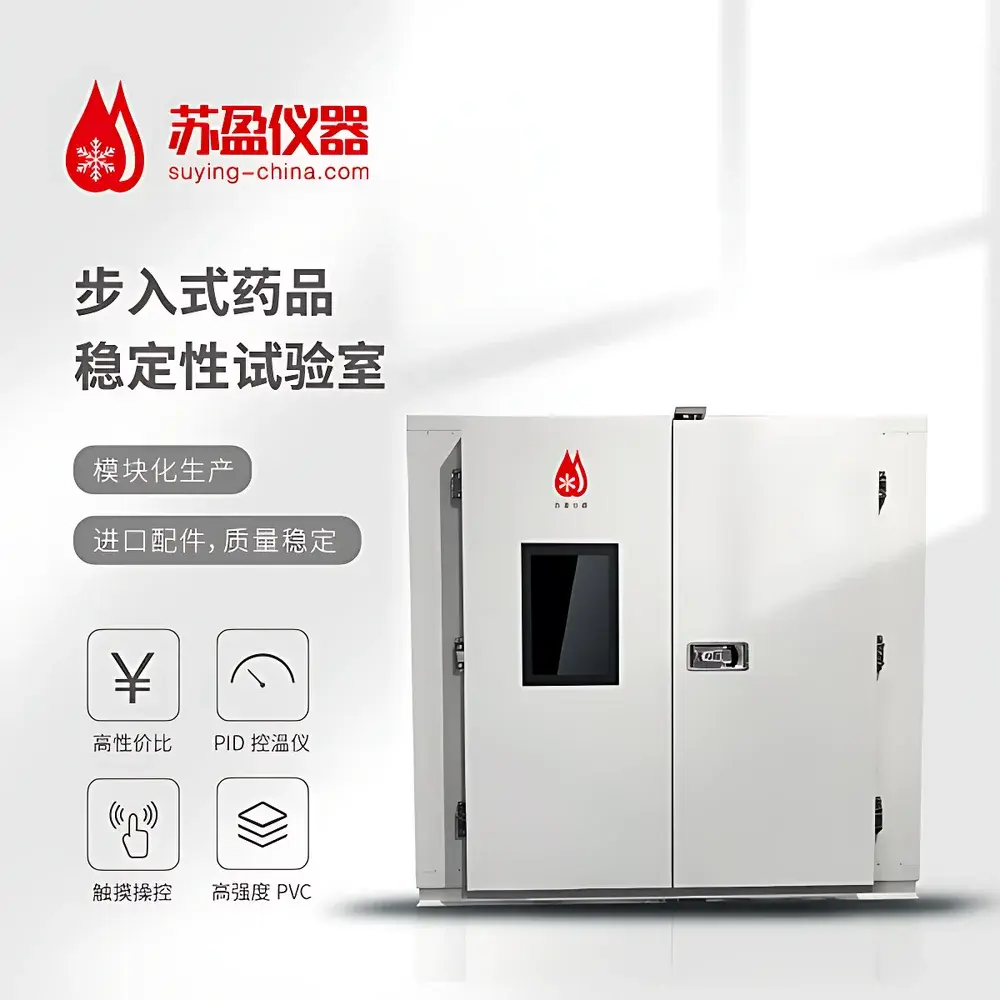
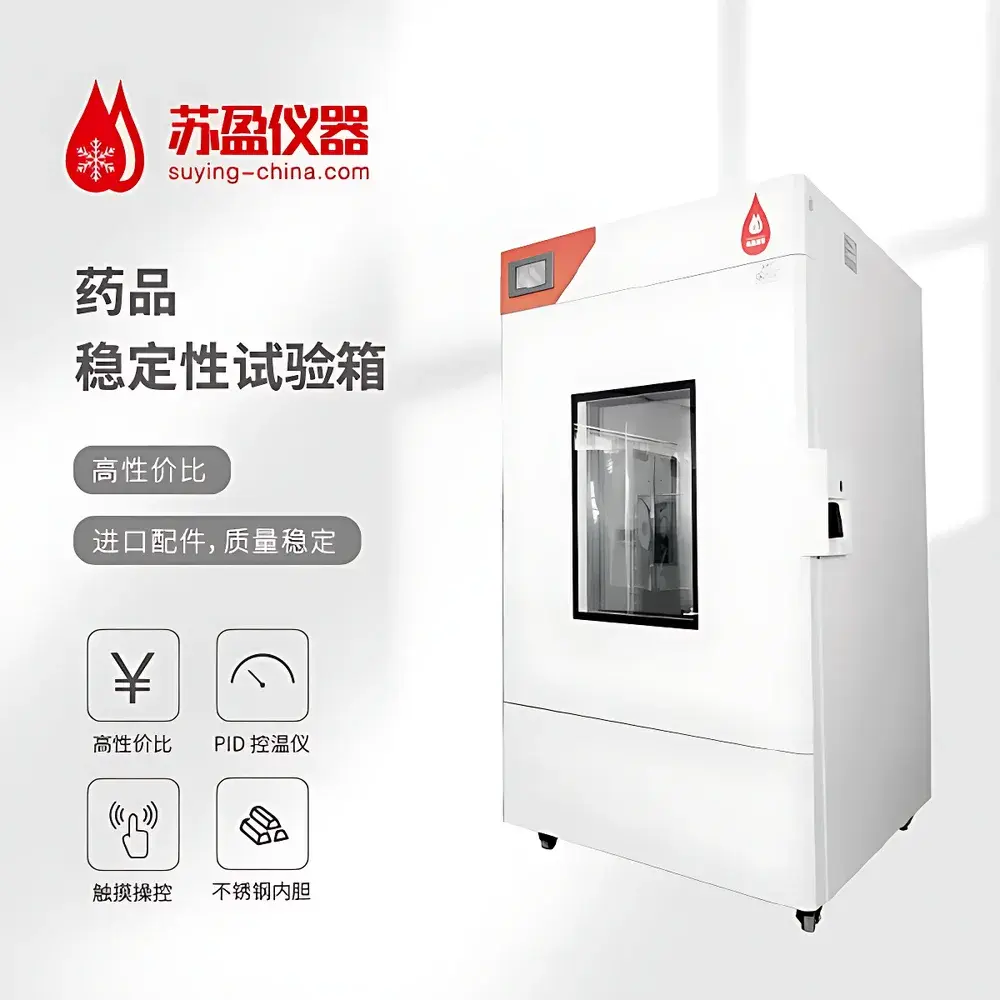

SuYing YP-Series Pharmaceutical Stability Testing Chamber
| Brand | SuYing |
|---|---|
| Origin | Shanghai, China |
| Model Series | YP-150SD / YP-250SD / YP-500SD (Standard), YP-150SDP / YP-250SDP / YP-500SDP (Programmable), YP-150GSP / YP-250GSP / YP-500GSP (GMP-Compliant) |
| Temperature Range | 0–65 °C (dark), 10–65 °C (with illumination) |
| Temperature Uniformity | ±0.5 °C |
| Humidity Range | 30–95 %RH |
| Humidity Uniformity | ±0.5 %RH |
| Illumination Intensity | 0–6000 lx (adjustable), accuracy ±500 lx |
| Refrigeration | Danfoss hermetic compressor, R404A/R23 refrigerant |
| Control System | Fuji PID-based microprocessor controller with Pt100 sensor, 0.1 °C / 0.1 %RH resolution |
| Internal Construction | Mirror-finish SUS304B stainless steel |
| Compliance | GB 10586–2006, Chinese Pharmacopoeia (2010 Ed.) Stability Testing Guidelines, WHO TRS 953 Annex 2, ICH Q1–Q5 |
Overview
The SuYing YP-Series Pharmaceutical Stability Testing Chamber is an engineered environmental simulation system designed to meet the stringent requirements of regulatory-compliant drug stability assessment under ICH Q1A(R2), Q1B, Q5C, and WHO Technical Report Series No. 953 Annex 2. It provides precise, reproducible control of temperature, relative humidity, and photometric irradiance—three critical stress parameters defined in long-term (25 °C/60 %RH), accelerated (40 °C/75 %RH for 6 months), and photostability (ICH Q1B Option 1 & 2) protocols. Unlike generic climate chambers, the YP-Series integrates pharmaceutical-grade thermal-hygrometric uniformity validation, GMP-aligned data integrity architecture, and multi-zone illumination capability—enabling concurrent execution of ICH-mandated dark, near-UV, and visible light exposure studies within a single validated platform.
Key Features
- Regulatory-Grade Environmental Control: Achieves ±0.5 °C temperature uniformity and ±0.5 %RH humidity uniformity across full working volume, verified per ISO 16770:2017 and ASTM E2809–11 spatial mapping standards.
- Dual- or Triple-Chamber Configurations: Optional YP-GSD (two-zone) and YP-TSD (three-zone) variants allow independent, simultaneous operation of dark/humid, illuminated/humid, and photostability test environments—eliminating cross-contamination risk and reducing facility footprint.
- GMP-Ready Data Architecture: YP-GSP models include audit-trail-enabled controllers compliant with FDA 21 CFR Part 11 and EU Annex 11, supporting electronic signatures, user role-based access control, and encrypted raw data export (CSV/Excel).
- Pharmaceutical-Optimized Construction: Interior chamber fabricated from electropolished SUS304B stainless steel (passivated per ASTM A967); seamless welded corners; no crevices or porous surfaces; fully autoclavable sample trays and removable drip pans.
- Advanced Thermal Management: Balanced heating/cooling system with Danfoss BD50F hermetic compressors, finned evaporator, and air-cooled condenser—ensuring stable operation at ambient temperatures up to +25 °C without external water cooling.
- Illumination System: Adjustable 0–6000 lx LED array with spectral output matching ICH Q1B Option 1 (visible) and Option 2 (near-UV); integrated lux sensor with real-time feedback loop and ±500 lx calibration traceability to NIST-traceable standards.
Sample Compatibility & Compliance
The YP-Series accommodates primary and secondary packaging configurations—including blister packs, vials, ampoules, sachets, and unit-dose containers—on adjustable stainless-steel shelves with 30 mm vertical pitch. All models are pre-qualified per USP , ISO 14644-1 Class 8 (ISO Class 5 during door opening), and GMP Annex 15 qualification templates (IQ/OQ/PQ). Validation documentation includes as-installed temperature/humidity mapping reports, irradiance distribution profiles, and alarm response verification logs. The system conforms to GB 10586–2006 “Environmental Test Equipment – General Technical Conditions”, Chinese Pharmacopoeia 2020 Vol. IV General Chapter “Stability Testing of Drug Substances and Products”, and ICH harmonized guidelines for climatic zone classification (Zone IVb).
Software & Data Management
Standard YP-SD models feature Fuji PXR4 series microprocessor controllers with 7-inch capacitive touchscreen interface, local data logging (≥30 days at 1-min intervals), and USB export. YP-SDP models add Ethernet connectivity, Modbus TCP support, and optional cloud-based remote monitoring via SuYing StabilityLink™ web portal—enabling real-time dashboard visualization, email/SMS alerting on deviation events, and automated report generation (PDF/HTML). YP-GSP systems integrate with LIMS and MES platforms via OPC UA 1.04 and support ALCOA+ data principles: Attributable, Legible, Contemporaneous, Original, Accurate, Complete, Consistent, Enduring, Available.
Applications
- ICH Q1A(R2) long-term, accelerated, and intermediate condition testing of APIs and finished dosage forms
- ICH Q1B photostability studies (Option 1: visible light; Option 2: near-UV + visible)
- Accelerated stability protocol development per USP and Ph. Eur. 2.2.45
- Real-time stability monitoring for shelf-life assignment and retest date determination
- Excipient compatibility screening under controlled humidity gradients
- Biological product storage condition evaluation (e.g., lyophilized proteins, monoclonal antibodies)
- Medical device packaging integrity testing per ISO 11607–1
FAQ
What ICH guidelines does this chamber support?
It fully supports ICH Q1A(R2), Q1B, Q5C, and Q5D for stability testing design, photostability assessment, and cell culture media stability evaluation.
Is the chamber suitable for GMP manufacturing environments?
Yes—YP-GSP models are delivered with full qualification packages (IQ/OQ/PQ), 21 CFR Part 11 compliance, and configurable electronic audit trails.
Can temperature and humidity be controlled independently in different zones?
Yes—YP-GSD (dual-zone) and YP-TSD (triple-zone) configurations allow fully independent setpoint control and alarm thresholds per chamber segment.
How is illumination calibrated and maintained?
Each unit ships with factory-calibrated lux sensors traceable to NIST; annual recalibration kits and certified service are available through SuYing’s global network.
What is the maximum ambient operating temperature?
The system maintains specified performance at ambient temperatures up to +25 °C without auxiliary cooling, per GB 10586–2006 Clause 4.3.2.



