
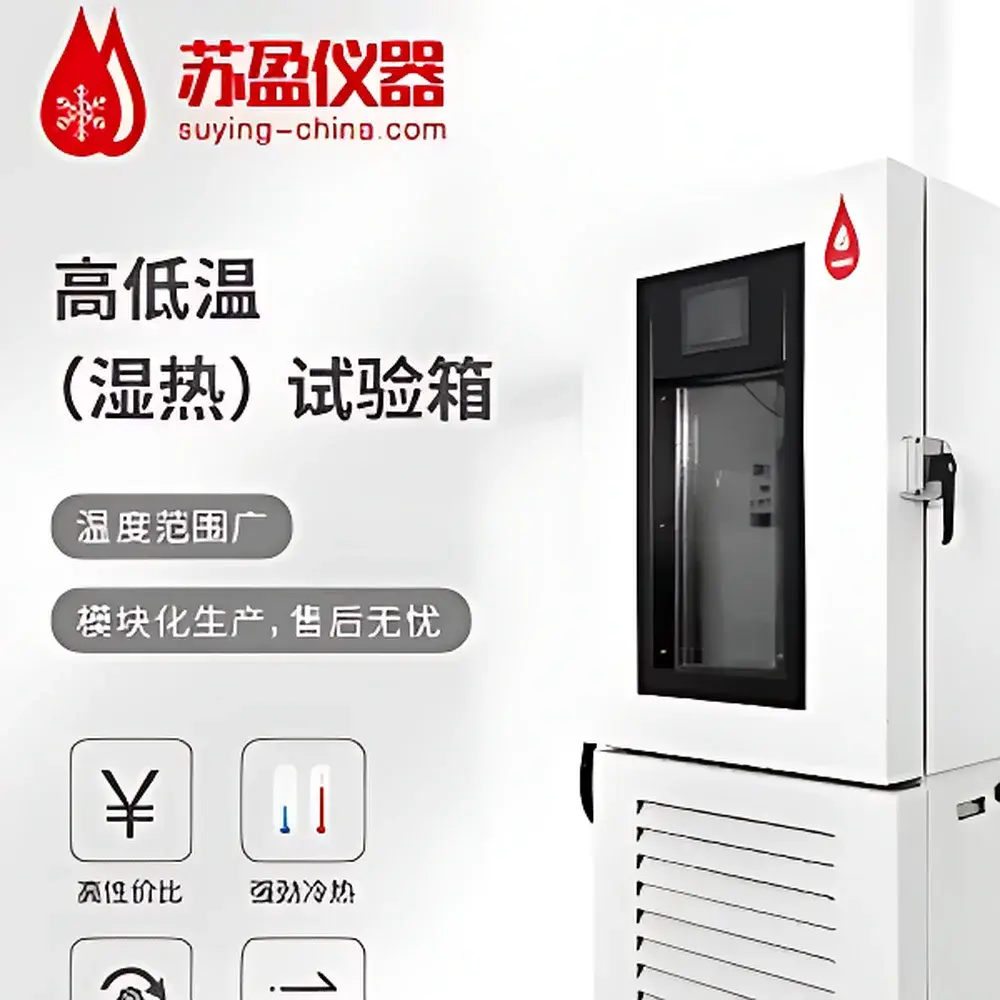
SuYing GDW-100 / GDW-250 / GDW-500 Series High-Low Temperature Alternating Environmental Test Chamber
| Brand | SuYing |
|---|---|
| Origin | Shanghai, China |
| Model | GDW-100 / GDW-250 / GDW-500 |
| Temperature Range Options | A: −20°C to +150°C |
| B | −40°C to +150°C |
| C | −60°C to +150°C |
| D | −70°C to +150°C |
| Temperature Uniformity | ≤ ±2°C |
| Temperature Fluctuation | ≤ ±0.5°C |
| Heating Rate (−20°C → 100°C) | ~35 min |
| Cooling Rate (25°C → −40°C) | ~50 min |
| Internal Dimensions (GDW-500) | 800 × 700 × 900 mm (D×W×H) |
| External Dimensions (GDW-500) | 1280 × 1350 × 2100 mm (D×W×H) |
| Power Supply | AC 380 V ±10%, 50 ±0.5 Hz, 3-phase 5-wire |
| Refrigeration System | French Tecumseh hermetic compressor (single-stage or cascade configuration) |
| Control System | Imported PID microprocessor-based digital controller with ±0.1°C setpoint/indication resolution |
| Safety Protections | Over-temperature, over-current, motor overload, refrigerant high-pressure, leakage, and short-circuit protection |
| Compliance Standards | GB/T 2423.1–2001, GB/T 2423.2–2001, GB 10589–1989, GB 10592–1989, GB 11158–1989, GB/T 5170.2–1996 |
Overview
The SuYing GDW-Series High-Low Temperature Alternating Environmental Test Chamber is an engineered solution for accelerated environmental stress testing of industrial components and materials under controlled thermal extremes. Based on the principle of forced-air convection thermoregulation within a double-wall insulated enclosure, this chamber enables precise simulation of rapid temperature transitions—critical for evaluating thermal shock resistance, dimensional stability, material embrittlement, seal integrity, and long-term reliability in electronics, automotive interiors, aerospace composites, polymer packaging, and metallic assemblies. Designed to meet the stringent repeatability and traceability requirements of product qualification protocols, the GDW-Series supports both steady-state exposure and programmed cycling between defined low- and high-temperature setpoints, with full compliance to internationally recognized test standards including IEC 60068-2-1 (Cold), IEC 60068-2-2 (Dry Heat), and their Chinese national equivalents (GB/T 2423.1 & GB/T 2423.2).
Key Features
- Robust dual-chamber construction featuring outer cold-rolled steel with electrostatic powder coating and inner SUS304 stainless steel mirror-finish lining (1.5 mm thickness), ensuring corrosion resistance and long-term dimensional stability.
- High-efficiency insulation system combining rigid polyurethane foam (≥80 mm thick) with supplementary ultra-fine glass fiber matting—achieving thermal conductivity ≤0.022 W/m·K and minimizing energy loss during extended cycles.
- Optimized air circulation architecture with multi-blade centrifugal fans and aerodynamically designed ductwork, delivering uniform airflow distribution and meeting ≤±2°C temperature uniformity across the working volume per GB/T 5170.2–1996 verification procedures.
- Large observation window with embedded heating element and LED illumination, preventing condensation and enabling real-time visual monitoring without thermal disturbance to the test space.
- Modular refrigeration design: single-stage (for models up to −40°C) or cascade-type (for −60°C/−70°C variants) using original Tecumseh hermetic compressors and Castel solenoid valves—ensuring stable sub-zero operation and reduced maintenance intervals.
- Dual independent heating and cooling circuits enable simultaneous ramp control, faster recovery after door opening (<60 s stabilization time), and improved test efficiency versus shared-loop architectures.
Sample Compatibility & Compliance
The GDW-Series accommodates a wide range of sample geometries and mounting configurations. Standard internal dimensions (e.g., 800 × 700 × 900 mm for GDW-500) allow placement of automotive instrument panels, PCB assemblies, battery modules, rubber gaskets, and plastic housings. Adjustable stainless steel sample shelves (3-position height adjustment) and optional custom fixtures support heterogeneous load arrangements. The left-side 50 mm diameter cable port (with silicone gasket sealing) permits integration with external power supplies, data loggers, or in-situ measurement probes. All models comply with mandatory safety and electromagnetic compatibility directives applicable to laboratory-grade environmental equipment. Calibration traceability follows ISO/IEC 17025 guidelines, and routine performance validation aligns with GB/T 5170.2–1996 temperature uniformity and fluctuation test methods.
Software & Data Management
Equipped with a programmable microprocessor controller featuring PID auto-tuning, ramp-soak cycling, and user-defined profile storage (up to 100 segments), the system ensures repeatable thermal profiles across multiple test runs. The interface provides real-time display of chamber temperature, setpoint, elapsed time, and alarm status, with ±0.1°C resolution for both setpoint entry and actual reading. Optional RS485/RS232 communication enables connection to SCADA systems or centralized lab management software for automated data acquisition and audit trail generation. When paired with compatible printers or PC interfaces, the controller logs timestamped temperature records compliant with GLP documentation requirements—including operator ID, test ID, start/stop times, and deviation alerts. Firmware supports password-protected parameter locking to prevent unauthorized modification during qualification runs.
Applications
This chamber serves as a core tool in R&D laboratories, quality assurance departments, and third-party certification bodies performing environmental qualification per MIL-STD-810, JEDEC JESD22-A104, ISO 16750-4, and ASTM D3418. Typical use cases include: pre-compliance thermal cycling of printed circuit boards prior to HALT; evaluation of adhesive bond strength degradation at −60°C; validation of LCD module response latency under rapid 25°C ↔ −40°C transitions; aging studies of elastomeric seals exposed to 150°C for 1,000 hours; and accelerated life testing of lithium-ion pouch cells under alternating thermal loads. Its reproducible thermal gradients also support failure analysis workflows requiring correlation between thermal history and observed mechanical or electrical anomalies.
FAQ
What temperature ranges are available for the GDW-Series?
The GDW-Series offers four standard operating ranges: Type A (−20°C to +150°C), Type B (−40°C to +150°C), Type C (−60°C to +150°C), and Type D (−70°C to +150°C), selected based on application-specific low-temperature requirements.
Is the chamber suitable for testing samples with active power input?
Yes—the standard 50 mm diameter feedthrough port (with replaceable silicone gasket) supports external power, signal, or sensor cabling while maintaining thermal integrity and pressure equilibrium.
How is temperature uniformity verified and maintained?
Uniformity is ensured through optimized fan placement, baffle-guided airflow, and high-density insulation; it is validated per GB/T 5170.2–1996 using nine calibrated PT100 sensors positioned at standardized locations within the working volume.
Can the controller generate compliant test reports for regulatory submission?
When configured with optional serial output and connected to validated data acquisition software, the system produces time-stamped, tamper-evident temperature logs meeting FDA 21 CFR Part 11 electronic record requirements for GMP environments.
What maintenance intervals are recommended for the refrigeration system?
Compressor oil and refrigerant levels should be inspected annually; filter-driers replaced every two years; and full system performance verification conducted per GB/T 5170.2 every 12 months or after 200 operational hours—whichever occurs first.



