
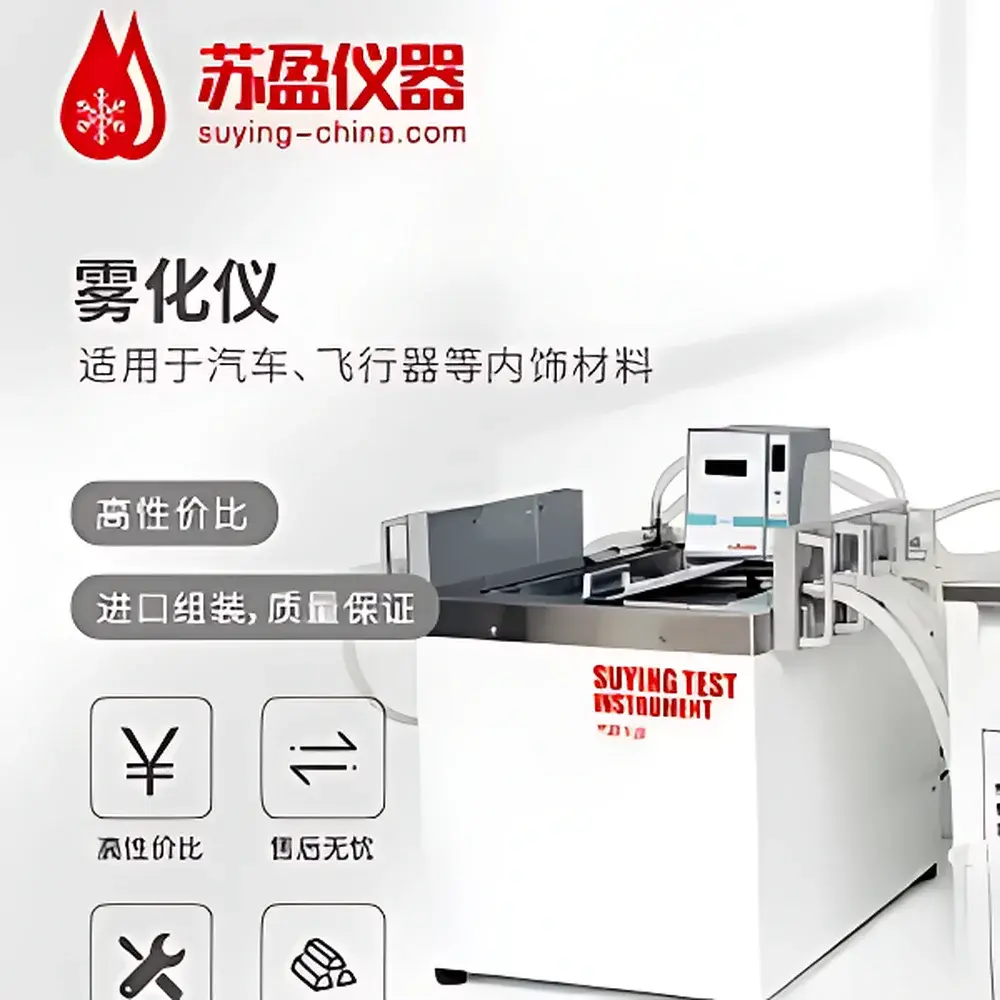
Suying WH-100 Automotive Interior Fogging Tester
| Brand | Suying |
|---|---|
| Origin | Shanghai, China |
| Model | WH-100 |
| Fogging Test Temperature Range | 45–160 °C |
| Cooling Bath Temperature Range | −28 to 100 °C |
| Compliance | ISO 6452, DIN 75201, SAE J1756, QB/T 2729 |
Overview
The Suying WH-100 Automotive Interior Fogging Tester is a precision-engineered instrument designed for quantitative assessment of volatile condensable emissions from interior materials used in automotive, aerospace, and rail transportation cabins. It operates on the principle of thermal desorption followed by cold-surface condensation—commonly referred to as the “fogging” phenomenon—where volatile organic compounds (VOCs) and plasticizer migrants volatilize under controlled elevated temperature, then condense onto a standardized chilled mirror or glass slide. The mass or optical density of the deposited fogging residue is measured to evaluate material compatibility with cabin air quality standards. This gravimetric or photometric method provides objective, repeatable data essential for pre-production validation and regulatory conformance.
Key Features
- Programmable high-temperature test chamber with precise PID-controlled heating (45–160 °C range), calibrated to ±0.5 °C accuracy across full span
- Dual-zone cooling bath capable of maintaining stable low-temperature surfaces from −28 °C to +100 °C, enabling both cold-mirror and glass-slide fogging modes per ISO 6452 Annex A and B
- Stainless-steel reaction chamber with inert internal surface finish to prevent catalytic degradation or adsorption artifacts during thermal desorption
- Integrated digital temperature logging with timestamped records compliant with GLP data integrity requirements
- Modular sample holder accommodating standard 30 mm × 30 mm specimens (ISO 6452) or optional 50 mm circular discs (DIN 75201)
- CE-marked electrical architecture meeting IEC 61010-1 safety standards for laboratory equipment
Sample Compatibility & Compliance
The WH-100 supports testing of polymeric foams, PVC trim, adhesives, sealants, leather substitutes, textile laminates, and composite substrates commonly employed in dashboard, headliner, seat upholstery, and console assemblies. It is fully aligned with internationally recognized fogging test protocols: ISO 6452:2022 (Rubber, vulcanized or thermoplastic — Determination of fogging characteristics of interior materials), DIN 75201-B (cold-glass method), SAE J1756 (automotive interior materials fogging), and QB/T 2729–2005 (Chinese national standard for automobile interior parts). All operational parameters—including exposure time (typically 3 h ± 5 min), specimen mass (10.00 ± 0.05 g), and distance between sample and condensing surface (75 mm)—are mechanically fixed to ensure inter-laboratory reproducibility.
Software & Data Management
While the WH-100 operates in standalone mode with front-panel digital controls, optional RS-485/USB interface enables integration with external PC-based data acquisition systems. Temperature profiles, cycle start/end timestamps, and ambient condition logs (optional external sensor input) can be exported in CSV format for audit-ready reporting. When deployed in regulated environments (e.g., Tier-1 supplier QC labs), the instrument supports 21 CFR Part 11-compliant electronic record workflows when paired with validated third-party LIMS or ELN platforms—particularly where user authentication, audit trails, and electronic signatures are required for GMP-aligned material release.
Applications
- Pre-qualification screening of new polymer formulations prior to vehicle-level VOC emission testing (e.g., VDA 278, ISO 12219-4)
- Root-cause analysis of haze formation on HUD displays, camera lenses, or rearview mirrors
- Supplier qualification against OEM-specific fogging limits (e.g., BMW GS 97038, Ford WSS-M99P1111-A2, VW TL 52251)
- Stability assessment of flame-retardant additives under thermal aging conditions
- Comparative evaluation of low-fogging alternatives to conventional phthalate plasticizers in PVC compounds
FAQ
What standards does the WH-100 support out-of-the-box?
It is configured for ISO 6452 (gravimetric and reflectometric), DIN 75201-B (cold-glass), and SAE J1756. Custom calibration kits for OEM-specific methods are available upon request.
Is the cooling bath compressor-based or Peltier-driven?
The WH-100 uses a sealed, maintenance-free dual-stage cascade refrigeration system rated for continuous operation at −28 °C, ensuring long-term thermal stability without cryogen dependency.
Can the instrument be validated for IQ/OQ/PQ?
Yes—Suying provides factory-issued Installation Qualification (IQ) documentation and a traceable temperature mapping report. Operational Qualification (OQ) templates aligned with ASTM E2500 are supplied for customer-executed verification.
Does it support automated residue weighing?
No built-in balance; however, the design includes a dedicated weighing station footprint and vibration-dampened platform compatible with Mettler Toledo XP series or Sartorius Cubis II analytical balances (user-supplied).
What is the typical turnaround time per test cycle?
Standard cycle duration is 3 hours heating + 1 hour cooldown + manual residue handling, totaling ~4.5 hours per sample set (up to 3 specimens simultaneously).





