
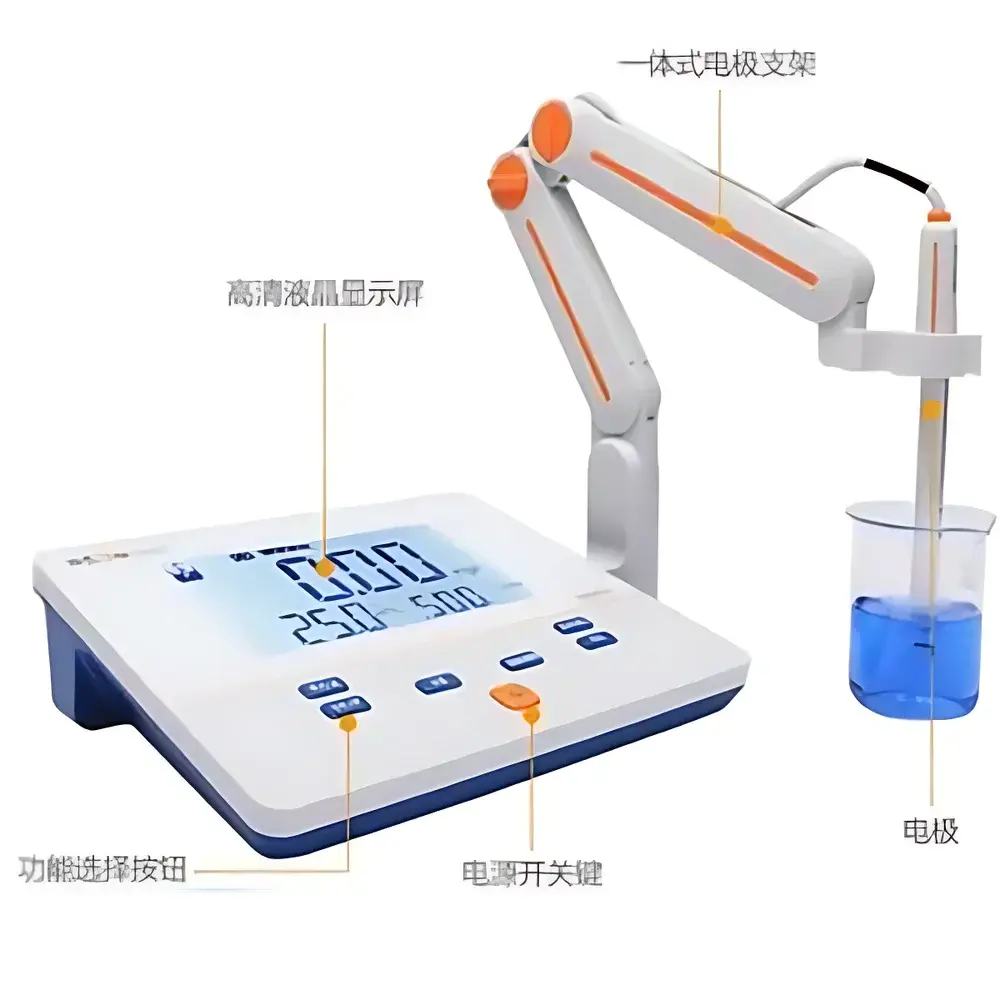
Leichi DDS-307A Benchtop Conductivity Meter
| Brand | Leichi |
|---|---|
| Origin | Shanghai, China |
| Model | DDS-307A |
| Form Factor | Benchtop |
| Intended Use | Laboratory |
| Conductivity Range | 0.00 μS/cm to 200 mS/cm |
| TDS Range | 0.00–100 mg/L |
| Temperature Range | −5.0 to 110.0 °C |
| Accuracy | ±1.0% FS |
| Minimum Resolution | 0.01 μS/cm |
Overview
The Leichi DDS-307A is a precision benchtop conductivity meter engineered for routine and high-reliability laboratory measurements of aqueous solutions. It operates on the principle of two-electrode AC conductometry—applying a low-frequency alternating current across a pair of platinum-black-coated titanium electrodes to minimize polarization effects and ensure stable readings across wide conductivity ranges. Designed in compliance with Chinese national standard JJG 376–2007 (Verification Regulation for Conductivity Meters) and aligned with international metrological practices, the DDS-307A delivers traceable, reproducible results suitable for quality control, environmental monitoring, pharmaceutical water testing, and academic research. Its robust architecture integrates manual and automatic temperature compensation (ATC), enabling accurate normalization of conductivity values to 25 °C per ISO 7888 and ASTM D1125 standards. The instrument is classified as Class 1.0 per GB/T 11013–2019, indicating a maximum permissible error of ±1.0% full scale under specified operating conditions.
Key Features
- Large LCD segment display with clear numeric readout and intuitive status indicators for conductivity, TDS, and temperature
- Dual-mode temperature compensation: user-selectable manual mode or automatic mode (0.0–40.0 °C range)
- Configurable temperature coefficient (default 2.0%/°C), adjustable to match solution-specific thermal response
- High-purity measurement capability enabled by a sealed cell design and 0.01 cm⁻¹ titanium alloy conductivity cell (DJS-1C type, Pt-black coated)
- Integrated T818-B6 thermistor-based temperature probe with ±0.3 °C accuracy and 0.1 °C resolution
- Stable DC power supply input (AC 220 V ±10%, 50 Hz), eliminating battery-related drift during extended operation
- Compact benchtop footprint (300 × 200 × 72 mm) and lightweight construction (1.5 kg) optimized for shared lab environments
Sample Compatibility & Compliance
The DDS-307A supports analysis of deionized water, boiler feedwater, ultrapure water (UPW), process streams, and standard reference solutions (e.g., KCl 0.01 mol/L, certified per NIST SRM 3194). Its 0.01 cm⁻¹ cell geometry minimizes electrode polarization and ensures linear response down to sub-μS/cm levels—critical for USP purified water and WFI conductivity verification. While the instrument does not include built-in data logging or audit trail functionality, its analog 0–10 mV output allows connection to external recorders or PLC systems for GLP-compliant documentation. It meets electromagnetic compatibility requirements per GB/T 18268.1–2010 (IEC 61326-1) and safety standards per GB 4793.1–2007 (IEC 61010-1).
Software & Data Management
The DDS-307A operates as a standalone hardware platform without embedded firmware-based data storage or PC connectivity. All measurements are displayed in real time; no internal memory or USB/RS-232 interface is provided. Users requiring digital data capture must integrate the instrument’s analog output into third-party acquisition systems or manually transcribe values. For laboratories implementing 21 CFR Part 11 compliance, external validation of the measurement workflow—including operator identity, timestamping, and raw value recording—is required. Documentation packages (including calibration certificates, uncertainty budgets, and verification reports) are available upon request from authorized Leichi service centers.
Applications
- Monitoring conductivity of purified water systems in pharmaceutical manufacturing (aligned with EU GMP Annex 1 and WHO TRS 970)
- Calibration verification of inline conductivity sensors in bioreactor and clean steam loops
- Environmental testing of surface water, groundwater, and wastewater effluents per EPA Method 120.1
- Educational labs for teaching fundamental electrochemical principles, including Kohlrausch’s law and molar conductivity
- Quality assurance of buffer solutions, saline standards, and electrolyte formulations in R&D settings
FAQ
What is the recommended calibration frequency for the DDS-307A?
Calibration should be performed before each analytical session or at least once per shift when used continuously. Two-point calibration using certified KCl standards (e.g., 1413 μS/cm and 12.88 mS/cm) is required to validate linearity across the measurement span.
Can the DDS-307A measure seawater or brine solutions?
No—the upper limit of 200 mS/cm is insufficient for undiluted seawater (~50 mS/cm typical) or saturated brines (>200 mS/cm). For such applications, a higher-range meter (e.g., 0–2 S/cm) with a 10 cm⁻¹ cell is recommended.
Is the DJS-1C electrode included with the instrument?
Yes—the standard configuration includes one DJS-1C platinum-black titanium conductivity cell and one T818-B6 temperature sensor.
Does the DDS-307A support GLP-compliant reporting?
Not natively. GLP compliance requires external documentation of calibration records, operator entries, environmental conditions, and raw data—none of which are generated or stored internally.
How is temperature compensation applied in automatic mode?
The instrument measures sample temperature in real time and applies a linear correction based on the configured temperature coefficient (default 2.0%/°C), referencing the measured value to 25 °C per ISO 7888.



