
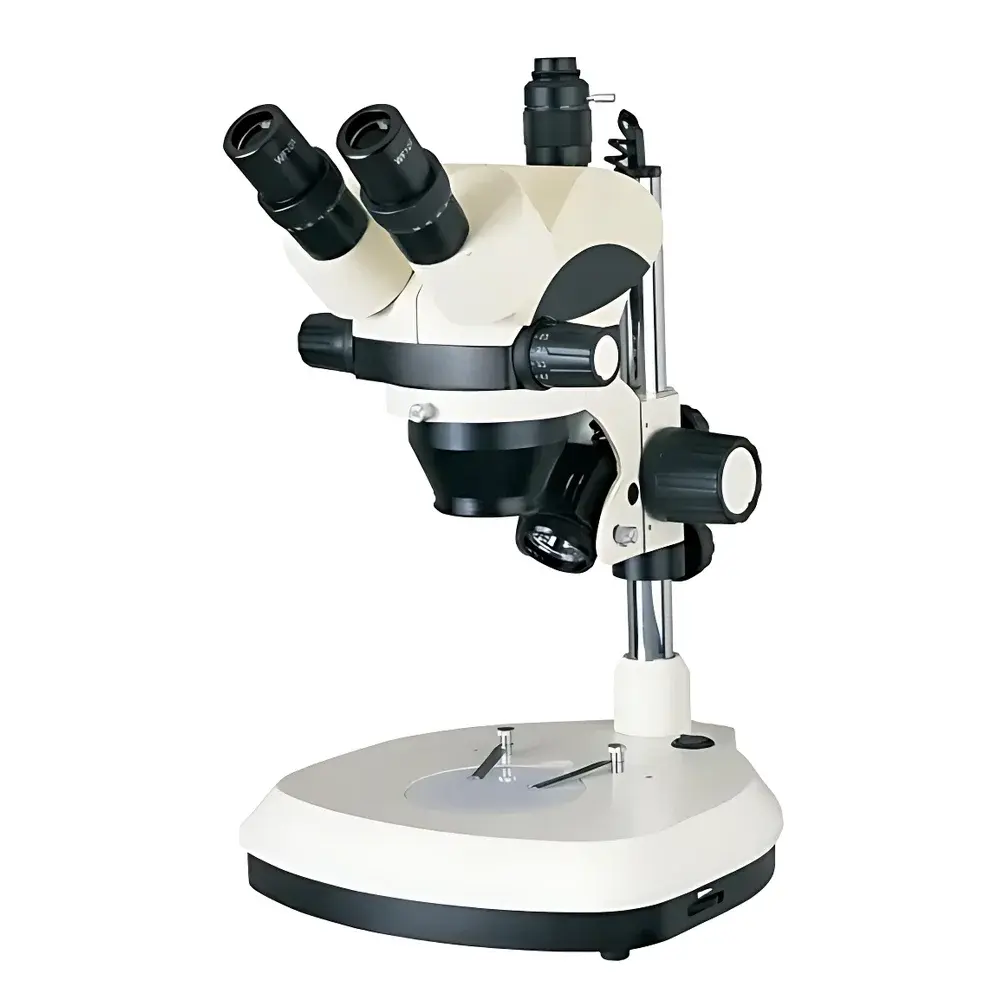
Betop Scientific XTL-101 Advanced Stereo Microscope
| Brand | Betop Scientific |
|---|---|
| Origin | Guangdong, China |
| Manufacturer Type | Direct Manufacturer |
| Country of Origin | China |
| Model | XTL-101 |
| Total Magnification | 45× |
| Working Distance | 88 mm |
| Objective Type | Continuous Zoom Objective |
| Illumination | Halogen Lamp |
| Eyepiece Inclination | 45° |
| Binocular Tube | Adjustable Interpupillary Distance & Diopter Compensation |
| Zoom Ratio | 0.7×–4.5× (extendable to 0.35×–9× with auxiliary lenses) |
| Optional Configurations | Trinocular Head, Ring LED Illuminator (8 W, 90–265 V), Ring Fluorescent Lamp (5 W, 110/220 V) |
Overview
The Betop Scientific XTL-101 Advanced Stereo Microscope is a high-stability, Greenough-type stereoscopic optical instrument engineered for real-time, three-dimensional observation of macro-to-mesoscale surface structures. Unlike compound microscopes, it employs dual independent optical paths—each with matched objective and eyepiece assemblies—to deliver true depth perception, natural parallax, and upright, unreversed (orthoscopic) image orientation. Its continuous zoom optics operate on the principle of synchronized lateral displacement of lens groups, ensuring seamless magnification transitions without mechanical backlash or focus shift. Designed for extended operator ergonomics and long-duration inspection tasks, the XTL-101 features a fixed 45° inclined binocular tube with independent diopter adjustment per eyepiece and interpupillary distance calibration—critical for reducing visual fatigue during quality control, failure analysis, or teaching applications.
Key Features
- Continuous zoom system with 0.7×–4.5× native magnification range; extendable to 0.35×–9× using optional auxiliary objectives (0.5× and 2×)
- Long working distance of 88 mm at 1× zoom—enabling unobstructed manipulation of specimens under observation (e.g., soldering, dissection, or sample mounting)
- Dual-path Greenough optical architecture delivering >15% depth of field retention across the zoom range and minimal chromatic aberration
- Halogen illumination system with adjustable intensity and heat-absorbing filter, optimized for consistent color rendering (CIE D65 approximated) and thermal stability during prolonged use
- Modular mechanical design: compatible with standard dovetail-mount stands, pillar bases, and translation stages; trinocular port supports C-mount or F-mount digital imaging systems
- Ergonomic construction: non-slip rubberized focusing knobs, precision-ground coarse/fine coaxial focusing mechanism (2 µm fine-focus resolution), and anti-fungal coated optical surfaces
Sample Compatibility & Compliance
The XTL-101 accommodates opaque, reflective, and semi-translucent specimens up to 120 mm in height and 150 mm in diameter—ideal for PCB assemblies, botanical sections, mineral thin sections, textile swatches, and pharmaceutical tablets. Its large stage aperture and open-bottom stand configuration allow integration with transmitted light bases (sold separately) for contrast-enhanced inspection of translucent polymers or stained biological tissues. The instrument complies with IEC 61000-6-3 (EMC emissions) and IEC 61000-6-2 (immunity) standards. All electrical components—including halogen lamp housing and optional LED ring illuminators—meet UL/CSA and CE safety requirements. For regulated environments, documentation packages support GLP-compliant instrument qualification (IQ/OQ/PQ protocols) and traceable calibration against NIST-traceable reference standards.
Software & Data Management
While the XTL-101 operates as a standalone optical platform, its trinocular configuration enables seamless coupling with industry-standard imaging software suites (e.g., ToupView, Stream Motion, or Olympus cellSens). When paired with USB3.0 CMOS cameras (e.g., 5 MP or 12 MP sensors), the system supports time-lapse capture, measurement annotation (length, angle, area), and multi-focus extended-depth-of-field (EDF) stacking. Metadata embedding (magnification, timestamp, user ID) adheres to EXIF 2.31 and DICOM Supplement 143 conventions. Audit trails for image acquisition parameters are exportable in CSV or XML formats—facilitating alignment with FDA 21 CFR Part 11 requirements when deployed in GMP-regulated QC laboratories.
Applications
- Electronics manufacturing: solder joint integrity assessment, component placement verification, and micro-defect mapping on flex circuits
- Materials science: characterization of fracture surfaces, porosity distribution in sintered metals, and grain boundary delineation in cast alloys
- Agronomy & forestry: morphological analysis of leaf stomata, fungal hyphae colonization, and seed coat microstructure
- Pharmaceutical QA: tablet coating uniformity evaluation, capsule shell defect screening, and excipient particle aggregation studies
- Educational laboratories: comparative anatomy demonstrations, mineral identification exercises, and introductory micro-manipulation training
- Textile engineering: fiber crimp analysis, yarn twist quantification, and pilling resistance assessment per ASTM D3512
FAQ
What is the maximum usable field of view at lowest magnification?
At 0.35× (with 0.5× auxiliary objective), the field number 22 eyepieces yield a ~63 mm diameter field of view—sufficient for full PCB board inspection without stage repositioning.
Can the halogen illumination be replaced with LED?
Yes—optional 8 W universal-voltage ring LED illuminators provide cooler operation, longer service life (>50,000 h), and flicker-free illumination compatible with high-speed video capture.
Is the XTL-101 suitable for photomicrography in ISO 17025-accredited labs?
When equipped with calibrated camera adapters and documented magnification verification procedures, it meets metrological traceability requirements for non-destructive examination reporting per ISO/IEC 17025:2017 Clause 7.8.3.
Does the microscope support ergonomic accessories for seated operation?
Yes—adjustable-height articulating arms, tilting base platforms, and anti-glare viewing hoods are available as OEM-certified accessories to comply with ISO 9241-5 workstation ergonomics guidelines.




