
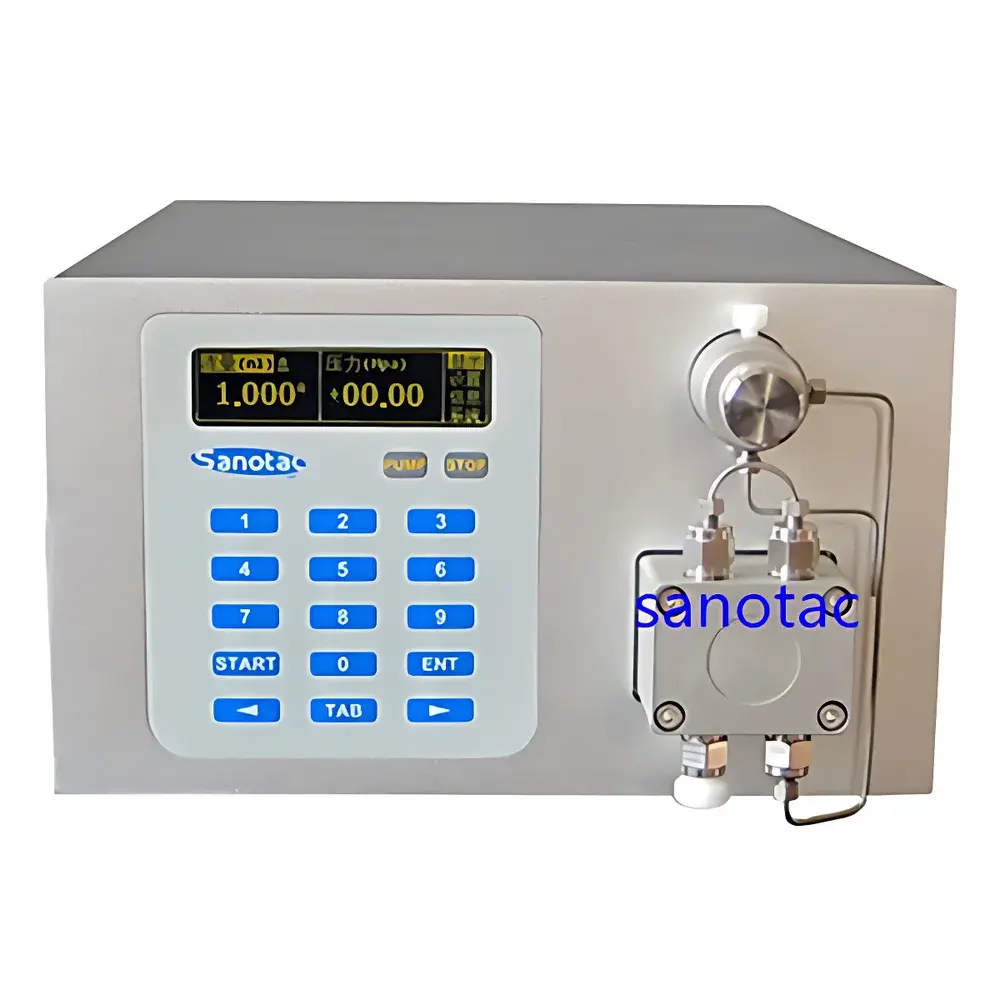
Sanotac S0140 High-Pressure Precision Metering Pump for Microchannel Reactors
| Brand | Sanotac |
|---|---|
| Model | S0140 |
| Drive Type | Electric |
| Flow Range | 0–100 mL/min |
| Accuracy | ±0.5% |
| Repeatability | ≤0.1% |
| Maximum Pressure | 40 MPa |
| Pressure Pulsation | ≤0.1 MPa |
| Wetted Materials | 316L Stainless Steel, Sapphire, PTFE, Ceramic |
| Power Supply | 85–264 VAC, 50 Hz |
| Power Consumption | 75 W |
| Dimensions | 370 × 240 × 152 mm |
| Weight | 8 kg |
| Communication Interfaces | USB, RS232, RS485/422 (optional), Modbus RTU/TCP, Custom Protocol |
Overview
The Sanotac S0140 is a high-pressure, precision metering pump engineered specifically for continuous-flow chemistry applications requiring strict volumetric control, minimal pulsation, and long-term operational stability. It operates on positive displacement principle using a dual-cam-driven sapphire-plunger assembly, delivering consistent flow across its full range (0.001–100 mL/min) without reliance on feedback loops or downstream pressure compensation. Its design conforms to the mechanical and fluidic demands of microchannel reactor systems—where residence time distribution, interfacial mass transfer, and stoichiometric fidelity are governed by precise, pulse-free delivery of reagents under elevated backpressure (up to 40 MPa). Unlike peristaltic or diaphragm-based alternatives, the S0140 eliminates elastic deformation-induced drift and maintains traceable volumetric accuracy through factory-calibrated cam profiles and real-time electronic pulsation suppression.
Key Features
- Ultra-low minimum increment: 0.0001 mL/min — enabling fine-tuned stoichiometric adjustment in catalytic screening or kinetic studies
- Dual-stage pulsation mitigation: mechanical cam-profile optimization combined with real-time digital flow correction ensures pressure ripple ≤0.1 MPa at rated flow
- Multi-material fluid path: chemically resistant wetted components (316L SS, sapphire, PTFE, ceramic) support compatibility with aggressive solvents, strong acids/bases, and supercritical CO₂
- Intelligent overpressure protection: programmable auto-shutdown modes (auto-restart, manual reset, low-pressure recovery) safeguard reactor integrity during blockage events
- Column plunger post-stroke cleaning: automated solvent flush sequence reduces seal wear and extends maintenance intervals beyond 6,000 hours
- Full-range linear calibration: supports both single-point user calibration and multi-point NIST-traceable flow mapping via PC software
- Configurable timing logic: independent start/stop triggers, duration-based dosing, and synchronized multi-pump sequencing for parallel reaction workflows
Sample Compatibility & Compliance
The S0140 accommodates liquid viscosities from 0 to 1000 cP, covering common organic solvents, ionic liquids, slurries (with suspended catalysts <5 µm), and low-viscosity polymer precursors. Its flow path geometry avoids dead volumes and shear-sensitive degradation—critical for enzyme-mediated transformations or nanoparticle synthesis. All firmware and communication protocols comply with IEC 61131-3 for industrial controller integration. Data logging meets GLP requirements with timestamped audit trails; optional 21 CFR Part 11-compliant software modules provide electronic signatures, role-based access control, and immutable method archiving. Mechanical construction adheres to ISO 8573-1 Class 2 for compressed air cleanliness (when used with pneumatic accessories) and CE/UL safety standards.
Software & Data Management
The Sanotac Control Suite (v4.2+) provides native Windows/Linux support with intuitive graphical interface for method development, real-time monitoring, and batch reporting. Users define complex flow profiles—including stepwise, linear ramp, and multi-segment gradient programs—with sub-second temporal resolution. All operational parameters (flow rate, pressure, temperature, valve status) are logged synchronously at 10 Hz and exportable as CSV or HDF5 files for statistical process analysis. The software embeds ASTM D341 viscosity-temperature correlation models to auto-compensate for thermal expansion effects during extended runs. Remote operation is enabled via Ethernet/WLAN using Modbus TCP or EtherNet/IP, allowing seamless incorporation into DCS environments (e.g., Emerson DeltaV, Siemens PCS7) or custom LabVIEW-based SCADA architectures.
Applications
- Microreactor feed systems for pharmaceutical API synthesis (e.g., nitration, halogenation, photoredox cascades)
- Catalyst evaluation rigs requiring precise co-feeding of gaseous H₂ and liquid substrates under 30–40 MPa
- Supercritical fluid processing (scCO₂ extraction, impregnation, particle formation)
- Electrochemical flow cells demanding stoichiometric O₂/H₂O₂ delivery with <±0.2% CV
- Continuous hydrothermal synthesis of metal oxides and MOFs with millisecond-level residence time control
- Lab-scale polyurethane foaming lines where A/B component ratio directly governs cell morphology
- Neutron scattering sample environments requiring ultra-stable laminar flow for contrast-matched solvent delivery
FAQ
What materials are in contact with the fluid path?
The standard wetted components consist of 316L stainless steel housing, sapphire plunger and check valves, PTFE seals, and ceramic valve seats—providing broad chemical resistance while maintaining dimensional stability under cyclic loading.
Can the pump handle abrasive slurries?
Yes, provided solid particles remain below 5 µm in diameter and volume fraction stays under 5%; optional hardened ceramic plungers and diamond-coated check valves are available for extended service life in slurry applications.
Is remote firmware update supported?
Firmware upgrades are performed via USB or Ethernet using signed binary packages verified against embedded SHA-256 checksums; no field-accessible bootloader mode is exposed for security compliance.
How is flow accuracy validated across operating conditions?
Each unit undergoes gravimetric calibration at three pressure points (0.1, 20, and 40 MPa) and five flow rates per decade, with results documented in the Certificate of Conformance (CoC) shipped with the instrument.
Does the pump meet explosion-proof requirements for hazardous area installation?
The base model is rated for Zone 2/Class I Div 2 environments; ATEX/IECEx-certified variants with intrinsically safe barriers and encapsulated electronics are available upon request.



