
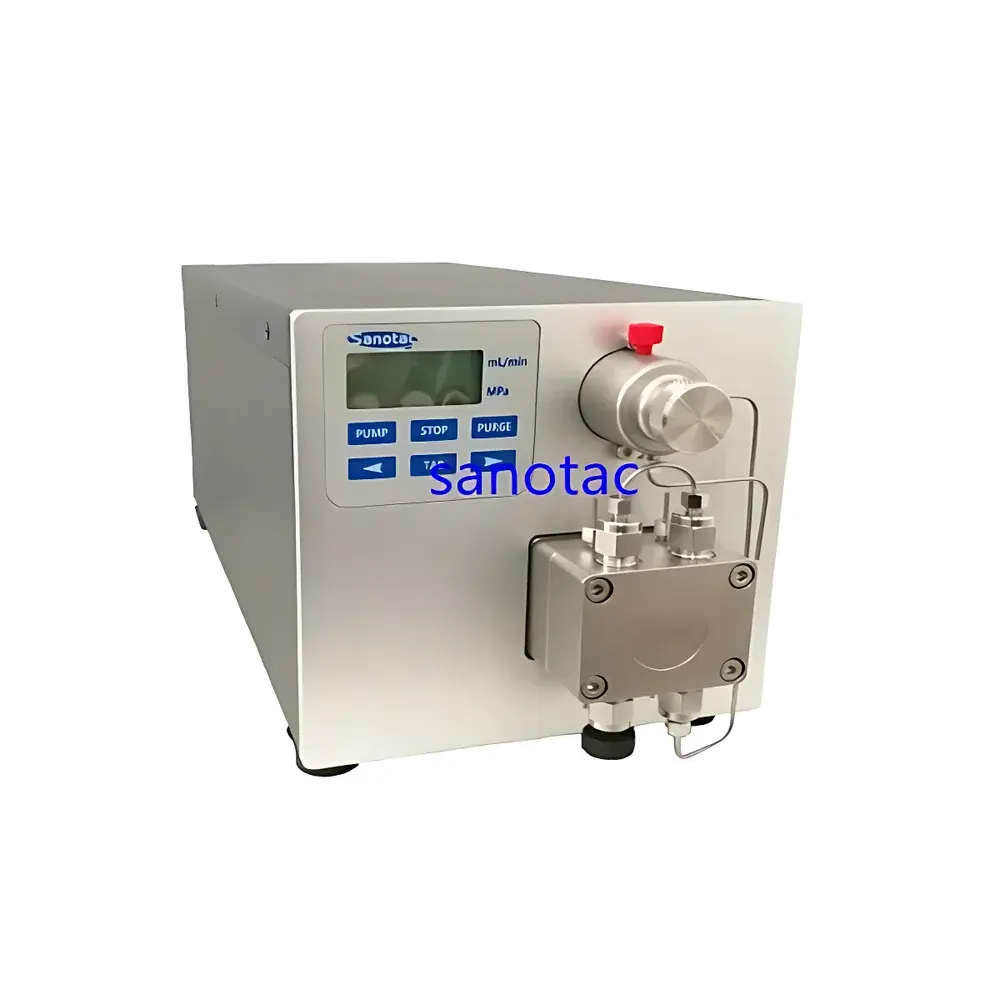
Sanotac DJ1020 High-Pressure Dual-Piston Precision Metering Pump for Lithium-Ion Battery Electrolyte Filling
| Brand | Sanotac |
|---|---|
| Model | DJ1020 |
| Flow Range | 0.01–100.00 mL/min |
| Flow Accuracy | ±0.5% |
| Flow Precision (RSD) | ≤0.1% |
| Max Pressure | 20 MPa |
| Pressure Pulsation | ≤0.2 MPa |
| Drive Mode | Dual Parallel Pistons with Floating Piston Design |
| Flow Compensation | Solvent Compressibility Compensation, Multi-Point Flow Curve Calibration, Cam Profile Compensation, Electronic Flow Pulse Suppression |
| Wetted Materials | 316L Stainless Steel, Sapphire, PTFE, Ceramic |
| Connection | 1/16" Standard Tubing Ports |
| Display | 256×64 Dot Matrix Backlit LCD |
| Control Interface | Front Panel Keypad + Open-Protocol RS232/USB Computer Remote Control |
| Power Supply | 85–264 VAC, 50 Hz |
| Dimensions | 370 × 240 × 152 mm |
Overview
The Sanotac DJ1020 is a high-precision, dual-piston high-pressure metering pump engineered specifically for controlled electrolyte filling in lithium-ion battery R&D and pilot-scale cell assembly. It operates on positive displacement principle using parallel dual-piston architecture with floating piston mechanics—ensuring minimal seal wear and long-term volumetric stability under sustained high backpressure. Unlike conventional peristaltic or single-piston systems, the DJ1020 employs real-time solvent compressibility compensation algorithms to correct for fluid density changes across pressure gradients (up to 20 MPa), enabling accurate delivery of low-viscosity, volatile, and chemically aggressive electrolytes such as LiPF6 in carbonate solvents (EC/DMC/EMC). Its design conforms to fundamental requirements of battery electrolyte handling: inert wetted path materials (316L stainless steel, sapphire check valves, ceramic plungers, PTFE seals), pulse-minimized flow (<0.2 MPa pressure ripple), and traceable calibration traceability via multi-point flow curve mapping.
Key Features
- Dual parallel piston configuration with dynamically balanced floating piston mechanism—reduces radial load on seals and extends service life beyond 10,000 operational hours under continuous 15 MPa load.
- Microprocessor-controlled flow regulation with integrated solvent compressibility compensation—enables consistent volumetric accuracy across pressure ranges from ambient to 20 MPa without manual recalibration.
- Multi-point flow curve calibration (12-point non-linear mapping) ensures linearity and repeatability (RSD ≤0.1%) over full dynamic range (0.01–100.00 mL/min, 0.01 mL/min increments).
- Cam profile optimization and active electronic pulse suppression reduce hydraulic pulsation to ≤0.2 MPa—critical for preventing bubble nucleation and ensuring uniform electrolyte wetting in porous electrode stacks.
- Open-protocol RS232/USB interface compliant with standard SCPI command sets—supports integration into automated battery cell filling workstations and third-party chromatography data systems (CDS) without proprietary drivers.
- Front-panel programmable memory for up to 10 user-defined methods—including flow rate ramps, step gradients, hold segments, and pressure-triggered pause/resume logic.
Sample Compatibility & Compliance
The DJ1020 accommodates aggressive battery electrolyte formulations including LiPF6, LiTFSI, and LiFSI dissolved in ethylene carbonate (EC), dimethyl carbonate (DMC), diethyl carbonate (DEC), and fluorinated ethers. All fluid-contact surfaces meet ASTM F2136-22 standards for elastomer compatibility with lithium salt solutions. The pump’s 316L stainless steel body, sapphire inlet/outlet check valves, and ceramic-coated plunger rods provide resistance to hydrolysis, HF generation, and oxidative degradation. It supports GLP-compliant operation through audit-trail-enabled method logging and timestamped parameter change records when used with validated CDS software. While not intrinsically rated for Class I Div 1 hazardous locations, explosion-proof variants (DJ-Ex series) are available per ATEX Directive 2014/34/EU and IECEx certification upon request.
Software & Data Management
The DJ1020 features an open communication protocol documented in IEEE 488.2 SCPI format, allowing seamless integration with LabVIEW, Python (PyVISA), MATLAB, or commercial battery manufacturing MES platforms. Firmware supports firmware-upgradable calibration tables and stores full operational logs—including cumulative runtime, total delivered volume, pressure history snapshots, and fault event timestamps. When paired with Sanotac’s optional PumpControl Studio v3.x, users gain access to real-time flow/pressure overlay graphs, ISO 5725-2 traceable calibration reporting, and CSV-exportable audit trails compliant with FDA 21 CFR Part 11 requirements (electronic signatures, operator authentication, and immutable log archiving).
Applications
- Precise electrolyte dosing in pouch, cylindrical, and prismatic Li-ion cell assembly lines (R&D and NMP-scale).
- Controlled infusion of electrolyte into solid-state battery prototypes during hot-press or vacuum-assisted infiltration.
- High-pressure solvent delivery in electrochemical impedance spectroscopy (EIS) flow cells requiring stable laminar flow at 10–20 MPa.
- Calibration reference pump for gravimetric flow verification systems per ISO 4064-2:2014.
- Gradient elution support in preparative HPLC systems for cathode material purification (e.g., Ni-rich NMC separation).
FAQ
What electrolyte chemistries is the DJ1020 validated for?
It is routinely qualified for carbonate-based (EC/DMC/EMC), ether-based (DOL/DME), and sulfone-based electrolytes containing LiPF6, LiTFSI, or LiFSI salts—provided operating temperature remains below 60°C and water content stays <20 ppm.
Can the DJ1020 be integrated into a fully automated battery filling station?
Yes—its open SCPI protocol, TTL-compatible start/stop triggers, and analog pressure feedback output enable deterministic synchronization with robotic dispensing arms, vision-guided alignment systems, and PLC-based process controllers.
Is flow calibration traceable to national metrology institutes?
Sanotac provides NIST-traceable calibration certificates (ISO/IEC 17025 accredited lab) for flow rate and pressure transducers; field recalibration kits with certified gravimetric standards are available for routine verification.
How does the floating piston design improve longevity compared to fixed-plunger pumps?
By eliminating side-loading forces on the plunger seal, the floating design reduces frictional heat and asymmetric wear—extending seal service interval by 3–5× under identical pressure and duty-cycle conditions.
Does the pump support gradient programming for multi-solvent electrolyte formulation?
While the DJ1020 itself is a single-solvent pump, it can be synchronized with up to three additional DJ-series units via master-slave timing signals to execute programmable binary or ternary solvent blending protocols with sub-second coordination accuracy.



