
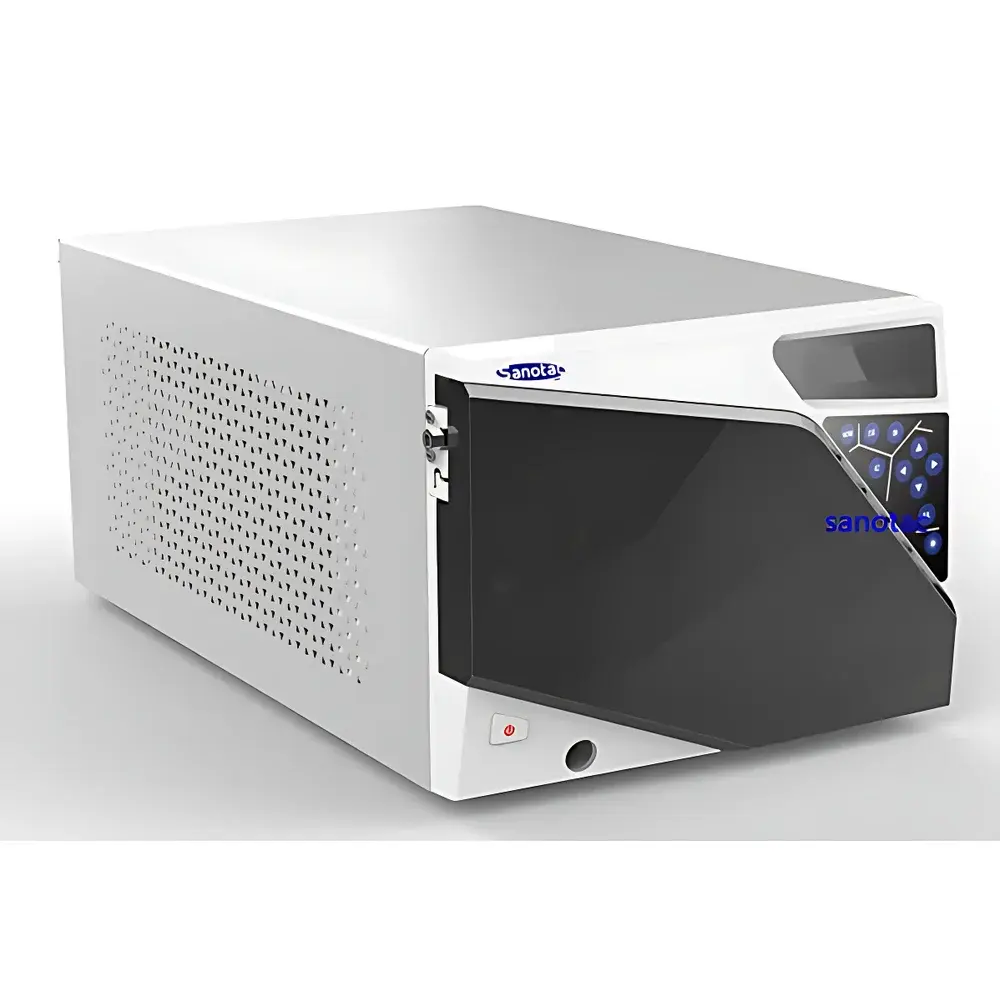
Sanotac Omnitor ELSD-3300 Evaporative Light Scattering Detector
| Brand | Sanotac |
|---|---|
| Origin | Shanghai, China |
| Manufacturer Type | Manufacturer |
| Product Category | Domestic |
| Model | ELSD-3300 |
| Instrument Type | Evaporative Light Scattering Detector (ELSD) |
| Wavelength | 650 nm |
| Detection Mode | Low-Temperature Evaporation |
| Light Source | Semiconductor Laser Diode |
Overview
The Sanotac Omnitor ELSD-3300 is a high-performance evaporative light scattering detector engineered for universal, non-destructive detection of non-volatile and semi-volatile analytes in liquid chromatography applications. Unlike UV-Vis or refractive index detectors, the ELSD-3300 operates on the principle of nebulization, controlled evaporation, and light scattering measurement—making it inherently insensitive to chromophore presence, molecular absorption characteristics, or optical activity. In this process, the column effluent is atomized into fine droplets, the mobile phase is removed under precisely regulated low-temperature evaporation conditions (up to 130 °C), and residual non-volatile analyte particles are illuminated by a stable 650 nm semiconductor laser. The scattered light intensity—proportional to analyte mass—is captured by a high-sensitivity photomultiplier tube (PMT) and converted into a quantitative signal. This physical detection mechanism enables robust, reproducible quantification of compounds lacking UV absorbance—including carbohydrates, lipids, surfactants, polymers, glycosides, and natural product fractions—particularly relevant in herbal medicine QC, pharmaceutical excipient analysis, and synthetic polymer characterization.
Key Features
- Low-temperature evaporation architecture: Optimized for thermally labile compounds; evaporation temperature adjustable from ambient to 130 °C (1 °C increments), with independent雾化 (nebulizer) temperature control (ambient to 56 °C)
- Stable optical system: 650 nm semiconductor laser source with integrated thermal stabilization ensures long-term beam alignment and signal consistency
- High-sensitivity detection: Baseline noise ≤ 0.03 mV; baseline drift ≤ 0.3 mV/30 min; minimum detectable mass 10⁴ (at fixed gain)
- Intelligent instrument self-diagnosis: 16-point automated daily system check including gas pressure validation, heater status, laser activation, and flow integrity monitoring
- Gas delivery precision: Digital mass flow control (1–4 L/min); accuracy ≤ ±1% or ±0.02 L/min; pressure sensing resolution 0.01 bar (2–5 bar input range)
- Modular integration readiness: RS-232, USB, and TCP/IP (HTTP/LAN) communication interfaces support seamless synchronization with major HPLC platforms and third-party acquisition systems
- Energy-efficient operation: Standby mode reduces power consumption; rapid auxiliary cooling system minimizes thermal recovery time between runs
Sample Compatibility & Compliance
The ELSD-3300 is compatible with reversed-phase, normal-phase, HILIC, and SEC mobile phases containing volatile solvents (e.g., acetonitrile, methanol, THF, chloroform, ethyl acetate) and compatible buffers (e.g., ammonium acetate, ammonium formate, volatile amines). It excludes non-volatile salts (e.g., phosphate, sulfate), ion-pair reagents, and high-boiling solvents (e.g., DMSO, glycerol). Its detection universality supports compliance-driven workflows: data acquisition and method storage align with ALCOA+ principles; audit trail functionality (via Clarity™ software integration) satisfies FDA 21 CFR Part 11 requirements for electronic records and signatures when deployed in GLP/GMP environments. The detector meets IEC 61010-1 safety standards for laboratory electrical equipment and complies with CE electromagnetic compatibility directives.
Software & Data Management
The ELSD-3300 is supported by Sanotac’s native multi-platform control software and fully interoperable with Clarity™ Chromatography Data System (CDS) via dynamic-link library (DLL) integration—enabling real-time parameter synchronization, event-triggered acquisition, and post-run calibration curve generation. Up to 10 user-defined methods (25 parameters each) can be stored onboard and recalled automatically. All acquisition parameters—including gain (0.3–30), output offset (–1000 to +1000 mV), sampling rate (100 Hz or 20 Hz), and external event programming (laser on/off, gas valve actuation, heater enable/disable)—are accessible through a structured 10-key interface and 16×2 backlit LCD display. Digital output supports analog voltage (–1200 to +1200 mV) and programmable zero-reset functionality for baseline correction across extended sequences.
Applications
- Quantitative analysis of UV-transparent natural products: saponins, flavonoid glycosides, polysaccharides, and terpene lactones in traditional Chinese medicine extracts
- Characterization of synthetic and biodegradable polymers: polyesters, polyethers, and PEG-based conjugates via SEC-ELSD
- Fatty acid and triglyceride profiling in food and nutraceutical matrices without derivatization
- Residual solvent and excipient quantification in pharmaceutical formulations (e.g., polysorbates, cyclodextrins, lecithin)
- Method development for preparative HPLC fraction collection where UV-inactive compounds require real-time detection
- Stability-indicating assays for degradation products lacking chromophores
FAQ
What types of mobile phases are compatible with the ELSD-3300?
Volatile organic solvents (e.g., acetonitrile, methanol, ethanol, THF, chloroform) and volatile buffer systems (e.g., ammonium acetate/formate, triethylamine) are fully supported. Non-volatile salts, phosphates, sulfates, and high-boiling solvents must be avoided.
Can the ELSD-3300 be used with UHPLC systems?
Yes—the detector accepts flow rates from 0.01 to 3 mL/min and features low internal volume nebulization optics, making it suitable for both conventional HPLC and UHPLC applications when paired with appropriate restrictor tubing.
How does the ELSD-3300 ensure long-term signal stability?
Through active temperature regulation (±1 °C accuracy), laser thermal stabilization, continuous gas pressure monitoring, and automated baseline recalibration triggered by programmable events or scheduled intervals.
Is the ELSD-3300 compliant with regulatory data integrity requirements?
When operated with validated Clarity™ CDS and configured with audit trail, electronic signature, and role-based access controls, the system supports 21 CFR Part 11, EU Annex 11, and ISO/IEC 17025 documentation requirements.
What maintenance routines are recommended?
Daily: Nebulizer capillary inspection and cleaning; weekly: optical window wipe with lint-free cloth and isopropanol; quarterly: PMT gain verification and gas filter replacement. Full service intervals are defined per usage hours and logged automatically in system diagnostics.




