
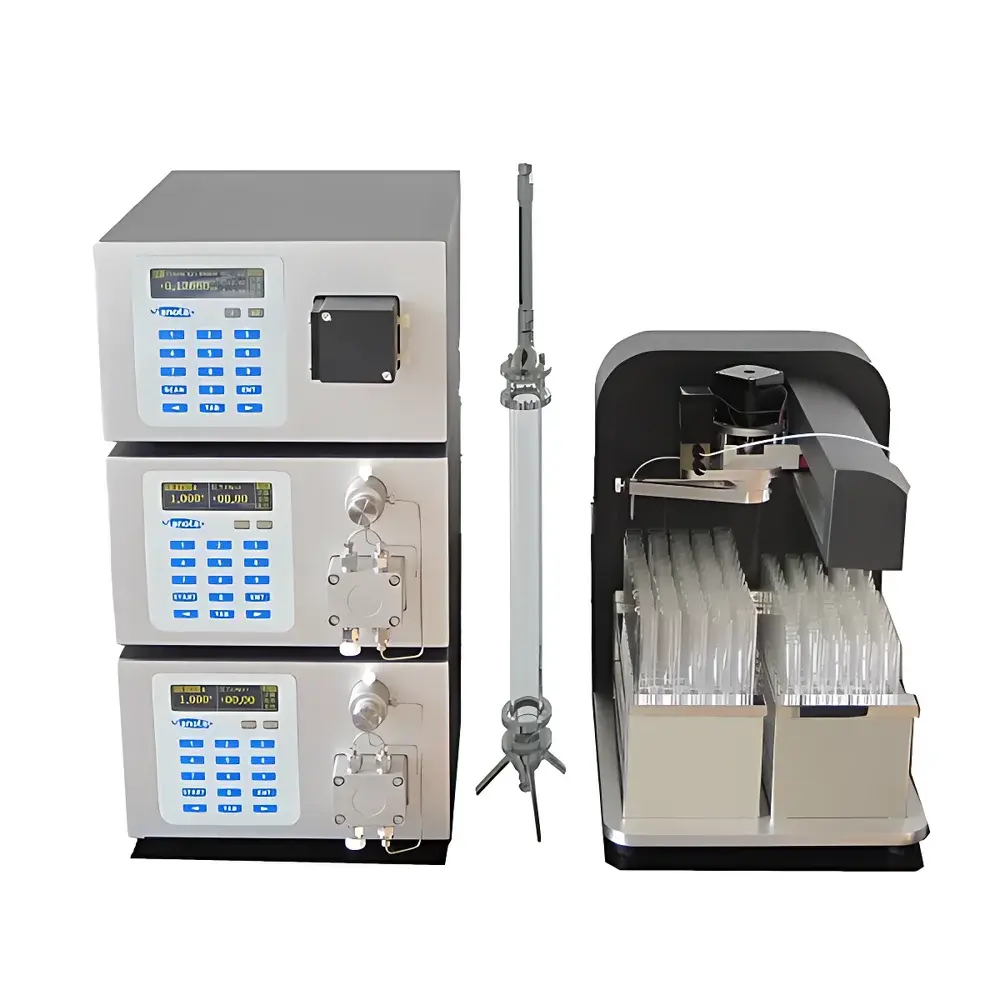
Sanotac Purifier 200 Medium-Pressure Preparative Liquid Chromatography System
| Brand | Sanotac |
|---|---|
| Origin | Shanghai, China |
| Manufacturer Type | Direct Manufacturer |
| Regional Classification | Domestic (China) |
| Model | Purifier 200 |
| Application Level | Laboratory-Scale |
| Instrument Type | Medium-to-Low Pressure Preparative HPLC |
| Flow Rate Range | 0.01–200.00 mL/min |
| Flow Accuracy | ±1% |
| Flow Precision (RSD) | ≤0.5% |
| Maximum Operating Pressure | 20 MPa |
| Wavelength Range | 190–700 nm (D₂ lamp) |
| Wavelength Accuracy | ±1 nm |
| Wavelength Repeatability | ±0.2 nm |
| Baseline Noise | ±0.75×10⁻⁵ AU at 254 nm, TC = 1 s |
| Data Acquisition Rate | 10 Hz |
Overview
The Sanotac Purifier 200 is a medium-pressure preparative liquid chromatography (PLC) system engineered for high-fidelity isolation and purification of organic synthetic compounds, pharmaceutical intermediates, natural product isolates, antibiotics, and biologically active molecules. Designed around core principles of isocratic and gradient elution chromatography, the system employs dual high-precision reciprocating piston pumps operating in parallel architecture to deliver stable solvent delivery across a wide dynamic flow range (0.01–200.00 mL/min). Its hydraulic design incorporates real-time chamber pressure feedback, cam-profile flow pulsation compensation, and floating plunger seal mechanics—collectively ensuring minimal baseline disturbance, exceptional flow reproducibility (RSD ≤ 0.5%), and extended seal service life under sustained 20 MPa operation. The system adheres to fundamental chromatographic performance criteria defined in ISO 13877 and ASTM D7469 for preparative-scale instrumentation, supporting method development, process optimization, and analytical-to-preparative method translation in compliance with GLP and early-stage GMP environments.
Key Features
- Microprocessor-controlled dual-pump architecture with dynamic pressure compensation for consistent flow delivery across full operational range.
- Cam-driven pulsation suppression mechanism achieving baseline noise as low as ±0.75×10⁻⁵ AU (254 nm, 1 s time constant), critical for trace-level impurity detection.
- Multi-point flow calibration curves enabling certified accuracy (±1%) and precision (RSD ≤ 0.5%) from microflow to high-flow regimes.
- Floating plunger design minimizing mechanical wear on high-pressure PEEK or stainless-steel pump seals, extending maintenance intervals.
- Programmable gradient and flow profiles—10 user-defined methods stored onboard, supporting complex multi-step purification sequences.
- Dual-wavelength UV detection with time-programmable wavelength switching, stop-flow spectral scanning, and real-time baseline correction algorithms.
- Modular flow cell configuration: interchangeable semi-preparative cells (1–5 mm pathlength, adjustable) optimized for 10–30 mm I.D. columns.
Sample Compatibility & Compliance
The Purifier 200 accommodates standard stainless-steel and PEEK-packed columns with internal diameters ranging from 10 mm to 30 mm, supporting reversed-phase (C18, C8), normal-phase (silica, amino), and ion-exchange media. It is routinely deployed in isolation workflows for synthetic APIs, chiral intermediates, plant-derived alkaloids, flavonoids, and peptide fragments. System hardware and firmware comply with essential requirements of IEC 61010-1 (safety) and electromagnetic compatibility per EN 61326-1. While not validated for full 21 CFR Part 11 compliance out-of-the-box, its software architecture supports audit-trail-enabling configurations—including electronic signatures, user access levels, and immutable method/data logging—when deployed in regulated QC laboratories following internal SOPs aligned with USP and ISO/IEC 17025 documentation practices.
Software & Data Management
The native ChromaLink™ workstation provides intuitive method building, real-time chromatogram visualization, peak integration (with tangent skim, valley-to-valley, and Gaussian deconvolution options), and fraction collection triggering based on UV threshold, time window, or peak apex. All acquisition parameters—including flow rate, gradient slope, wavelength program, and detector gain—are fully scriptable and exportable in ASCII or .csv format. Raw data files adhere to ANDI/NetCDF standards, enabling interoperability with third-party chemometric tools (e.g., MATLAB, SIMCA, OpenChrom). Audit trails record operator ID, timestamp, parameter changes, and manual interventions—configurable to meet GLP documentation integrity requirements.
Applications
- Purification of reaction mixtures post-Suzuki coupling, reductive amination, or ester hydrolysis—enabling rapid removal of catalysts, ligands, and unreacted starting materials.
- Isolation of minor alkaloid constituents from crude botanical extracts (e.g., Camptotheca acuminata, Paullinia cupana) with sub-milligram recovery fidelity.
- Desalting and buffer exchange of synthetic peptides prior to lyophilization or biological assay.
- Chiral separation of racemic drug candidates using immobilized polysaccharide-based CSPs (e.g., Chiralpak AD-H, IC) at 10–50 mL/min flow rates.
- Scalable method transfer from analytical UHPLC (e.g., 2.1 mm I.D.) to semi-preparative scale (10–20 mm I.D.) using retention time normalization and linear velocity equivalence.
FAQ
What column dimensions are supported?
Standard column inner diameters from 10 mm to 30 mm; compatible with both stainless-steel and PEEK-bodied columns rated for ≤20 MPa.
Can the system perform pH-stable separations?
Yes—when equipped with PEEK fluidic paths and pH-compatible stationary phases (e.g., polymer-based or hybrid silica), it supports mobile phases from pH 1.5 to 12.0.
Is method validation support included?
The system provides raw data integrity, parameter traceability, and integration consistency required for Stage 1–2 method validation per ICH Q2(R2); full validation documentation templates are available upon request.
How is fraction collection triggered?
Via UV threshold crossing, time-based windows, or peak apex detection—output signals interface with third-party fraction collectors (e.g., Gilson FC204, Teledyne ISCO Foxy R1) through TTL or analog voltage outputs.
What maintenance intervals are recommended?
Pump seal inspection every 6 months under continuous operation; UV lamp replacement every 2,000 hours; flow cell cleaning after every 50 injections with viscous or particulate-laden samples.
Related Products




