
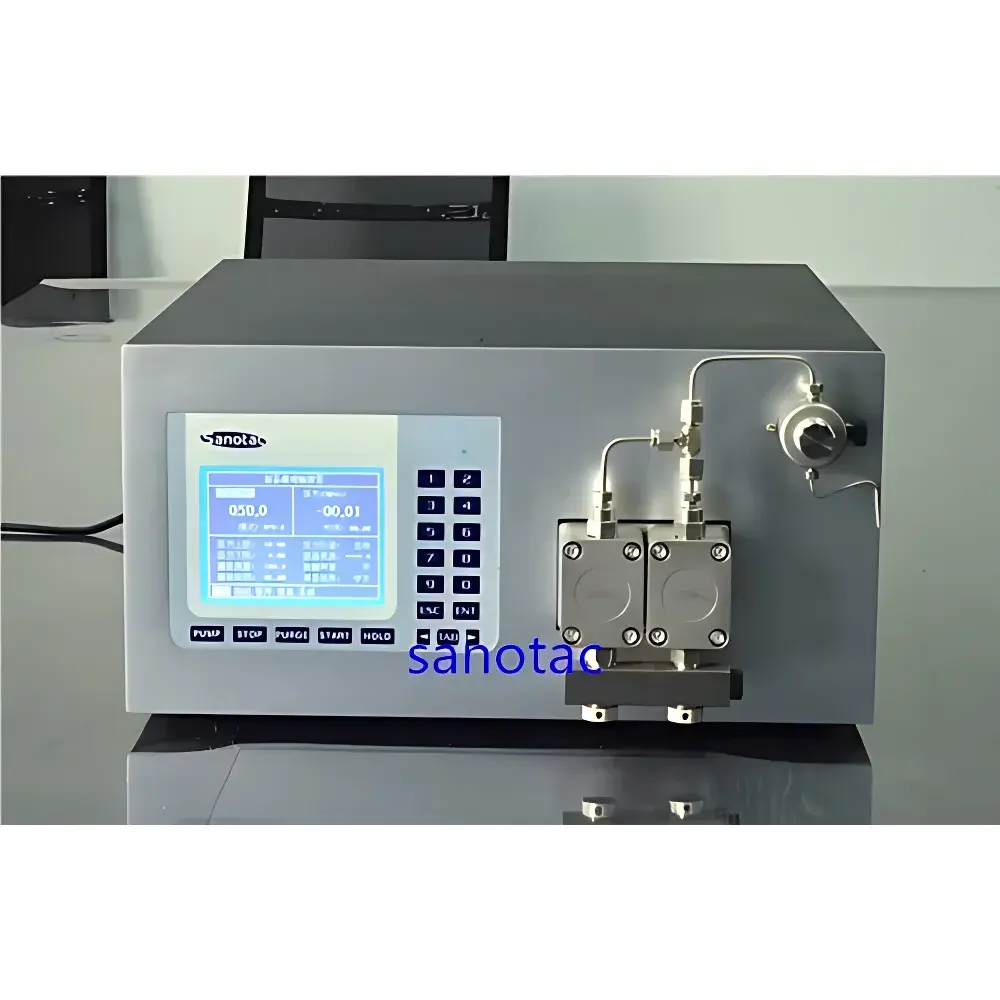
Sanotac SJ1020 High-Pressure Precision Metering Pump
| Brand | Sanotac |
|---|---|
| Origin | Shanghai, China |
| Manufacturer Type | Direct Manufacturer |
| Product Category | Domestic |
| Model | SJ1020 |
| Flow Rate | 0.01–100.00 mL/min |
| Pressure Rating | ≤ 20 MPa |
| Flow Accuracy | ±0.5% |
| Flow Precision (RSD) | ≤ 0.1% |
| Pressure Pulsation | ≤ 0.2 MPa |
| Drive Mechanism | Dual Parallel Piston with Floating Piston Design |
| Wetted Materials | 316L Stainless Steel, Sapphire, PTFE, Ceramic |
| Connection | 1/16″ Standard Tubing Fittings |
| Display | 256×64 Dot Matrix Backlit LCD |
| Communication Interfaces | RS232, USB (standard) |
| Protocols | Sanotac Proprietary Protocol, Modbus RTU |
| Power Supply | 85–264 VAC, 50 Hz |
| Dimensions | 370 × 240 × 152 mm |
Overview
The Sanotac SJ1020 High-Pressure Precision Metering Pump is an engineered constant-flow liquid delivery system designed for demanding laboratory and pilot-scale process applications requiring stable, repeatable, and traceable fluid dosing under elevated pressure conditions. Based on dual parallel piston architecture with floating piston compensation, the pump delivers volumetric flow control via positive displacement—eliminating reliance on external flow meters or pressure transducers. Its integrated pressure and flow monitoring circuitry enables real-time feedback without signal drift or calibration dependency. The SJ1020 operates within a defined pressure envelope of up to 20 MPa and supports flow rates from 0.01 to 100.00 mL/min with programmable resolution down to 0.01 mL/min. This makes it suitable for continuous infusion in high-pressure reaction systems, microreactor feed control, catalyst screening platforms, and automated synthesis workflows where consistent stoichiometric delivery is critical.
Key Features
- Dual parallel piston drive with floating piston design ensures mechanical symmetry and minimizes dead volume while compensating for wear-induced clearance changes over time.
- Onboard flow and pressure sensing—no external instrumentation required—enables self-contained operation and reduces system integration complexity.
- High-accuracy volumetric delivery: flow accuracy ±0.5% and repeatability ≤0.1% RSD across the full operating range, validated per ISO 5725-2 guidelines for precision measurement.
- Low-pressure pulsation performance (≤0.2 MPa) achieved through cam-profile compensation and active electronic pulse suppression algorithms, ensuring laminar inlet conditions for sensitive downstream equipment.
- Chemically inert wetted path composed of 316L stainless steel, sapphire check valves, PTFE seals, and ceramic plungers—compatible with aggressive solvents, acids, bases, and suspensions.
- Backlit 256×64 dot-matrix LCD provides local visualization of setpoints, actual flow/pressure values, error codes, and operational status without requiring host software.
Sample Compatibility & Compliance
The SJ1020 accommodates a broad spectrum of liquid-phase samples—including aqueous buffers, organic solvents (e.g., THF, DMF, acetonitrile), viscous reagents (up to 500 cP at 25°C), and low-concentration particulate slurries—without compromising metering fidelity. Its materials of construction conform to USP Class VI biocompatibility standards for pharmaceutical contact surfaces. While not certified for explosion-proof environments out-of-the-box, the unit complies with IEC 61000-6-3 (EMC emissions) and IEC 61000-6-2 (immunity) for industrial laboratory deployment. For regulated environments, audit trail generation, user access control, and electronic signature support are available when integrated with compliant SCADA or LIMS platforms adhering to FDA 21 CFR Part 11 requirements.
Software & Data Management
The SJ1020 supports native communication via RS232 and USB as standard interfaces, with optional RS485/RS422 modules for multi-drop industrial networks. It implements both Sanotac’s proprietary ASCII-based command protocol and industry-standard Modbus RTU, enabling seamless integration into PLC-controlled reactor trains, DCS architectures, and LabVIEW-based automation frameworks. Configuration, parameter tuning, and runtime monitoring can be performed locally or remotely using Sanotac’s PumpControl Suite—a Windows-based application offering waveform logging, multi-pump synchronization, and CSV export of timestamped flow/pressure datasets. All firmware updates follow secure signed binary verification to maintain integrity in GxP-aligned workflows.
Applications
- Continuous-flow chemistry: precise co-feeding of reagents into microstructured reactors or tubular catalytic beds.
- Pharmaceutical process development: controlled addition of APIs or excipients during crystallization, hydrogenation, or photoredox reactions.
- Materials science: metered delivery of precursor solutions in sol-gel synthesis or CVD precursor injection systems.
- Food & beverage R&D: dosage of flavorings, preservatives, or functional ingredients under hygienic pressurized conditions.
- Environmental testing: calibrated spiking of contaminants into simulated wastewater streams for toxicity assay validation.
- Calibration laboratories: use as a primary reference pump for validating secondary flow measurement devices per ISO/IEC 17025 procedures.
FAQ
What is the maximum allowable viscosity for reliable operation?
The SJ1020 maintains specified accuracy and pulse suppression performance for liquids with dynamic viscosities up to 500 mPa·s at 25°C. Higher viscosities may require reduced maximum flow rate and temperature stabilization to prevent cavitation or seal extrusion.
Can the pump be operated in weight-based mode?
No—the SJ1020 is a volumetric displacement pump. Weight-based dosing requires integration with an external balance and closed-loop feedback via analog input (0–10 V or 4–20 mA), supported through optional I/O expansion modules.
Is firmware upgrade capability available over network interfaces?
Firmware updates must be performed via USB or RS232 using Sanotac PumpControl Suite; remote update over Ethernet or WLAN is not supported for security and validation reasons.
Does the pump support gradient elution protocols?
Yes—multi-step flow/pressure profiles can be pre-programmed and executed autonomously using internal sequencing logic, compatible with binary or ternary solvent mixing configurations when paired with appropriate valve manifolds.
What maintenance intervals are recommended for extended service life?
Plunger seals and check valves should be inspected every 500 hours of cumulative operation or after processing 2,000 L of fluid—whichever occurs first—with replacement guided by observed flow deviation or pressure loss exceeding specification limits.



