
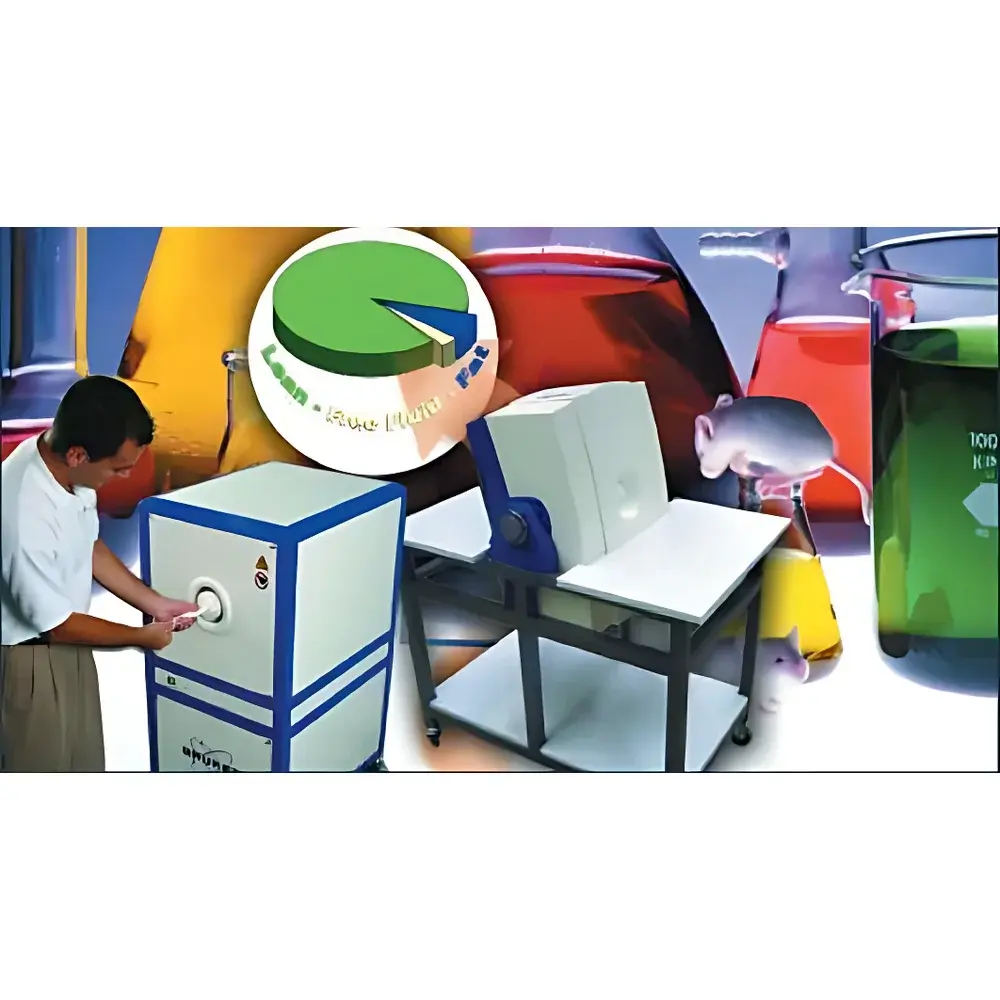
Bruker Minispec TD-NMR Body Composition Analyzer for Live Mice and Rats
| Brand | Bruker |
|---|---|
| Origin | Germany |
| Manufacturer Type | Authorized Distributor |
| Origin Category | Imported |
| Model | Minispec TD-NMR (LF50/LF90) |
| NMR Frequency | 7.5 MHz (LF50) / 6.2 MHz (LF90) |
| Magnet Type | Permanent Magnet (0.17 T / 0.14 T) |
| Sample Capacity | Up to 60 g (LF50) / Up to 850 g (LF90) |
| Power Supply | 110–220 V AC |
| Power Consumption | 330 W (LF50) / 4500 W (LF90) |
| Operating Temperature | Controlled Magnet Environment |
| Form Factor | Benchtop (LF50) or Mobile Cart-Based (LF90) |
| Dimensions (L×W×H) | 65×75×30 cm (LF50, benchtop) / 95×55×115 cm (LF90, mobile) |
| Weight | 150 kg (LF50) / 350 kg (LF90) |
| PC Requirements | Pentium IV or higher, Windows XP Professional |
| Compliance | ISO 9001 certified |
Overview
The Bruker Minispec TD-NMR Body Composition Analyzer is a dedicated time-domain nuclear magnetic resonance (TD-NMR) instrument engineered for non-invasive, quantitative assessment of total body composition in live rodents—specifically mice and rats. Unlike destructive or radiation-based methods, this system exploits the intrinsic differences in transverse relaxation times (T2) between proton populations in adipose tissue, lean muscle mass, and free fluid compartments. By applying standardized pulse sequences (e.g., CPMG), the analyzer acquires decay signals from all hydrogen nuclei in the sample volume and deconvolutes them into three physiologically distinct components: fat mass, lean tissue mass, and free water content. This principle enables absolute quantification without calibration curves or reference standards, delivering high reproducibility across longitudinal studies. The system operates at fixed Larmor frequencies—7.5 MHz for the LF50 variant (optimized for small rodents ≤60 g) and 6.2 MHz for the LF90 (designed for larger subjects up to 850 g). Its permanent magnet architecture eliminates cryogen dependency, ensuring stable field homogeneity and zero routine maintenance.
Key Features
- Non-invasive, anesthesia-free measurement: Animals remain conscious and unrestrained during acquisition; no surgical preparation or contrast agents required.
- Rapid analysis cycle: Full-body composition quantification completed within ≤120 seconds per subject, enabling high-throughput screening in preclinical cohorts.
- Longitudinal study compatibility: Enables repeated measurements on the same animal over weeks or months without physiological interference or cumulative risk.
- Robust hardware design: Temperature-stabilized permanent magnet with active shimming ensures signal stability across ambient fluctuations; dual-voltage compatibility (110/220 V AC) supports global deployment.
- Two platform configurations: Benchtop LF50 for high-density mouse phenotyping; mobile-cart LF90 for flexible use across vivarium zones and larger rodent models including rats and juvenile guinea pigs.
- Regulatory-ready architecture: Compliant with ISO 9001 quality management standards; software architecture supports audit trails and user access control—foundational for GLP-compliant pharmacokinetic and metabolic studies.
Sample Compatibility & Compliance
The Minispec TD-NMR accommodates live, conscious rodents placed in standard acrylic restraint tubes compatible with IACUC-approved handling protocols. LF50 accepts animals up to 60 g (typical adult C57BL/6 mice); LF90 supports subjects up to 850 g (e.g., Sprague-Dawley rats, obese db/db models, or aged cohorts). No ionizing radiation is involved—eliminating regulatory constraints associated with DEXA or micro-CT. The system complies with electromagnetic compatibility (EMC) directives (IEC 61326-1) and meets electrical safety requirements (IEC 61010-1). While not FDA-cleared as a medical device, its methodology aligns with ASTM E2828–12 (“Standard Guide for Quantitative Analysis of Fat and Lean Mass in Rodents Using TD-NMR”) and supports data traceability under 21 CFR Part 11 when integrated with validated laboratory information management systems (LIMS).
Software & Data Management
Acquisition and analysis are executed via Bruker’s proprietary Minispec Analysis Suite, running on Windows XP Professional (or later via virtualization layer). The software implements automated peak integration, T2 distribution modeling, and multi-component fitting algorithms based on established biophysical models of tissue relaxation. Raw FID and echo train data are stored in vendor-neutral formats (e.g., ASCII, CSV), facilitating third-party statistical analysis in MATLAB, R, or Python. Audit logs record operator ID, timestamp, sequence parameters, and calibration status—critical for protocol adherence in contract research organizations (CROs) and pharmaceutical development labs. Optional modules enable batch processing, trend visualization, and export to ELN (electronic lab notebook) platforms compliant with ALCOA+ principles.
Applications
- Preclinical obesity and diabetes research: Monitoring dynamic shifts in fat/lean ratio during dietary intervention, genetic manipulation, or drug treatment.
- Metabolic phenotyping: Correlating body composition changes with glucose tolerance, insulin sensitivity, and energy expenditure metrics.
- Oncology support: Assessing cachexia progression or treatment-induced lean mass preservation in tumor-bearing models.
- Toxicology and safety pharmacology: Detecting early organ-specific edema or sarcopenia following chronic compound exposure.
- Nutritional science: Validating efficacy of functional food ingredients or probiotic interventions on adiposity and hydration balance.
- Gerontology: Tracking age-related sarcopenia and ectopic fat deposition in longitudinal aging cohorts.
FAQ
Is anesthesia required for measurement?
No. The system is designed for conscious, unrestrained animals placed in ventilated restraint tubes. Stress levels are significantly lower than those induced by anesthesia or physical restraint for imaging modalities.
How does TD-NMR compare to DEXA for rodent body composition?
TD-NMR provides superior precision for soft-tissue differentiation—particularly between intramuscular fat and lean mass—due to inherent contrast in proton mobility. DEXA lacks specificity for fluid compartmentalization and suffers from beam-hardening artifacts in heterogeneous tissues.
Can the system be used for other species?
While optimized for mice and rats, the LF90 configuration has been validated for use with rabbits, ferrets, and young pigs (≤5 kg) when appropriate tube adapters and sequence parameter adjustments are applied.
What maintenance is required for the permanent magnet?
None. The magnet is passively temperature-stabilized and requires no cryogens, power supply, or realignment. Annual field homogeneity verification using Bruker’s QA phantom is recommended.
Is method validation documentation available?
Yes. Bruker provides IQ/OQ documentation packages, SOP templates, and technical notes supporting validation per ICH M10 and OECD TG 407 guidelines.




