
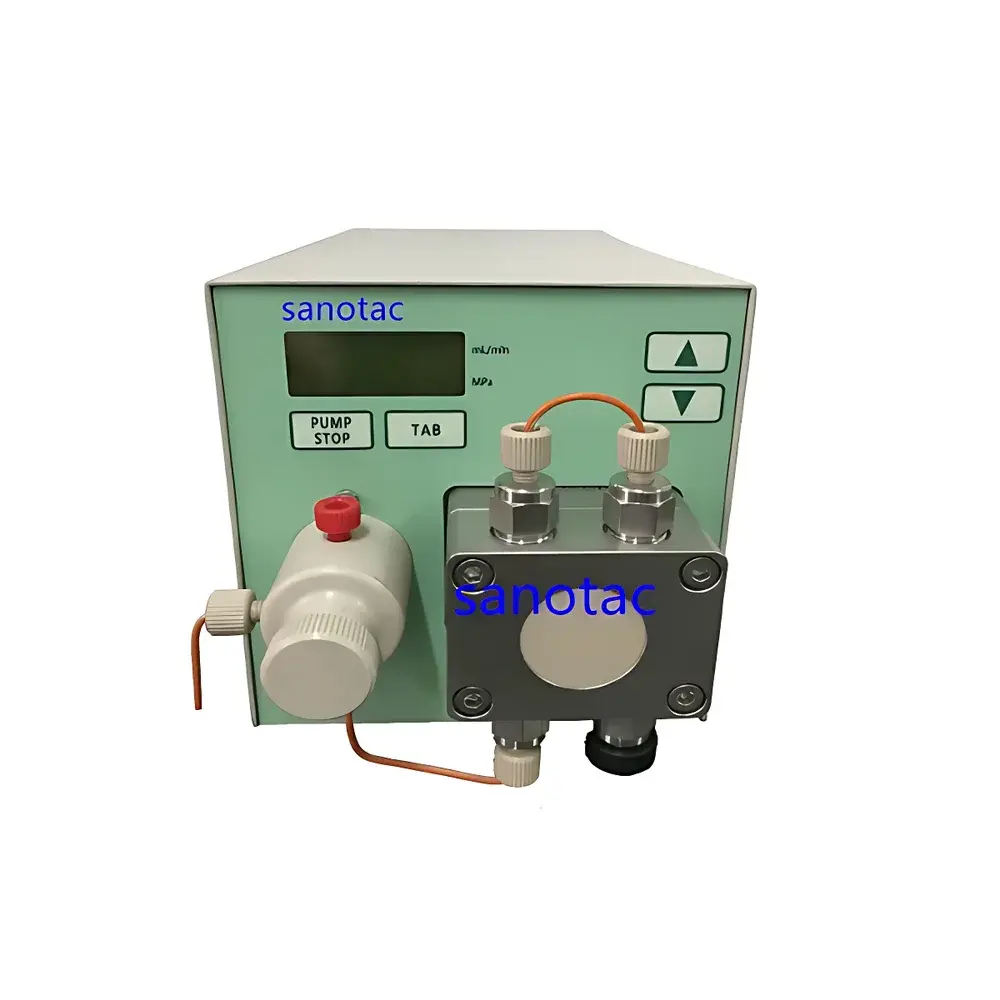
Sanotac QP0013 Micro PEEK High-Pressure Syringe Pump
| Brand | Sanotac |
|---|---|
| Origin | Shanghai, China |
| Manufacturer Type | Direct Manufacturer |
| Model | QP0013 |
| Flow Range | 0.001–9.999 mL/min |
| Flow Increment | 0.001 mL/min |
| Flow Accuracy | ±0.1% |
| Flow Precision (RSD) | ≤0.1% |
| Max Pressure | 30 MPa |
| Pressure Pulsation | ≤0.1 MPa |
| Pump Head Volume | 10 mL |
| Wetted Materials | PEEK, Sapphire, PTFE, Ceramic |
| Tubing Connection | 1/16" Standard |
| Display | 256×64 Dot Matrix Backlit LCD |
| Control Interface | Front Panel Keypad + RS232/USB Open Communication Protocol |
| Power Supply | 85–264 VAC, 50 Hz |
| Dimensions | 260 × 110 × 110 mm³ |
| Compliance | Designed for GLP/GMP-aligned lab environments, compatible with ASTM D3764 and ISO 13877 workflows |
Overview
The Sanotac QP0013 Micro PEEK High-Pressure Syringe Pump is an engineered constant-flow delivery system designed for precision fluid handling in analytical, synthetic, and process development laboratories. It operates on a dual-piston serial displacement principle with floating piston architecture—minimizing mechanical wear while maintaining consistent volumetric output across its full operational range. The pump employs microprocessor-based closed-loop flow control, integrating solvent compressibility compensation and multi-point flow calibration to ensure traceable accuracy from nanoliter-per-minute regimes up to 9.999 mL/min. Its core function is to deliver stable, pulse-dampened, and chemically inert fluid streams under pressures up to 30 MPa—making it suitable for high-pressure liquid chromatography (HPLC), supercritical fluid applications, catalytic reaction dosing, and controlled reagent addition in batch or continuous-flow reactors.
Key Features
- Chemically inert wetted path: Entire fluidic pathway—including pump head, check valves, and internal tubing—is constructed from PEEK (polyether ether ketone), sapphire, PTFE, and ceramic components, ensuring compatibility with aggressive solvents (e.g., THF, DMF, concentrated acids/bases) and biologically active compounds.
- High-fidelity flow control: Achieves ±0.1% flow accuracy and ≤0.1% RSD via real-time pressure feedback, cam-profile pulsation suppression, and electronic flow pulse cancellation algorithms.
- Modular gradient capability: Supports isocratic, linear, and step-gradient profiles through programmable time-segmented flow rate transitions—enabling method development for complex separations or multi-stage reaction quenching.
- Low-maintenance mechanical design: Floating piston mechanism reduces seal stress; imported Swiss-made sapphire/PTFE check valves provide >10⁶ cycle durability; cam-driven actuation ensures long-term positional repeatability.
- Open-control architecture: RS232 and USB interfaces implement a documented, vendor-neutral command protocol—allowing integration with third-party chromatography data systems (CDS), LabVIEW, Python-based automation frameworks, or custom SCADA platforms.
- Intuitive local operation: Backlit 256×64 dot-matrix display supports ten user-defined methods with editable flow, pressure limit, and gradient parameters—no PC required for routine operation.
Sample Compatibility & Compliance
The QP0013 is validated for use with aqueous buffers, organic solvents, ionic liquids, slurries (≤5 µm particle size), and viscous media up to 500 cP. Its PEEK-based construction meets USP Class VI biocompatibility requirements and complies with ISO 10993-5 cytotoxicity standards—supporting applications in pharmaceutical formulation studies, biomolecule purification, and cell culture media perfusion. While not certified for IEC 61010-1 safety marking out-of-box, the unit conforms to electromagnetic compatibility (EMC) Class B limits per EN 61326-1 and includes over-pressure cut-off logic aligned with ISO 13877 guidelines for high-pressure liquid handling equipment.
Software & Data Management
The pump supports audit-trail-capable operation when paired with compliant CDS software (e.g., Chromeleon, Empower, or open-source alternatives). All parameter changes—including flow setpoints, gradient tables, and pressure thresholds—are timestamped and logged internally. The communication protocol includes CRC-16 error checking and supports 21 CFR Part 11–compliant digital signature extensions when implemented within validated workstation environments. Raw flow/pressure telemetry can be streamed at 10 Hz for real-time process monitoring and post-run statistical analysis (e.g., ANOVA of inter-run variability).
Applications
- HPLC and UHPLC mobile phase delivery in research-grade systems
- Controlled addition of catalysts or initiators in homogeneous catalysis screening
- Supercritical CO₂ co-solvent metering in extraction and particle engineering
- Stoichiometric reagent dosing in flow chemistry reactors (e.g., photochemical, electrochemical)
- Fuel precursor injection in battery electrolyte synthesis and hydrogen storage material testing
- Calibration fluid delivery for inline viscometers, densitometers, and UV-Vis flow cells
FAQ
What is the maximum viscosity this pump can handle at full pressure?
The QP0013 maintains rated accuracy up to 500 cP at 30 MPa when using pre-degassed, particle-free fluids and appropriate dwell volume compensation.
Can the pump be integrated into a GMP-compliant chromatography system?
Yes—when deployed with validated firmware, secure user access controls, and electronic record retention protocols, it meets functional requirements for Annex 11 and FDA 21 CFR Part 11 compliance.
Is PTFE used anywhere in the fluid path?
PTFE is employed exclusively in static sealing elements (e.g., valve seat gaskets); all dynamic flow surfaces are PEEK or sapphire to prevent cold flow deformation.
Does the pump support analog input for external flow modulation?
No—control is limited to digital commands via RS232/USB; analog voltage control is not implemented.
What maintenance intervals are recommended for extended service life?
Check valves should be inspected every 6 months or after 5,000 operating hours; piston seals require replacement every 12–18 months depending on solvent aggressiveness and duty cycle.



