
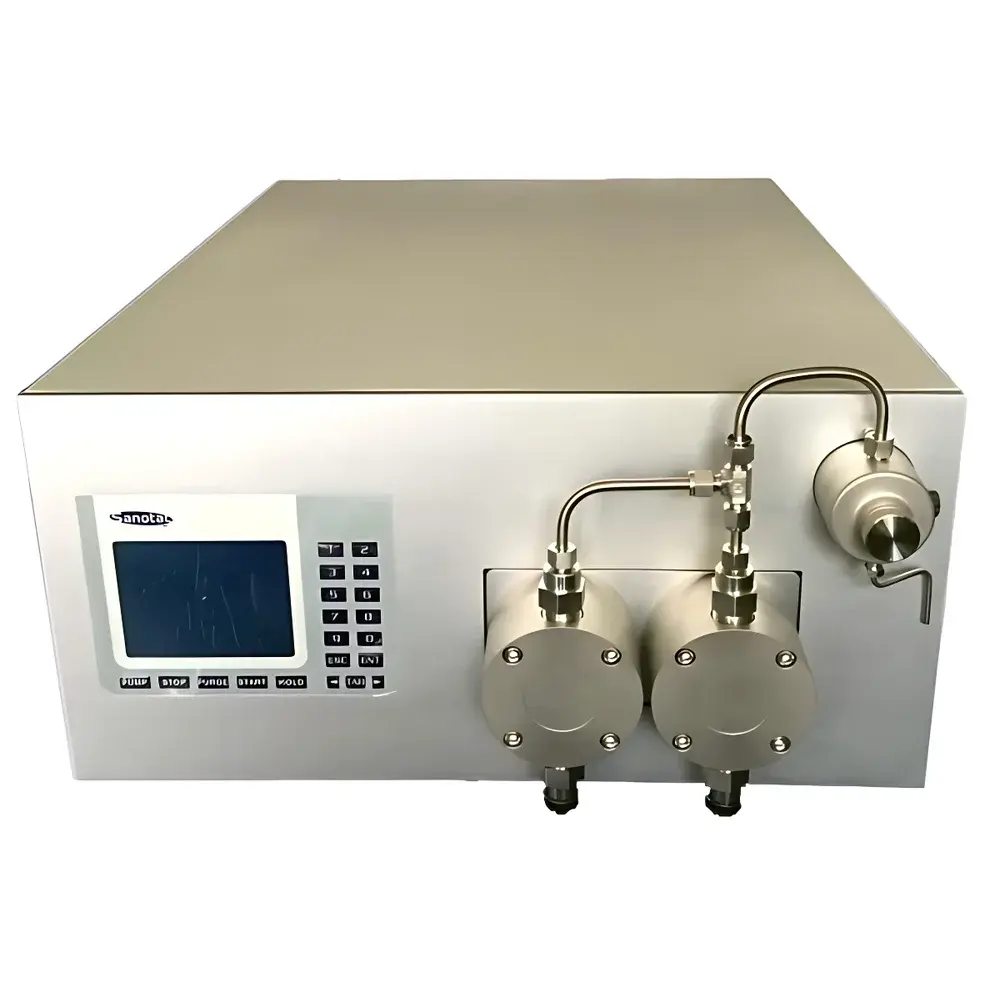
Sanotac LP-1010 Preparative High-Pressure Solvent Delivery Pump (10 L/min, 10 MPa)
| Brand | Sanotac |
|---|---|
| Origin | Shanghai, China |
| Manufacturer Type | Direct Manufacturer |
| Product Origin | Domestic (China) |
| Model | LP-1010 |
| Flow Rate | 0.1–10,000.00 mL/min (0.1 mL/min increment) |
| Pressure Range | ≤10 MPa (316L stainless steel pump head) |
| Flow Accuracy | ±1.5% |
| Flow Precision (RSD) | ≤1.0% |
| Pressure Pulsation | ≤0.5 MPa |
| Display | 256×64-dot self-luminous LCD with adjustable backlight |
| Control Interface | Front-panel keypad + open-protocol computer remote control (RS-485/Ethernet) |
| Power Supply | 85–264 VAC, 5000 W |
Overview
The Sanotac LP-1010 Preparative High-Pressure Solvent Delivery Pump is an engineered solution for large-scale liquid chromatography, process-scale purification, and continuous-flow synthesis applications requiring high-volume, high-pressure solvent delivery. Designed around a dual-piston parallel architecture with floating piston technology, the LP-1010 delivers stable, pulse-minimized flow across an exceptionally wide dynamic range—from analytical trace injection (0.1 mL/min) to preparative throughput (10,000 mL/min). Its core operational principle relies on real-time chamber pressure feedback combined with dual high-speed drive motors, enabling active compensation for solvent compressibility and refill dynamics—critical for maintaining volumetric accuracy under variable backpressure conditions typical in packed-bed columns, membrane filtration systems, or supercritical fluid processes. The pump’s structural integrity is reinforced by a 316L stainless steel pump head rated to 10 MPa, ensuring compatibility with aggressive organic solvents, aqueous buffers, and corrosive mobile phases used in pharmaceutical purification and fine chemical synthesis.
Key Features
- Dual-piston parallel configuration with floating piston design—extends seal service life and maintains consistent sealing force across pressure gradients.
- Multi-point flow calibration curves programmable per user method—ensures linear accuracy over the full 0.1–10,000 mL/min range without manual recalibration.
- Cam-profile pulsation compensation algorithm—reduces baseline noise in UV/Vis and conductivity detection, improving signal-to-noise ratio in fraction collection.
- Ten independent user programs supporting gradient flow profiles, ramped pressure sequences, and timed solvent switching—enabling unattended multi-step purification protocols.
- Self-luminous 256×64-dot LCD display with uniform brightness and wide viewing angle—operable under ambient lab lighting or low-light glovebox environments; adjustable backlight supports extended shift operation.
- Open-protocol communication interface (RS-485 and Ethernet) compliant with Modbus RTU/TCP—facilitates integration into LIMS, SCADA, or custom Python/Node-RED automation frameworks without proprietary drivers.
Sample Compatibility & Compliance
The LP-1010 accommodates a broad spectrum of solvents—including acetonitrile, methanol, THF, DCM, ethyl acetate, and aqueous buffers up to 1 M NaCl—without degradation of wetted components. All fluidic pathways contact only 316L stainless steel, sapphire check valves, and chemically resistant PEEK or FFKM seals. The system conforms to IEC 61010-1:2010 for laboratory equipment safety and meets CE electromagnetic compatibility (EMC) requirements. While not certified for GMP manufacturing environments out-of-the-box, its deterministic flow control, audit-trail-capable firmware logging (via optional software module), and repeatable performance support GLP-compliant method development and QC release testing when operated within validated SOPs.
Software & Data Management
The pump operates natively via front-panel controls but is fully addressable through its open industrial protocol stack. Third-party software—including LabVIEW, MATLAB, Python (pySerial/pyModbus), and commercial chromatography data systems (CDS)—can initiate run sequences, monitor real-time flow/pressure telemetry, and log timestamped events. Firmware supports configurable data sampling intervals (100 ms to 5 s) and stores up to 10,000 historical records onboard. Optional Sanotac Control Suite (v3.2+) provides FDA 21 CFR Part 11–compliant electronic signatures, role-based access control, and automated report generation aligned with ISO/IEC 17025 documentation standards.
Applications
- Preparative HPLC and flash chromatography for API isolation and natural product purification.
- Continuous-flow reactor feed systems requiring precise stoichiometric reagent delivery at elevated pressures.
- Membrane-based solvent exchange and diafiltration in bioprocessing workflows.
- High-throughput screening platforms integrating automated fraction collectors and inline UV/MS detection.
- Method transfer from analytical to preparative scale with preserved retention time fidelity.
FAQ
What is the maximum recommended operating pressure for continuous use?
The LP-1010 is rated for continuous operation up to 10 MPa using the standard 316L pump head; derating is advised above 8.5 MPa for extended seal longevity.
Can the pump be integrated into a PLC-controlled production line?
Yes—the RS-485 and Ethernet interfaces support native Modbus register mapping, enabling direct read/write access to flow setpoints, pressure readings, alarm status, and program execution flags.
Is flow calibration traceable to NIST standards?
Calibration certificates are provided with each unit; users may perform in-house verification using gravimetric methods per ASTM D3427 or ISO 5725-2, with traceability established via certified mass standards.
Does the pump support solvent degassing or mixing functions?
No—the LP-1010 is a dedicated solvent delivery device; external degassers and low-pressure mixing modules must be integrated upstream per system design requirements.
What maintenance intervals are recommended for the pump seals and check valves?
Under typical preparative usage (≤6 MPa, organic solvents), sapphire check valves require inspection every 6 months, and FFKM seals every 12 months—or sooner if pressure pulsation exceeds 0.4 MPa RMS.



