
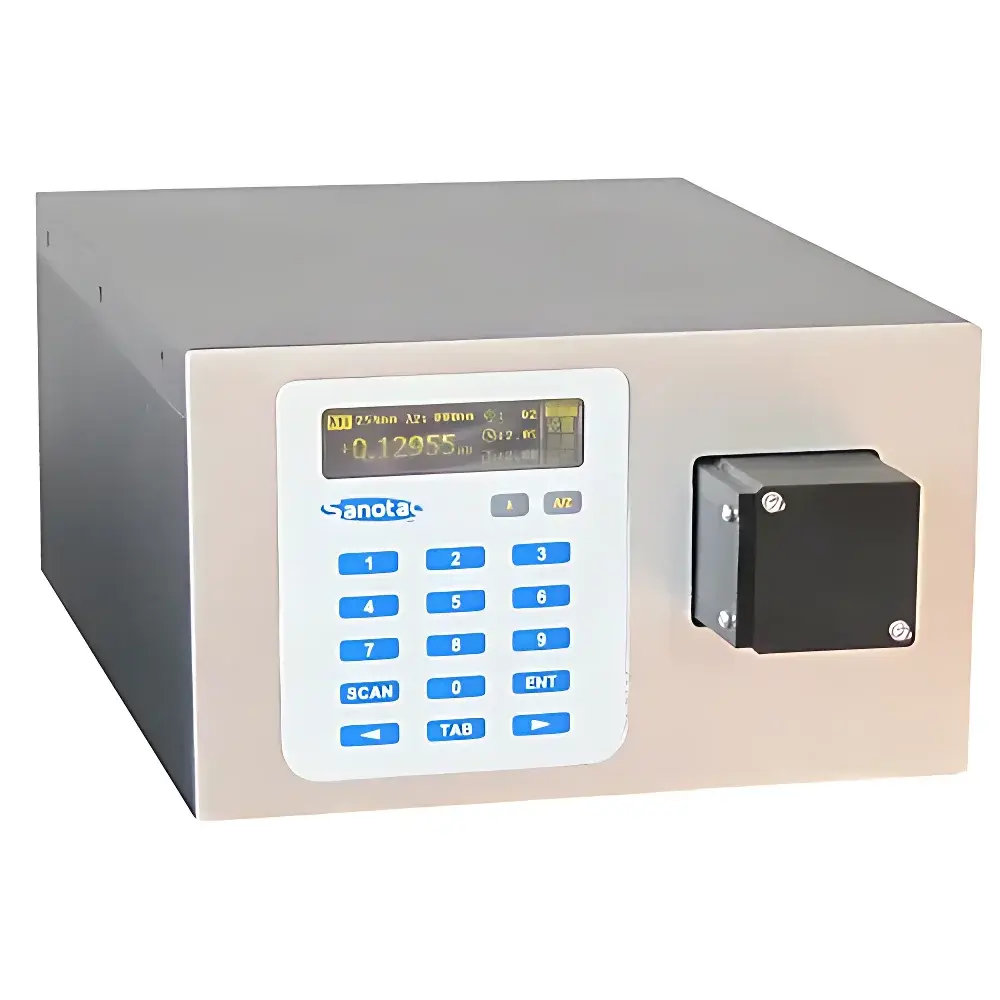
Sanotac UV1000 Dual-Wavelength UV-Vis Detector for HPLC
| Brand | Sanotac |
|---|---|
| Model | UV1000 |
| Origin | Shanghai, China |
| Manufacturer Type | Original Equipment Manufacturer (OEM) |
| Instrument Type | Ultraviolet-Visible Absorbance Detector (UVD) |
| Wavelength Range | 190–800 nm |
| Detection Modes | Simultaneous dual-wavelength detection across full range |
| Light Sources | Deuterium Lamp (190–400 nm) + Tungsten-Halogen Lamp (400–800 nm) |
| Wavelength Accuracy | ±1 nm |
| Wavelength Repeatability | 0.2 nm |
| Flow Cell Pathlength | Adjustable from 1 to 5 mm |
| Flow Cell Inlet/Outlet | 1/16" for analytical & semi-preparative |
| Baseline Noise | ±0.5 × 10⁻⁵ AU at 254 nm, time constant = 1 s |
| Baseline Drift | 1.5 × 10⁻⁴ AU/h at 254 nm |
| Absorbance Range | ≥3 AU |
| Time Constants | 0.1 / 0.2 / 0.5 / 1.0 / 2.0 / 5.0 / 10.0 s |
| Zero Adjustment | Digital full-scale auto-zero |
| Display | 320 × 240 pixel monochrome LCD, 4.7-inch active-matrix, adjustable backlight |
| Control Interface | Front-panel keypad + RS-232/USB digital interface with open communication protocol for third-party HPLC software integration |
| Power Supply | 85–264 VAC, 50/60 Hz, max. 150 W |
Overview
The Sanotac UV1000 is a high-performance, dual-lamp ultraviolet-visible absorbance detector engineered for integration into analytical and semi-preparative high-performance liquid chromatography (HPLC) systems. It operates on the principle of Beer-Lambert absorption spectroscopy, measuring analyte concentration via attenuation of incident light at user-selectable wavelengths. Its dual-source optical architecture—comprising a deuterium lamp (190–400 nm) and tungsten-halogen lamp (400–800 nm)—enables seamless coverage across the entire UV-Vis spectrum without manual lamp replacement or recalibration. The detector employs a balanced dual-beam optical path with precision stepper-motor-driven wavelength selection, ensuring long-term photometric stability and minimizing baseline drift. Designed specifically for compliance-critical environments, the UV1000 supports GLP/GMP-aligned operation through deterministic signal processing, hardware-level analog-to-digital conversion, and traceable wavelength calibration routines.
Key Features
- Dual-wavelength simultaneous detection: Real-time monitoring at two independent wavelengths within 190–800 nm, enabling ratio-based quantitation and interference correction.
- Three operational modes: Dual-wavelength detection, wavelength-time programming (for gradient UV monitoring), and stop-flow spectral scanning (for peak purity assessment).
- Adjustable flow cell pathlength (1–5 mm): Optimizes sensitivity for low-concentration analytes or dynamic range extension for high-abundance components.
- Modular lamp management: Automatic lamp selection logic and programmable on/off scheduling reduce thermal stress and extend source lifetime.
- Open communication protocol: RS-232 and USB interfaces support bidirectional control and data streaming compatible with Agilent ChemStation, Waters Empower, Thermo Chromeleon, and custom LabVIEW or Python-based acquisition platforms.
- Front-panel 4.7-inch LCD with 320 × 240 resolution: Provides real-time display of absorbance, wavelength, time constant, lamp status, and user-defined method parameters—viewable under varied laboratory lighting conditions.
- Low-noise analog electronics: Baseline noise ≤ ±0.5 × 10⁻⁵ AU (254 nm, TC = 1 s) and drift ≤ 1.5 × 10⁻⁴ AU/h ensure reliable detection of trace impurities in pharmaceutical QC and synthetic chemistry workflows.
Sample Compatibility & Compliance
The UV1000 is validated for use with standard stainless-steel, PEEK, or fused-silica capillary HPLC flow paths operating at pressures up to 400 bar. Its interchangeable flow cells accommodate analytical (1/16″), semi-preparative (1/16″), and preparative (1/8″) configurations—eliminating the need for external flow splitting during scale-up. The detector meets key performance benchmarks defined in ASTM E260, ISO 17025 (when operated within accredited lab procedures), and USP for chromatographic system suitability testing. While not inherently 21 CFR Part 11 compliant, its digital audit trail capability—including timestamped method logs, lamp usage records, and firmware version tracking—facilitates implementation of electronic signature and data integrity controls required for regulated submissions.
Software & Data Management
The UV1000 does not include proprietary acquisition software but delivers raw absorbance voltage output (0–1 V DC) and digital metadata via ASCII-formatted serial packets. All control commands—including wavelength setpoint, time constant, zero calibration, and lamp selection—are ASCII-readable and scriptable. This open architecture enables integration into LIMS and ELN ecosystems via middleware such as LabWare LIMS or Dotmatics. Internal non-volatile memory stores up to 10 user-defined methods with full parameter retention across power cycles. Firmware updates are performed via USB flash drive using signed binary images, preserving configuration integrity during maintenance.
Applications
- Pharmaceutical quality control: Quantification of active pharmaceutical ingredients (APIs), degradation products, and residual solvents per ICH Q2(R2) guidelines.
- Natural product isolation: Real-time monitoring of fraction collection in semi-preparative HPLC with simultaneous UV254/UV365 tracking for compound class differentiation.
- Environmental analysis: Detection of aromatic hydrocarbons, nitroaromatics, and phenolic compounds in water extracts using EPA Method 8330B-compliant wavelength settings.
- Academic research: Method development for chiral separations, polymer characterization, and kinetic studies requiring multi-wavelength kinetic profiling.
- Food safety testing: Screening for preservatives (e.g., benzoic acid, sorbic acid) and artificial colorants (e.g., tartrazine, sunset yellow) in complex matrices.
FAQ
Does the UV1000 support GMP-compliant electronic records?
Yes—when deployed with validated third-party acquisition software that implements 21 CFR Part 11 controls (e.g., Waters Empower 3 with Audit Trail enabled), the UV1000’s deterministic analog signal path and timestamped digital logs meet ALCOA+ data integrity principles.
Can the flow cell be cleaned in-place without disassembly?
Yes—the standard 1/16″ flow cell features a removable quartz window and chemically resistant PEEK body, allowing solvent flush protocols (e.g., 50% methanol/water → 100% acetonitrile → chloroform) without tools.
Is wavelength calibration traceable to NIST standards?
The internal holmium oxide and didymium oxide filters provide factory-calibrated reference peaks at 241.1, 279.4, 360.9, and 536.2 nm; users may perform periodic verification per ISO/IEC 17025 Clause 6.5.2.
What is the maximum recommended flow rate for the 5 mm pathlength cell?
For optimal laminar flow and minimal band broadening, the 5 mm cell is rated for ≤2 mL/min with mobile phases of viscosity ≤1.5 cP at ambient temperature.
How often should the deuterium lamp be replaced?
Lamp lifetime is specified at ≥1,500 hours under typical cycling conditions (≤10 on/off cycles per day); the instrument logs cumulative lamp-on time and triggers a warning at 1,200 hours.




