
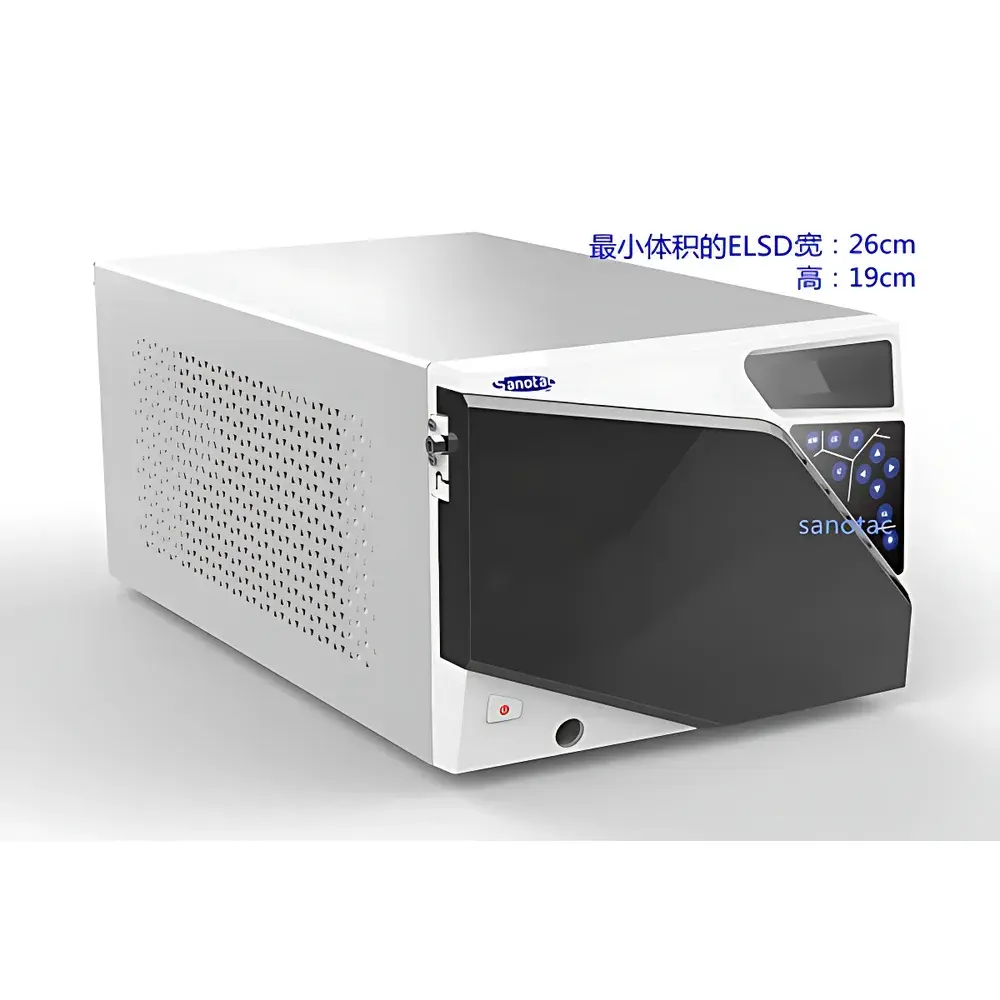
Sanotac Z6000 Evaporative Light Scattering Detector (ELSD) for Pharmacopoeial Compliance and Traditional Chinese Medicine (TCM) Quality Control
| Brand | Sanotac |
|---|---|
| Origin | Shanghai, China |
| Manufacturer Type | Original Equipment Manufacturer (OEM) |
| Product Category | Domestic |
| Model | Z6000 ELSD |
| Instrument Type | Evaporative Light Scattering Detector |
| Wavelength | 650 nm |
| Detection Mode | Low-Temperature Evaporation |
| Light Source | Semiconductor Laser |
Overview
The Sanotac Z6000 Evaporative Light Scattering Detector (ELSD) is a dedicated, GMP-aligned detection system engineered for universal response detection in reversed-phase and normal-phase liquid chromatography. Unlike UV-absorbing detectors, the Z6000 operates on the physical principle of nebulization, solvent evaporation, and light scattering—making it inherently mass-sensitive and independent of chromophore presence. This enables robust quantification of non-volatile, semi-volatile, and non-UV-active analytes commonly encountered in pharmacopoeial monographs—including saponins, triterpenoids, alkaloids, glycosides, and aminoglycoside antibiotics. Designed to meet the analytical requirements outlined in the Chinese Pharmacopoeia (ChP) Volume IV (General Chapters 0512 & 0521), the Z6000 supports method validation parameters such as linearity, precision, LOD/LOQ, and ruggedness across TCM raw materials, decoction pieces, herbal extracts, and finished formulations.
Key Features
- Optimized optical architecture: Integrated 650 nm semiconductor laser source with precisely aligned photomultiplier tube (PMT) detection path, delivering high signal-to-noise ratio and long-term stability.
- Low-temperature evaporation mode: Drift tube temperature programmable from ambient to 130 °C (1 °C increments); nebulizer temperature up to 56 °C—minimizing thermal degradation of thermolabile compounds like ginsenosides and astragalosides.
- Intelligent gas management: Mass flow-controlled inert gas (N₂ or clean air) delivery with real-time pressure monitoring (0.01 bar resolution) and adjustable flow (1–4 L/min, ±1% accuracy), reducing gas consumption by >50% in standby mode.
- Enhanced operational reliability: 16-point self-diagnostic routine covering gas pressure, heater status, laser activation, PMT voltage, and flow integrity—preventing solvent ingress into the detection chamber.
- User-centric interface: Backlit 16×2 LCD with 10-key keypad; 10 pre-stored methods (25 configurable parameters each); front-accessible nebulizer capillary for rapid visual inspection and cleaning.
- Fast thermal equilibration: Auxiliary cooling system enables drift tube temperature transition between methods in <90 seconds, supporting multi-method sequence runs without manual intervention.
Sample Compatibility & Compliance
The Z6000 is validated for quantitative analysis of pharmacopoeially referenced compounds including but not limited to: Fritimine A, Astragaloside IV, Ginkgolide B, Saponin A from *Achyranthes bidentata*, Fritimine B, Anemarrhena Asphodeloides Saponin BII, Platycodin D, Oleanolic Acid, Ilicis Rotunda Saponin B, Dipsaci Radix Saponin B, Ursolic Acid, Nesfatin-1-related glycosides, Ilicis Cornuta Glycoside, Semen Platycladi Saponin, Polygalae Saponin, Saposhnikoviae Radix Saponin, Cynanchum Bungei Saponin, Stachydrine Hydrochloride, Liquidambaric Acid, Jujubosid A, Triolein, Asiaticoside, Artificial Calculus Bovis (Cholic Acid), and Cholic Acid. In antibiotic QC, it supports assay of Paromomycin, Kanamycin, Sisomicin, Gentamicin C1a, Gentamicin complex, Netilmicin, Etmicin, Ribostamycin, Neomycin, Streptomycin, and Tobramycin per USP , EP 2.2.29, and ChP general chapter 0512. All hardware and firmware comply with ISO/IEC 17025 traceability requirements for calibration and maintenance records.
Software & Data Management
The Sanotac Chromatography Data System (CDS) is fully compliant with FDA 21 CFR Part 11, featuring role-based electronic signatures, immutable audit trails, and secure user authentication (password + optional token). It supports ALCOA+ principles (Attributable, Legible, Contemporaneous, Original, Accurate) through time-stamped event logging—including method changes, integration parameter edits, baseline corrections, and detector calibration updates. The software interfaces seamlessly with all major HPLC platforms via RS-232, USB, or TCP/IP (HTTP), enabling centralized instrument control, remote diagnostics, and automated report generation (PDF/CSV). Digital output at 20 Hz sampling rate ensures high-fidelity peak capture during gradient elution.
Applications
- Chinese Pharmacopoeia-monograph compliance testing for crude herbs, processed slices, and compound prescriptions.
- Stability-indicating assays of heat-sensitive saponins and terpenoid lactones under ICH Q5C conditions.
- Batch release testing of injectables containing aminoglycosides where UV detection lacks specificity due to overlapping excipients.
- Method transfer between R&D, QC, and contract laboratories using standardized ELSD response curves.
- Supporting GLP studies requiring full data integrity, instrument qualification (IQ/OQ/PQ), and electronic record retention for regulatory submission.
FAQ
Does the Z6000 support regulatory submissions to NMPA, FDA, or EMA?
Yes—the instrument design, software architecture, and documentation package align with NMPA Guideline on Analytical Instrument Qualification, FDA 21 CFR Part 11, and EU Annex 11 requirements for computerized systems used in GMP environments.
Can the Z6000 be integrated with third-party HPLC systems such as Agilent 1260 or Waters e2695?
Yes—it provides native RS-232, USB, and LAN (TCP/HTTP) connectivity, and its analog/digital output signals are compatible with any data acquisition system supporting ±1000 mV offset and 0.3–30× gain scaling.
What is the minimum detectable mass for saponin standards under typical HPLC-ELSD conditions?
Under optimized nebulization and evaporation settings, the Z6000 achieves a typical limit of detection (LOD) of <1 ng on-column for triterpenoid saponins such as Oleanolic Acid and Platycodin D, consistent with ChP method validation criteria.
Is nitrogen gas mandatory, or can compressed air be used?
Clean, oil-free, desiccated compressed air (meeting ISO 8573-1 Class 2:2:2) is acceptable for most applications; however, nitrogen is recommended for trace-level analysis and when operating at elevated drift tube temperatures to prevent oxidation artifacts.
How does the Z6000 handle gradient elution with high aqueous mobile phases?
Its low-temperature evaporation mode and precise gas flow control enable stable baseline performance even with 95% water content mobile phases—eliminating the need for post-column makeup flow or solvent removal traps.





