
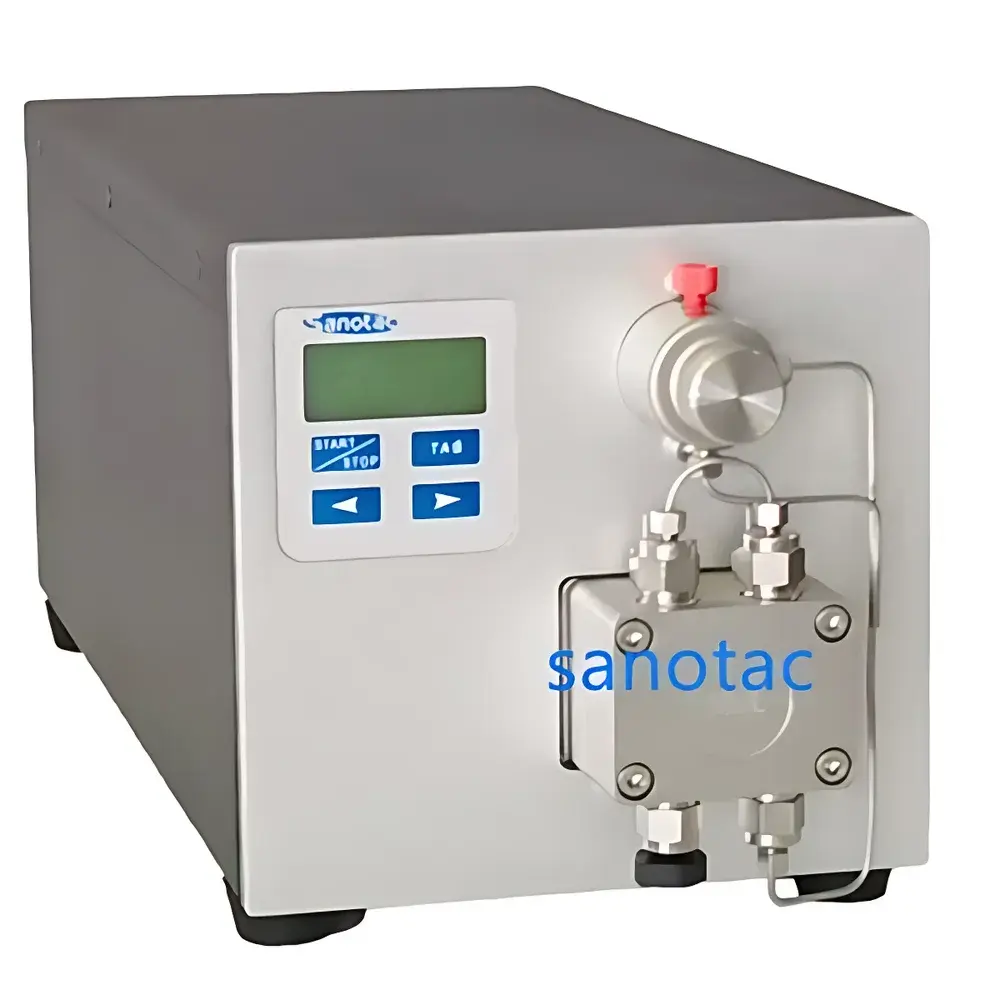
Sanotac SF-1005 High-Pressure Precision Metering Pump for Deionized Water Circulation in Hydrogen Fuel Cell Systems
| Brand | Sanotac |
|---|---|
| Origin | Shanghai, China |
| Manufacturer Type | OEM/ODM Manufacturer |
| Country of Origin | China |
| Model | SF-1005 |
| Flow Range | 0.01–100 mL/min |
| Maximum Pressure | 5 MPa |
| Flow Accuracy | ±0.5% |
| Flow Repeatability | ≤0.1% |
| Pressure Pulsation | ≤0.1 MPa |
| Wetted Materials | 316L Stainless Steel / PTFE / Sapphire / Ceramic |
| Communication Interfaces | RS232, RS485, USB, Modbus RTU/TCP, Profinet |
| Power Supply | 85–264 VAC, 50 Hz |
| Power Consumption | 75 W |
| Dimensions | 260 × 110 × 110 mm (standard head) |
Overview
The Sanotac SF-1005 is a high-integrity, microprocessor-controlled positive displacement metering pump engineered specifically for precision fluid handling in hydrogen energy infrastructure—particularly in proton exchange membrane (PEM) fuel cell manufacturing, electrolyzer stack conditioning, and bipolar plate humidification systems. It operates on the reciprocating plunger principle with dual-stage compression compensation and active pulse suppression, enabling stable delivery of ultra-pure deionized (DI) water, ultralow-conductivity rinse media, and low-viscosity electrolyte carriers under controlled pressure conditions up to 5 MPa. Unlike conventional peristaltic or diaphragm pumps, the SF-1005 integrates real-time volumetric flow calibration, closed-loop pressure feedback, and material-compatible wetted-path construction (316L SS or PTFE), ensuring compliance with semiconductor-grade purity requirements (ASTM D1193 Type I water handling) and minimizing particulate generation during long-duration circulation cycles.
Key Features
- Integrated flow metrology: Built-in high-resolution flow transduction eliminates need for external flow meters or PLC-based compensation logic.
- Multi-point volumetric calibration: User-configurable calibration across full flow range (0.01–100 mL/min) ensures traceable accuracy per ISO/IEC 17025-compliant validation protocols.
- Active pulse suppression: Combined mechanical cam-profile optimization and electronic flow-rate modulation reduce pressure pulsation to ≤0.1 MPa—critical for maintaining membrane hydration uniformity in PEM stacks.
- Dual-material fluid path options: Selectable 316L stainless steel (for mechanical robustness and thermal stability) or fully fluoropolymer-wetted (PTFE/PCTFE/sapphire/ceramic) configuration for aggressive chemical compatibility and extractables control.
- Embedded pressure monitoring: Real-time digital pressure readout with programmable overpressure cutoff (adjustable setpoint) safeguards sensitive fuel cell components during startup and transient operation.
- Column cleaning cycle function: Automated post-stroke plunger wash sequence minimizes seal wear and prevents crystallization-induced stiction—extending mean time between maintenance (MTBM) beyond 6,000 operating hours.
Sample Compatibility & Compliance
The SF-1005 is validated for continuous-duty handling of DI water (resistivity ≥18.2 MΩ·cm), dilute KOH or H2SO4 solutions (<5 wt%), and glycol-free humidification media used in anode/cathode humidifiers. Its wetted surfaces meet USP Class VI biocompatibility standards and pass ASTM F2473 extractables testing for low-metal-ion leaching (<0.1 ppb Fe, Cr, Ni). The pump architecture supports GMP-aligned operational qualification (OQ) through configurable audit trails, parameter lockout, and firmware version logging—fully compatible with FDA 21 CFR Part 11 electronic record requirements when paired with Sanotac’s optional secure control software.
Software & Data Management
The embedded controller supports native Modbus RTU (RS485), Modbus TCP (Ethernet), and Profinet interfaces for seamless integration into industrial automation ecosystems—including Siemens PCS7, Rockwell FactoryTalk, and Yokogawa CENTUM VP DCS platforms. Optional PC-based software provides GLP-compliant data acquisition: real-time plotting of flow vs. pressure curves, timestamped event logging (start/stop/calibration/overpressure), CSV export with ISO 8601 timestamps, and method recall with version-controlled parameter sets. All calibration coefficients are stored in non-volatile memory with checksum verification; factory reset restores NIST-traceable default values without firmware reflash.
Applications
- Precision DI water recirculation in PEM fuel cell membrane electrode assembly (MEA) hot-pressing and catalyst ink coating lines
- Controlled humidification fluid dosing in cathode gas diffusion layers (GDLs) during accelerated stress testing (AST)
- Electrolyte replenishment in alkaline electrolyzers with dynamic pH stabilization loops
- Low-flow coolant injection in battery thermal management system (BTMS) validation rigs
- Calibration fluid delivery in online conductivity analyzers (e.g., METTLER TOLEDO InPro 7250) deployed in cleanroom DI loop monitoring
FAQ
Is the SF-1005 certified for use in Class 100 cleanroom environments?
Yes—the PTFE-wetted variant meets ISO 14644-1 Class 5 particle emission limits when operated within specified flow and pressure envelopes; full cleanroom qualification reports available upon request.
Can the pump maintain flow accuracy at elevated temperatures (e.g., 60°C)?
Thermal drift compensation is implemented via internal temperature sensing; flow accuracy remains within ±0.7% from 15–60°C ambient, verified per ASTM E29 standard rounding rules.
Does the controller support deterministic timing for synchronized multi-pump sequencing?
Yes—Modbus TCP master-slave synchronization achieves sub-10 ms inter-pump timing jitter; hardware-triggered start/stop via isolated digital I/O further enables phase-aligned delivery in multi-channel humidification manifolds.
What is the maximum allowable particulate load in the inlet fluid?
Inlet filtration to ≤0.22 µm is mandatory; the pump does not include integrated filtration—users must install upstream sterile-grade filters compliant with ISO 4406:2017 code 14/12/9.
How frequently must flow calibration be performed to maintain ISO/IEC 17025 traceability?
Initial calibration is performed at factory using gravimetric reference standards; field recalibration interval is 6 months or 2,000 operating hours—whichever occurs first—per Sanotac Calibration Protocol S-CP-004 Rev.3.



