
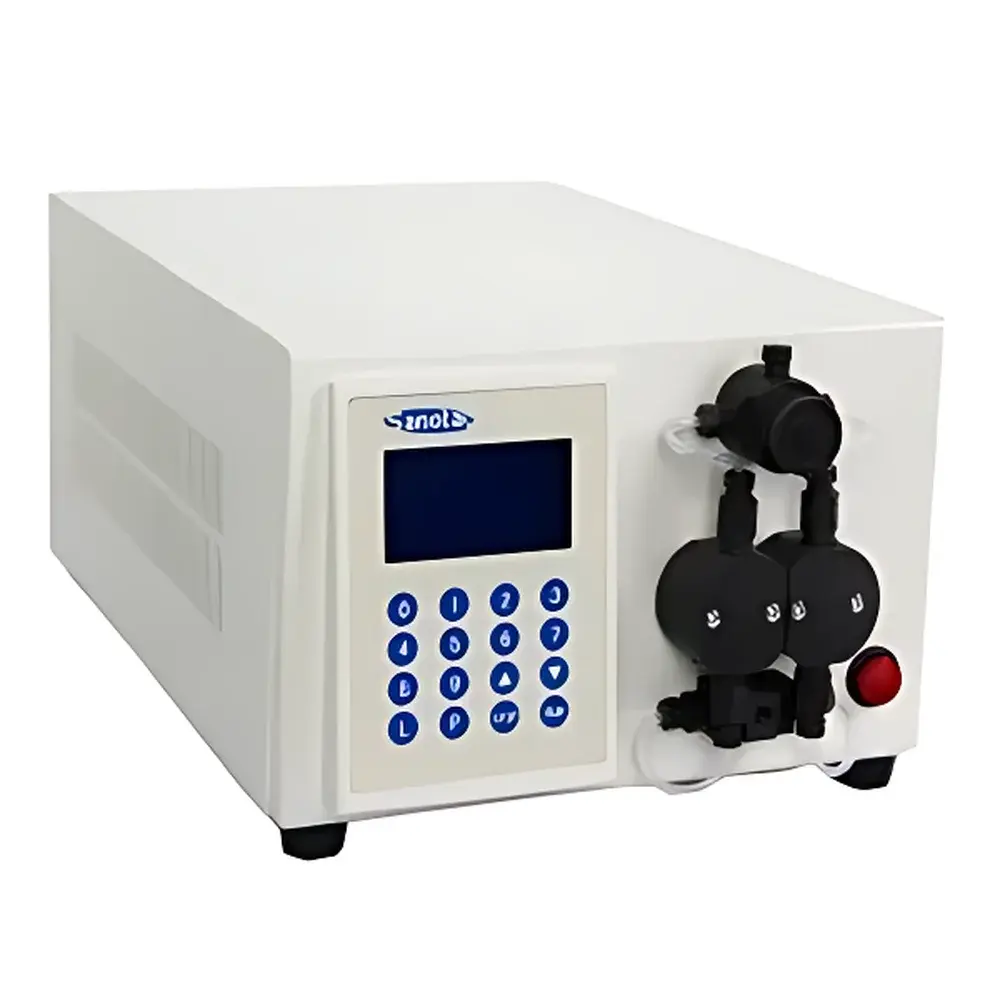
Sanotac VPF0502 PTFE-Lined High-Pressure Constant Flow Pump
| Brand | Sanotac |
|---|---|
| Origin | Shanghai, China |
| Manufacturer Type | Direct Manufacturer |
| Country of Origin | China |
| Model | VPF0502 |
| Flow Rate | 0.1–50.0 mL/min |
| Max Pressure | 2 MPa |
| Flow Accuracy | ±1% |
| Flow Repeatability | ≤1% |
| Pressure Pulsation | ≤0.2 MPa |
| Viscosity Range | 0–100 cP |
| Wetted Materials | PTFE, Sapphire, Zirconia Ceramic |
| Communication | RS232 (standard), RS485/RS422 (optional), Modbus RTU/ASCII, Sanotac Proprietary Protocol |
| Power Supply | 85–264 VAC, 50 Hz |
| Power Consumption | 75 W |
| Weight | 12 kg |
Overview
The Sanotac VPF0502 is a precision-engineered, PTFE-lined constant flow pump designed for demanding laboratory and pilot-scale applications involving highly corrosive, high-viscosity, or gas-laden fluids. Built upon positive displacement diaphragm technology with cam-driven actuation, it delivers stable volumetric delivery under pressures up to 2 MPa—making it suitable for pressurized reaction systems including microreactors, catalytic evaluation units, supercritical fluid processing, and continuous-flow synthesis setups. Its chemically inert fluid path—comprising PTFE tubing, sapphire check valves, and zirconia ceramic plunger components—ensures long-term compatibility with aggressive reagents such as hydrogen peroxide (H₂O₂), concentrated acids, halogenated solvents, and oxidizing agents. Unlike conventional peristaltic or syringe pumps, the VPF0502 maintains consistent flow performance across variable backpressures and viscosity shifts (up to 100 cP), without requiring recalibration during routine operation.
Key Features
- Chemically resistant wetted path: All fluid-contact surfaces constructed from PTFE, sapphire, and zirconia ceramic—validated for compatibility with H₂O₂, nitric acid, hydrofluoric acid derivatives, and other Class 3–4 corrosives per ASTM D543.
- High-pressure capability: Rated for continuous operation up to 2 MPa (290 psi), enabling integration into pressurized reactor loops, autoclave feed systems, and supercritical CO₂ delivery circuits.
- Low pulsation design: Combines mechanical cam-profile optimization with real-time electronic flow pulse suppression to limit pressure fluctuation to ≤0.2 MPa—critical for maintaining laminar flow in microfluidic and catalytic fixed-bed configurations.
- Dual-mode delivery: Supports both volumetric (mL/min) and gravimetric (g/min) flow control, with user-accessible calibration parameters for system-specific density compensation.
- Programmable operation: Offers two operational modes—constant flow and gradient flow—with programmable ramp profiles via external controller or onboard interface.
- Integrated safety logic: Configurable pressure upper-limit threshold with automatic shutdown and fault logging, compliant with IEC 61508 SIL 2 functional safety requirements for unattended operation.
Sample Compatibility & Compliance
The VPF0502 is routinely deployed in environments governed by GLP, GMP, and ISO/IEC 17025 frameworks. Its material construction meets USP Class VI biocompatibility standards for PTFE components and conforms to FDA 21 CFR Part 11 data integrity requirements when operated with audit-trail-enabled SCADA or DCS systems. The pump has been validated for use with hydrogen peroxide concentrations up to 70 wt%, sulfuric acid (≤98%), and organic peroxides used in polymer initiation. It complies with CE marking directives (2014/30/EU EMC, 2014/35/EU LVD) and carries IP54 ingress protection for laboratory benchtop deployment.
Software & Data Management
The pump supports native Modbus RTU/ASCII protocol over RS232 (standard) and RS485/RS422 (optional), enabling seamless integration into industrial automation architectures—including Siemens S7 PLCs, Rockwell ControlLogix, and Schneider EcoStruxure DCS platforms. Optional Ethernet TCP/IP module allows direct connection to MES or LIMS infrastructure. All communication interfaces support full command set access: start/stop, flow setpoint adjustment, pressure monitoring, alarm status polling, and firmware version interrogation. Data logging capabilities include timestamped pressure and flow curve export (CSV), compatible with MATLAB, Python Pandas, and LabVIEW for post-acquisition analysis. Audit trails record all parameter changes, operator logins, and fault events—meeting ALCOA+ principles for regulated R&D workflows.
Applications
- Catalytic reaction engineering: Precise co-feeding of catalyst precursors and substrates into fixed-bed or slurry reactors under elevated pressure.
- Microreactor process intensification: Stable metering of viscous slurries (e.g., metal-organic framework suspensions) into chip-based reactors.
- Supercritical fluid applications: Delivery of CO₂-miscible solvents into extraction or impregnation systems operating at >7.4 MPa critical point conditions.
- New energy research: Controlled injection of electrolyte formulations into battery electrode coating lines or fuel cell MEA fabrication rigs.
- Pharmaceutical process development: Gravimetric dosing of API solutions in continuous crystallization and antisolvent precipitation modules.
- Foam extrusion & polymer processing: Low-pulse feeding of reactive polyol/isocyanate blends into twin-screw extruders for structural foam production.
FAQ
What is the maximum allowable viscosity for continuous operation?
The VPF0502 is rated for fluids up to 100 cP at 25 °C; optimal performance is maintained below 50 cP. For viscosities exceeding 100 cP, consult Sanotac application engineering for customized cam profile or pre-heating recommendations.
Can the pump be integrated into a Siemens S7-1500 PLC system?
Yes—via RS485 Modbus RTU or optional Profinet interface module. Preconfigured function blocks and sample TIA Portal projects are available upon request.
Is pressure feedback provided as an analog output signal?
No—pressure is measured internally via strain-gauge transducer and reported digitally via Modbus register map. External 4–20 mA pressure transducers may be connected separately for analog loop integration.
Does the pump support remote calibration verification?
Yes—users may execute on-device flow verification using gravimetric collection and time-stamped mass delta inputs, with results stored in non-volatile memory and exportable via serial interface.
What maintenance intervals are recommended for extended service life?
Diaphragm replacement is advised every 6,000 operating hours or 12 months, whichever occurs first. Sapphire valve inspection is recommended quarterly in abrasive or particulate-laden service.



