
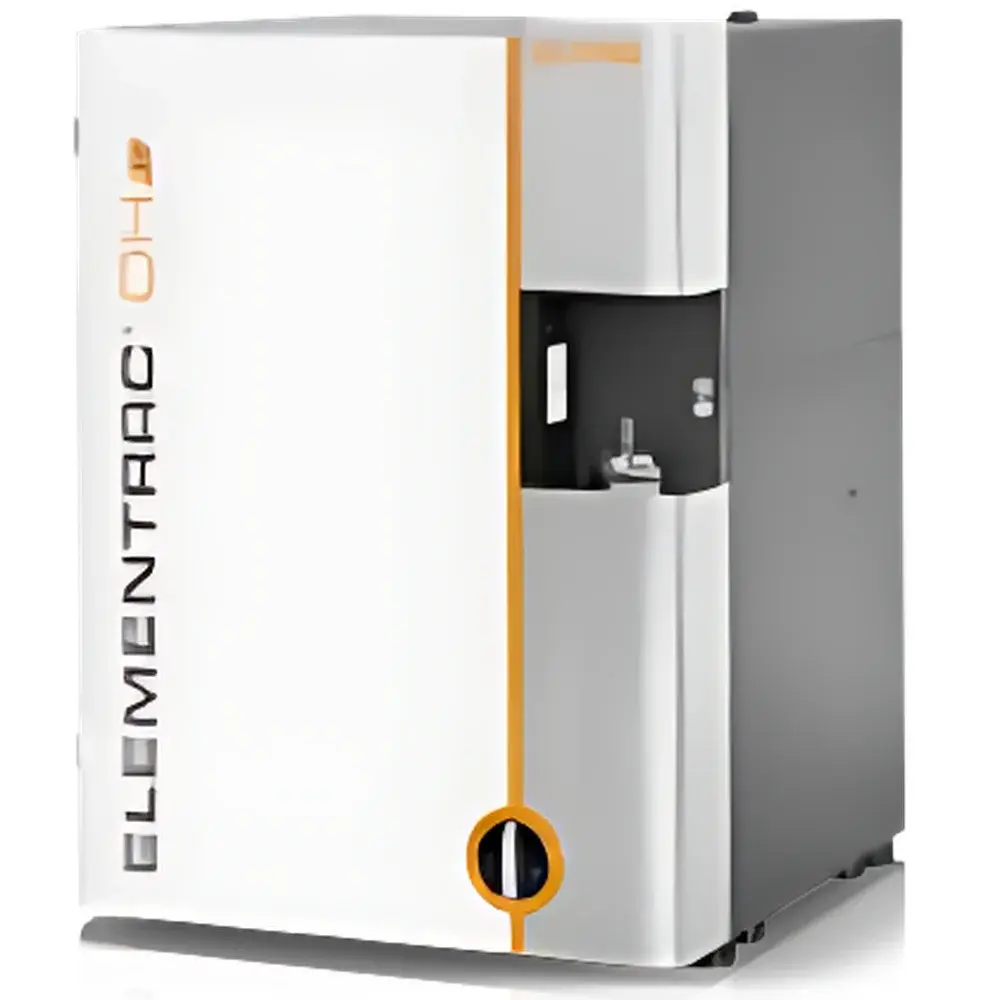
ELTRA ELEMENTRAC ON-p 2 Oxygen and Nitrogen Analyzer
| Brand | ELTRA |
|---|---|
| Origin | Germany |
| Model | ON-p 2 |
| Analyzer Type | Oxygen/Nitrogen Analyzer |
| Detection Principle | Infrared Absorption (O₂ → CO₂) & Thermal Conductivity Detection (N₂) |
| Sample Form Compatibility | Solid rods, granules, powders (in Ni capsules or direct), inorganic matrices |
| Maximum Sample Mass | 2000 mg |
| Analysis Time | 120–180 s |
| Carrier Gas Options | Argon (economical grade), Helium, or high-purity inert gases |
| Furnace Power | Up to 8.5 kW |
| Detector Configuration | Dual-channel IR for oxygen (as CO₂) |
| Gas System | Sealed, pressurized gas circuit |
| Compliance Ready | Supports GLP/GMP audit trails, 21 CFR Part 11–compatible data handling via ELEMENTS software |
Overview
The ELTRA ELEMENTRAC ON-p 2 is a high-precision, dual-element combustion-based analyzer engineered for the quantitative determination of oxygen (O) and nitrogen (N) in inorganic solid materials. It operates on the principle of high-temperature inert-gas fusion: samples are flash-heated to up to 3000 °C in a graphite crucible under controlled argon or helium atmosphere, releasing oxygen as carbon monoxide (CO) and nitrogen as molecular N₂. Oxygen is quantified via infrared absorption after catalytic oxidation of CO to CO₂ in a copper oxide catalyst bed; nitrogen is measured directly by thermal conductivity detection (TCD). The sealed, pressurized gas manifold ensures complete transfer of evolved gases to detectors—eliminating dilution losses and delivering exceptional sensitivity (sub-ppm O/N detection limits in optimized configurations) and long-term reproducibility (<0.5% RSD for certified reference materials). Designed for routine QC and R&D laboratories in metallurgy, ceramics, mining, and advanced materials research, the ON-p 2 meets the analytical rigor required for ISO 14284, ASTM E1019, and JIS G 1211 standards.
Key Features
- Sealed, pressurized gas circuit architecture minimizes carrier gas consumption by >40% versus open-loop systems while enhancing signal-to-noise ratio and baseline stability.
- Integrated pulse purge sample introduction: automated air displacement from the sample chamber prior to drop ensures consistent matrix conditioning and eliminates atmospheric O₂/N₂ interference—critical for low-level analysis and high-mass (up to 2000 mg) granular or rod-shaped specimens.
- Dual detection strategy: two independent IR cells for oxygen (CO₂ measurement at 4.26 µm and 2.7 µm wavelengths) provide cross-validated quantification; high-stability TCD with temperature-controlled cell and extended-path flow cell enables precise N₂ detection across wide dynamic ranges.
- Modular furnace design with 8.5 kW induction heating delivers rapid thermal ramping and uniform crucible heating—essential for complete decomposition of refractory oxides, nitrides, and slag matrices.
- Front-panel service access: all consumables—including CO oxidation catalyst (CuO), desiccant tubes, and particulate filters—are mounted behind a quick-release door, reducing routine maintenance time to under 5 minutes without tools.
- Optional automatic electrode cleaner: motor-driven mechanical scraper removes graphite soot buildup from upper electrodes and furnace lining during idle cycles—maintaining calibration integrity over >500 analyses per day without manual intervention.
Sample Compatibility & Compliance
The ON-p 2 accommodates diverse physical forms without preprocessing: solid metal rods (e.g., steel billets), crushed ores, sintered ceramics, furnace slags, and powdered alloys. Powders may be analyzed directly in nickel capsules (unsealed) or pressed into pellets—no wax binding or pre-combustion steps required. The system supports trace-level analysis in certified reference materials (CRMs) such as NIST SRM 660c (SiO₂) and BCS CRM 386/1 (low-alloy steel). Its hardware and ELEMENTS software architecture comply with GLP documentation requirements and support full 21 CFR Part 11 compliance when deployed with electronic signatures, audit trail logging, and role-based user access control. Data export formats include ASTM E1382-compliant ASCII, CSV, and direct LIMS integration via ODBC.
Software & Data Management
ELEMENTS is a Windows-native, modular application that orchestrates instrument control, real-time signal processing, calibration management, and report generation. The central workspace integrates sample registration (auto-import from balance via RS232/USB), method selection, live chromatogram visualization, and post-run quantification using multi-point linear or quadratic calibration curves. All raw detector signals, furnace temperature profiles, gas pressure logs, and operator actions are timestamped and archived with SHA-256 hash integrity verification. Advanced features include batch reprocessing, outlier flagging per ASTM E691, and customizable certificate-of-analysis templates aligned with ISO/IEC 17025 reporting guidelines. Remote diagnostics and firmware updates are supported via secure HTTPS interface.
Applications
- Metallurgical QC: O/N content verification in stainless steels, titanium alloys, and superalloys where interstitial levels govern ductility, weldability, and creep resistance.
- Refractory & ceramic manufacturing: quantification of residual oxygen in SiC, Al₂O₃, and ZrO₂ components affecting dielectric strength and thermal shock performance.
- Mineral processing labs: rapid screening of O/N in iron ore concentrates, bauxite residues, and phosphate slags to optimize smelting efficiency.
- Research on novel battery cathode materials: detection of lattice oxygen loss and nitride impurities in Li-rich layered oxides and solid-state electrolytes.
- Recycling analytics: identification of nitrogen contamination in scrap aluminum and copper streams impacting extrusion quality.
FAQ
Can the ON-p 2 analyze hydrogen (H) in addition to oxygen and nitrogen?
No—the ON-p 2 is configured exclusively for O and N. For simultaneous O/N/H analysis, ELTRA recommends the ELEMENTRAC ONH-p series, which adds a third TCD channel and dedicated H₂ calibration path.
Is helium mandatory as carrier gas, or can technical-grade argon be used?
Technical-grade argon (≥99.995% purity, <5 ppm O₂/H₂O) is fully supported and recommended for cost-sensitive operations; helium improves N₂ resolution in ultra-trace applications but offers no advantage for routine metallurgical samples.
How often must the CuO catalyst be replaced?
Under standard operating conditions (≤100 analyses/day), the oxidant catalyst maintains performance for ≥6 months; ELEMENTS software monitors catalyst efficiency via CO→CO₂ conversion yield and alerts users when replacement is indicated.
Does the system require external cooling water?
No—all critical components—including detectors and power electronics—are air-cooled with intelligent fan speed modulation, eliminating plumbing infrastructure and enabling benchtop deployment in ISO Class 7 cleanrooms.
Can calibration be performed with in-house reference materials?
Yes—ELEMENTS supports user-defined calibration sets with uncertainty propagation; however, initial certification requires NIST-traceable CRMs to establish metrological traceability per ISO/IEC 17025 Clause 6.4.
Related Products





