
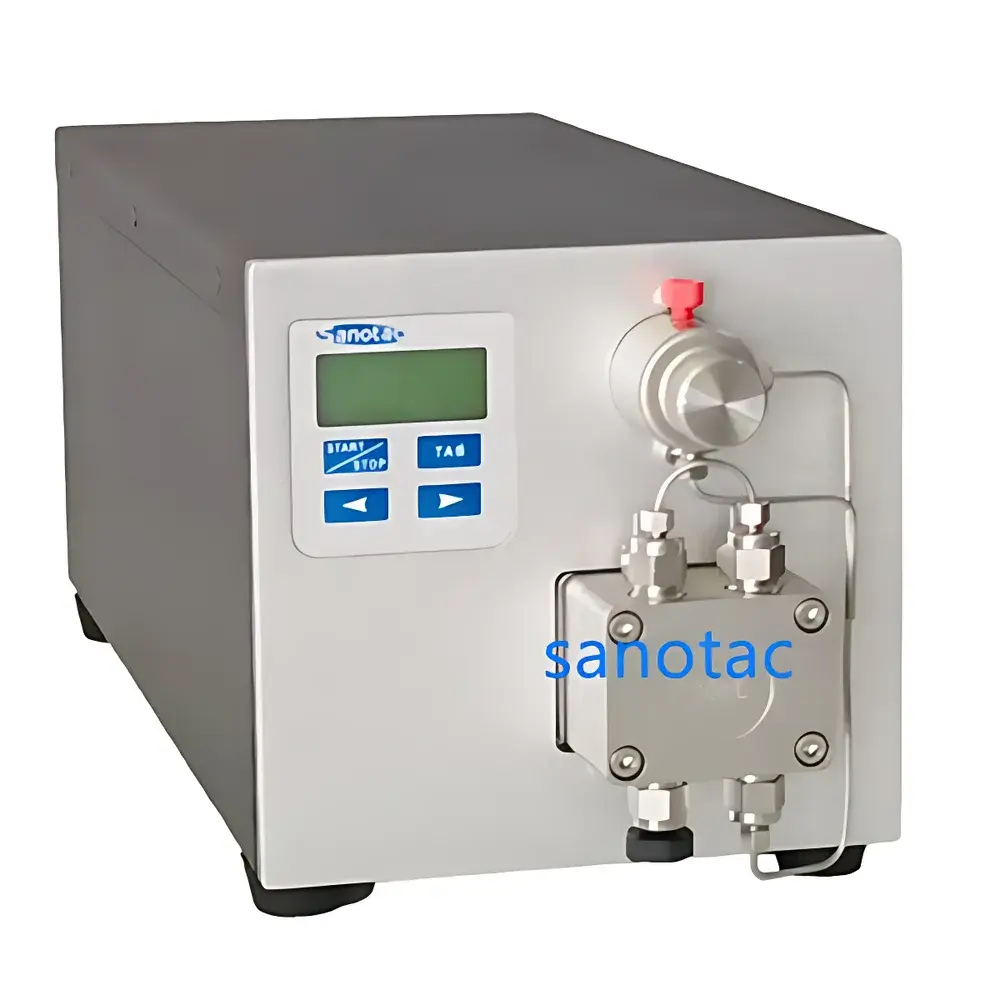
Sanotac QP0530 High-Precision Dual-Piston High-Pressure Solvent Delivery Pump
| Brand | Sanotac |
|---|---|
| Origin | Shanghai, China |
| Manufacturer Type | Direct Manufacturer |
| Model | QP0530 |
| Flow Rate | 0.01–50.00 mL/min |
| Pressure Rating | ≤ 30 MPa |
| Flow Accuracy | ±0.5% |
| Flow Precision | ≤ 0.1% RSD |
| Pressure Pulsation | ≤ 0.2 MPa |
| Pump Head Volume | 50 mL |
| Drive Mechanism | Dual-piston parallel mode with floating piston design |
| Wetted Materials | 316L stainless steel, ruby, PTFE, ceramic |
| Tubing Connection | 1/16″ standard |
| Display | 256×64 dot matrix backlit LCD |
| Control Interface | Front-panel keypad + RS232/485/422, USB, Ethernet (Modbus RTU/ASCII, Profibus DP, Profinet) |
| Power Supply | 85–264 VAC, 50 Hz |
| Dimensions | 370 × 145 × 152 mm |
Overview
The Sanotac QP0530 is a high-precision dual-piston high-pressure solvent delivery pump engineered for demanding continuous-flow applications requiring stable, pulse-minimized fluid displacement under elevated pressure. Based on positive displacement principle via synchronized dual-piston actuation with floating piston compensation, the QP0530 delivers exceptional volumetric accuracy and long-term stability across its full operational range. Its core architecture integrates mechanical pulse suppression—via optimized cam-profile drive—and real-time electronic flow pulsation correction, enabling consistent delivery even at low flow rates (<0.1 mL/min) and near-maximum pressure (up to 30 MPa). Designed for integration into automated analytical and process systems, the pump supports both standalone operation and closed-loop control within SCADA, DCS, or PLC environments—making it suitable for regulated laboratory and pilot-scale industrial workflows where reproducibility, traceability, and material compatibility are critical.
Key Features
- Dual-piston parallel drive with floating piston mechanism ensures balanced load distribution, minimizing wear and extending seal life.
- Multi-point flow calibration across the entire 0.01–50.00 mL/min range enables traceable volumetric accuracy of ±0.5% and repeatability ≤0.1% RSD.
- Integrated pressure pulsation suppression achieves ≤0.2 MPa residual pulsation—critical for HPLC-grade gradient formation and sensitive reaction monitoring.
- Column-piston post-wash function automatically flushes the rear seal interface during idle cycles, reducing abrasive particle accumulation and prolonging maintenance intervals.
- Configurable pressure protection setpoints and zero-offset compensation mitigate thermal drift and system backpressure variations.
- Native support for analog (0–5 V / 4–20 mA), digital (TTL), and industrial protocol stacks—including Modbus RTU/ASCII, Profibus DP, and Profinet—enables seamless interoperability with legacy and modern control infrastructures.
- Front-panel LCD (256×64 pixels, self-illuminated) provides real-time visualization of flow rate, pressure, program status, and alarm conditions without external software dependency.
Sample Compatibility & Compliance
The QP0530 accommodates a broad spectrum of chemically aggressive and high-viscosity media through optional wetted-path configurations: standard 316L stainless steel, corrosion-resistant Hastelloy C-276, inert PTFE/PEEK-lined heads, and ceramic-ruby check valve assemblies. All fluidic interfaces conform to ISO 8503-2 surface finish standards for hygienic and low-particulate applications. While not certified for Class I Div 1 hazardous locations, the pump complies with CE marking requirements (EMC Directive 2014/30/EU and LVD Directive 2014/35/EU), and its firmware architecture supports audit-trail-capable operation when deployed in GLP/GMP environments per FDA 21 CFR Part 11 guidelines—provided external software validation and electronic signature controls are implemented at the system level.
Software & Data Management
The QP0530 operates natively via embedded firmware supporting programmable flow profiles (constant, linear ramp, multi-step gradient), real-time pressure/flow curve plotting, and timestamped data logging to internal memory or external storage via USB. Export formats include CSV and PNG for traceable reporting. Calibration parameters are stored per user-defined method, allowing rapid recall of validated delivery protocols. Optional remote management software enables secure TCP/IP-based monitoring, parameter adjustment, and event-triggered notifications. All configuration changes generate immutable logs—including operator ID, timestamp, and pre/post-value—supporting ALCOA+ data integrity principles when integrated into validated chromatographic or reaction engineering platforms.
Applications
- HPLC and UHPLC mobile phase delivery in research and QC laboratories.
- Precise reagent dosing in catalytic screening reactors, including fixed-bed and slurry-phase systems.
- Supercritical fluid delivery (e.g., CO₂, CHF₃) for extraction and impregnation processes.
- Controlled monomer feed in continuous polymerization and microreactor synthesis.
- Electrolyte infusion in battery electrolyte testing and fuel cell membrane hydration studies.
- High-pressure chemical feed in refinery pilot units and hydroprocessing evaluation rigs.
FAQ
What is the maximum allowable operating pressure for the QP0530?
The QP0530 is rated for continuous operation up to 30 MPa (4350 psi) with appropriate wetted-material selection and proper system relief protection.
Can the pump be integrated into a PLC-controlled process skid?
Yes—the pump supports native Modbus RTU over RS485 and Profinet for deterministic real-time control, with configurable polling intervals and fault-handling logic.
Is flow calibration traceable to national standards?
Calibration is performed using gravimetric reference methods compliant with ISO 4064-2; users may perform field verification using NIST-traceable mass flow meters or precision balance systems.
Does the pump support gradient elution programming?
Yes—up to eight programmable segments per method, with independent ramp rates, dwell volume compensation, and real-time feedback synchronization.
What maintenance intervals are recommended for continuous 24/7 operation?
With proper fluid conditioning and column-piston wash activation, primary seal replacement is typically required every 6–12 months depending on solvent abrasivity and pressure profile.



