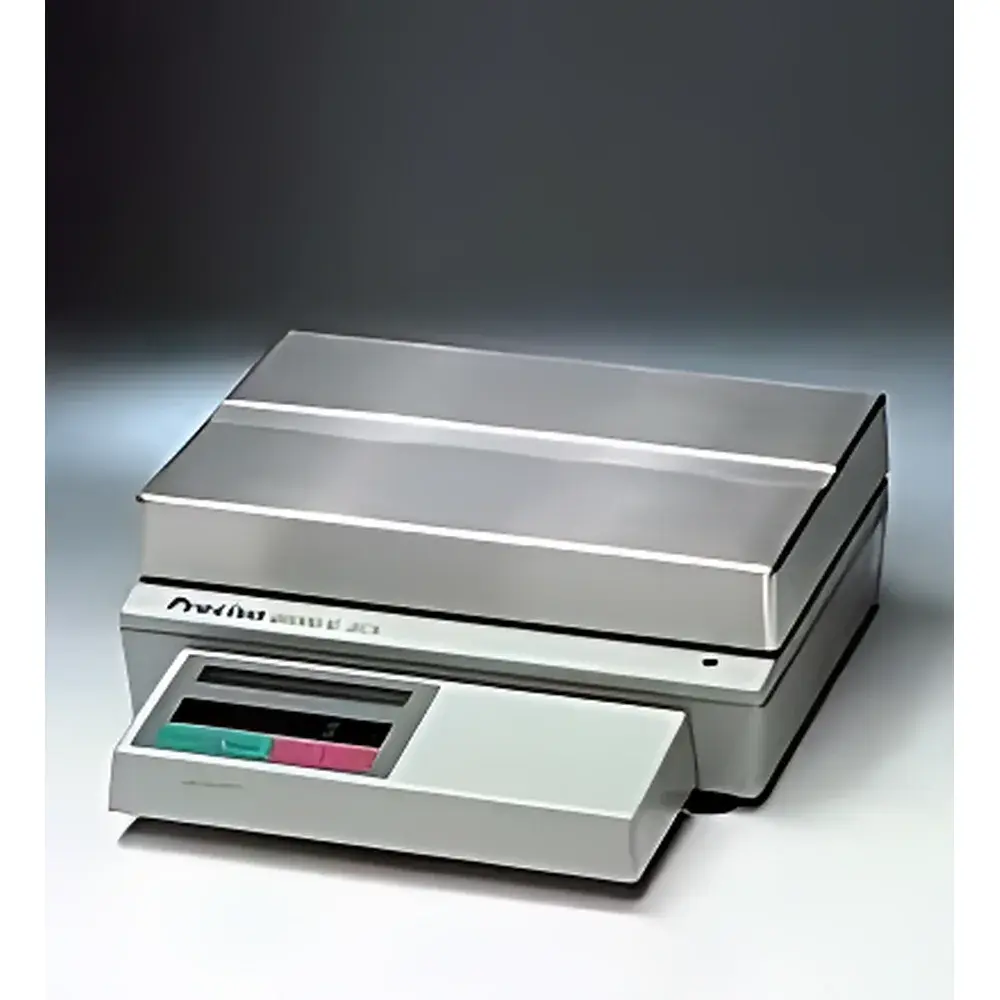
Precisa 20000G SCS High-Capacity Precision Balance
| Brand | Precisa |
|---|---|
| Model | 20000G SCS |
| Capacity | 20100 g |
| Readability | 1 g |
| Display Update Rate | 0.08 / 0.16 / 0.32 sec (adjustable) |
| Stability Settings | LOW / MED / HIGH |
| Operating Temperature | 0–40 °C |
| Power Supply | AC 230 V, 50/60 Hz |
| Power Consumption | 13 VA |
| Calibration | Internal motorized weight, auto-calibration triggered by time (every 24 h) or temperature drift (>2 °C) |
| Dimensions (W×H×D) | 375 × 130 × 396 mm |
| Pan Size | 375 × 250 mm |
| Net Weight | 14.5 kg |
| Interface | RS-232/V24 |
| Units Supported | g, kg, gn, dwt, ozt, oz, lb, ct, cm, pcs, tlh, tlm, tlt, % |
Overview
The Precisa 20000G SCS is a high-capacity precision balance engineered for demanding industrial, quality control, and laboratory environments where robustness, long-term stability, and regulatory-compliant weighing performance are essential. Designed around electromagnetic force compensation (EMFC) technology, it delivers consistent repeatability and linearity across its full 20,100 g capacity range with 1 g readability—optimized for applications requiring reliable gross-weight measurement rather than microgram-level analytical resolution. Its architecture integrates thermal mass stabilization, draft-free enclosure compatibility (via optional dust-proof display cover), and intelligent environmental adaptation logic to mitigate drift caused by ambient temperature fluctuations. The balance complies with ISO 9001 quality management system requirements as certified by the manufacturer, and its design principles align with fundamental metrological standards referenced in OIML R76 and ASTM E898 for non-automatic weighing instruments.
Key Features
- SCS (Smart Calibration System): Fully automated internal calibration using a built-in motorized reference weight; configurable for scheduled calibration every 24 hours or event-triggered recalibration upon detection of ≥2 °C ambient temperature change—ensuring traceable accuracy without manual intervention.
- Triple-mode stability selection (LOW/MED/HIGH): Dynamically adjusts filtering algorithms to match sample dynamics—ideal for viscous liquids, powders, or vibration-prone production floor installations.
- Multi-rate display update (0.08 / 0.16 / 0.32 sec): Enables optimization between responsiveness and noise suppression depending on operational priority.
- Dual-unit simultaneous display: Supports real-time conversion between two user-defined units (e.g., g and %, or kg and pcs) without toggling menus—critical for batch verification and formulation workflows.
- UMM (User Memory Module): Stores all operational parameters—including unit preferences, stability mode, auto-calibration schedule, and password settings—retained across power cycles for immediate readiness at startup.
- RS-232/V24 serial interface: Compatible with standard laboratory printers, LIMS, and SCADA systems; supports ASCII protocol for seamless integration into GLP/GMP data capture environments requiring audit trails.
- Security & traceability: Password-protected access prevents unauthorized configuration changes; optional audit log export via RS-232 supports FDA 21 CFR Part 11-aligned record retention when paired with compliant software.
Sample Compatibility & Compliance
The 375 × 250 mm stainless-steel weighing pan accommodates large-volume containers, industrial samples, and irregularly shaped objects—including drums, trays, and composite assemblies. Optional bottom-loading accessories enable suspension weighing for density determination (solid/liquid), while the integrated % weight indicator supports formulation ratio monitoring directly on the display. The balance operates reliably within 0–40 °C and ≤80% RH non-condensing environments—suitable for cleanrooms (ISO Class 8), warehouse QC labs, and manufacturing line-side stations. It meets CE marking requirements under the EU Measuring Instruments Directive (MID) Annex MI-001 for Class III non-automatic weighing instruments and conforms to electromagnetic compatibility (EMC) standards EN 61326-1 and safety standard EN 61010-1.
Software & Data Management
Data output follows standard ASCII framing over RS-232, enabling direct ingestion into Excel, LabWare LIMS, or custom MES platforms. While no proprietary software is bundled, the balance’s command set is fully documented in the technical manual (available upon request), supporting script-based automation for routine calibration logs, weight trending, and statistical process control (SPC) charting. When deployed in regulated environments, timestamped weight records—combined with UMM-stored operator IDs and calibration event flags—facilitate retrospective analysis during internal audits or regulatory inspections per ISO/IEC 17025 or ICH Q7 guidelines.
Applications
- Raw material receipt inspection and lot acceptance testing in pharmaceutical excipient and fine chemical supply chains.
- Batch dispensing and formulation verification in food & beverage production (e.g., dry mix blending, sauce base preparation).
- Component counting (pieces mode) with user-defined reference sample counts—used for fast inventory reconciliation of hardware, PCBs, or packaging components.
- Density determination of solids and liquids using optional buoyancy kits—supporting QC checks for polymer pellets, metal alloys, and solvent purity.
- Stability testing support: Monitoring weight loss/gain of desiccators, accelerated aging samples, or corrosion coupons over extended periods.
FAQ
What does “SCS” stand for in the model name?
SCS refers to Precisa’s Smart Calibration System—a self-contained, motor-driven internal calibration mechanism that maintains metrological integrity without external weights or technician involvement.
Is this balance suitable for GxP-regulated environments?
Yes—when configured with password protection, RS-232 logging, and documented calibration schedules, it supports ALCOA+ data integrity principles; however, final validation must be performed per site-specific SOPs and risk assessment.
Can the balance perform dynamic weighing (e.g., filling operations)?
It supports stable static weighing only; for continuous in-motion applications, a dedicated checkweigher or belt scale is recommended.
Does the 1 g readability meet USP <41> requirements for heavy-load balances?
USP <41> applies primarily to analytical balances (≤200 g capacity); this instrument falls under general-purpose Class III instrumentation governed by OIML R76—where 1 g readability at 20 kg is metrologically appropriate.
Is firmware upgradable in the field?
Firmware updates require authorized service center intervention via dedicated diagnostic port; no end-user flash capability is provided to preserve calibration traceability.