
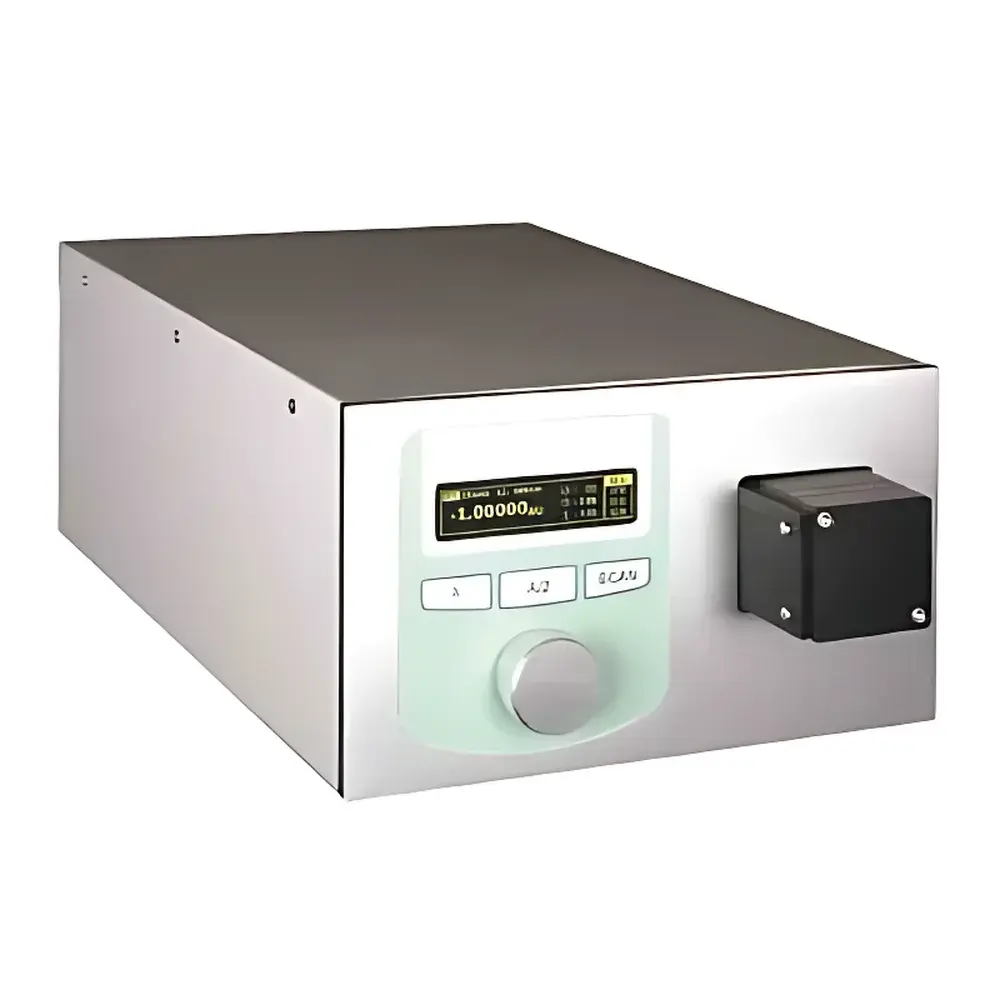
Sanwei UV2000 Full-Range Ultraviolet Detector
| Origin | Shanghai, China |
|---|---|
| Manufacturer Type | Distributor |
| Origin Category | Domestic |
| Model | UV2000 |
| Price Range | USD 1,400–2,800 (est.) |
| Instrument Type | Ultraviolet Detector (UVD) |
| Wavelength Range | 190–800 nm |
| Detection Mode | Simultaneous dual-wavelength detection across 190–800 nm |
| Light Source | Deuterium Lamp + Tungsten-Halogen Lamp |
| Wavelength Accuracy | ±1 nm |
| Wavelength Repeatability | 0.2 nm |
| Flow Cell Pathlength | Adjustable from 1 to 5 mm |
| Flow Cell Inlet/Outlet | 1/16" for analytical & semi-preparative |
| Baseline Noise | ±0.5 × 10⁻⁵ AU at 254 nm (time constant = 1 s) |
| Baseline Drift | 1.5 × 10⁻⁴ AU/h at 254 nm |
| Absorbance Range | ≥3 AU |
| Time Constants | 0.1 / 0.2 / 0.5 / 1.0 / 2.0 / 5.0 / 10.0 s |
| Digital Zero Adjustment | Full-scale auto-zero |
| Display | 256 × 64 dot-matrix OLED with uniform brightness and wide viewing angle |
| Control Interface | Front-panel keypad + RS-232/USB bidirectional communication for PC remote control |
| Power Supply | 85–264 VAC, 50/60 Hz, 150 W |
| Compliance | FDA 21 CFR Part 11, CFDA GxP (GLP/GMP-aligned), audit trail, electronic signature, role-based user authentication |
Overview
The Sanwei UV2000 Full-Range Ultraviolet Detector is a high-stability, dual-lamp UV-Vis absorbance detector engineered for integration into analytical and preparative liquid chromatography systems—including HPLC, medium-pressure LC (MPLC), preparative HPLC, protein purification platforms, and chromatographic fraction collectors. It operates on the principle of Beer–Lambert absorption spectroscopy, measuring sample-specific attenuation of ultraviolet and visible light across a continuous 190–800 nm spectral range. Its dual-optical-path architecture—comprising a deuterium lamp for deep-UV performance (190–370 nm) and a tungsten-halogen lamp for stable visible-range output (350–800 nm)—ensures seamless spectral coverage without manual lamp switching or intensity discontinuities. The detector delivers high photometric linearity and reproducibility essential for quantitative analysis of UV-absorbing analytes such as nucleic acids, aromatic amino acids, pharmaceutical actives, natural product alkaloids, flavonoids, and synthetic intermediates.
Key Features
- Dual-wavelength simultaneous detection capability enables real-time monitoring of primary analyte and co-eluting impurities or degradation products—critical for method development, peak purity assessment, and forced degradation studies.
- Adjustable flow cell pathlength (1–5 mm) supports both high-sensitivity analytical detection and low-dilution preparative monitoring without flow splitting, preserving column efficiency and fraction integrity.
- Three built-in wavelength scanning modes—full-spectrum scan, fixed-wavelength tracking, and multi-point wavelength optimization—facilitate method scouting and spectral library matching.
- Onboard wavelength auto-calibration using internal reference peaks ensures long-term spectral fidelity and traceable alignment to NIST-traceable standards.
- Open communication protocol (RS-232 and USB) enables full bidirectional control by third-party chromatography data systems (CDS), including Thermo Chromeleon, Waters Empower, Agilent OpenLab, and custom LabVIEW or Python-based automation frameworks.
- OLED display with 256 × 64 resolution provides high-contrast, ambient-light-insensitive visualization of absorbance traces, system status, and parameter settings across all viewing angles.
Sample Compatibility & Compliance
The UV2000 is compatible with standard stainless-steel, PEEK, and titanium flow cells and interfaces seamlessly with columns and SPE cartridges from major vendors (e.g., Waters, Phenomenex, Agilent, Thermo Fisher, GL Sciences). Its hardware and firmware architecture complies with regulatory requirements for data integrity in regulated environments: full implementation of FDA 21 CFR Part 11—including electronic signatures, role-based access control (RBAC), immutable audit trails, session lockout, and secure electronic record storage. All user actions—including method modification, data export, and instrument calibration—are timestamped, attributed, and non-erasable. System validation documentation (IQ/OQ/PQ templates), URS mapping, and change control logs are provided to support GLP, GMP, and ISO/IEC 17025 laboratory accreditation processes.
Software & Data Management
The bundled ChromaControl software provides integrated control of UV2000 detectors alongside compatible pumps, conductivity detectors, and fraction collectors. Project-based database architecture stores methods, chromatograms, calibration curves, and report templates within hierarchical project folders. Raw absorbance data are saved in vendor-neutral .csv and .cdf formats, supporting post-acquisition reprocessing in MATLAB, OriginLab, or Python (pandas + matplotlib). All software modules enforce strict permission tiers: Administrator, Analyst, Reviewer, and Auditor—with configurable privileges for method editing, data deletion, signature approval, and audit log review. Electronic signature workflows require dual-user authentication for critical operations (e.g., batch release, method validation), satisfying ALCOA+ data governance principles.
Applications
The UV2000 serves as a core detection module in diverse research and production settings: quantification of herbal marker compounds (e.g., berberine, ginsenosides, hypericin) in TCM quality control; purity assessment of monoclonal antibody fragments during affinity and ion-exchange purification; stability-indicating assay development for small-molecule APIs per ICH Q2(R2); monitoring of oligonucleotide synthesis by trityl-on HPLC; and rapid screening of combinatorial libraries in medicinal chemistry. Its broad spectral range also supports characterization of novel dyes, photocatalysts, and quantum dot suspensions where UV-Vis fingerprinting informs structural and aggregation state analysis.
FAQ
Does the UV2000 support gradient elution compatibility with variable-wavelength scanning?
Yes—the detector synchronizes wavelength selection with pump gradient profiles via TTL or analog trigger signals, enabling dynamic spectral acquisition during method gradients.
Can the UV2000 be used with high-salt mobile phases common in protein chromatography?
Yes—standard flow cells are chemically resistant to ammonium acetate, sodium phosphate, and arginine-based buffers up to pH 9. Optional corrosion-resistant titanium cells are available for extended use with >0.5 M salt concentrations.
Is method transfer between different UV2000 units supported?
Yes—method files include embedded wavelength calibration offsets and baseline correction parameters, ensuring consistent retention time and peak area reproducibility across instruments in multi-site laboratories.
How is wavelength accuracy verified during routine operation?
Users may perform on-demand verification using holmium oxide or didymium oxide filters; the system logs each verification event with operator ID, date, deviation value, and pass/fail status in the audit trail.
What level of cybersecurity is implemented for network-connected operation?
When connected via Ethernet (optional module), the device implements TLS 1.2 encryption, configurable firewall rules, and disabled default credentials—all aligned with IEC 62443-3-3 Level 1 requirements for laboratory instrumentation.





