
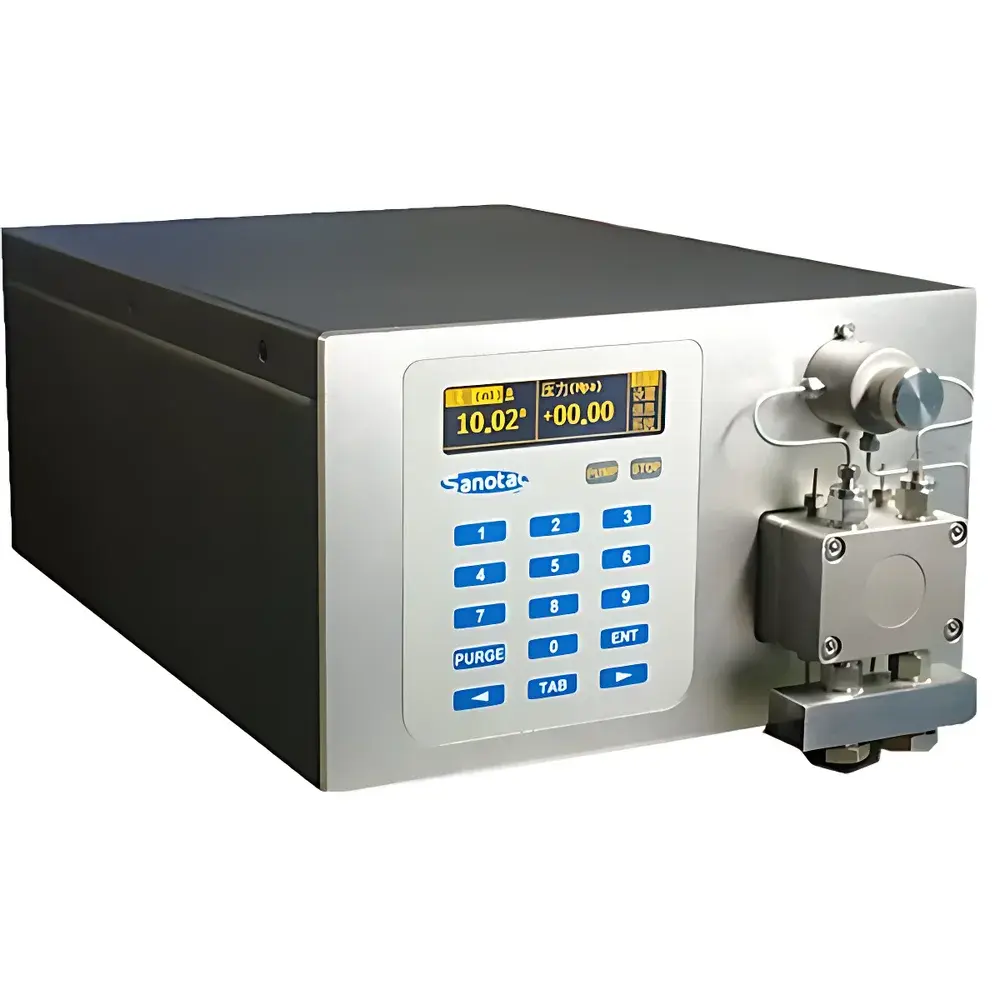
Sanotac SP0530 Semi-Preparative High-Pressure Solvent Delivery Pump
| Brand | Sanotac |
|---|---|
| Origin | Shanghai, China |
| Manufacturer Type | Original Equipment Manufacturer (OEM) |
| Product Category | Domestic |
| Model | SP-0530 |
| Flow Rate | 0.01–50.00 mL/min |
| Pressure Rating | ≤30 MPa |
| Flow Increment | 0.01 mL/min |
| Flow Accuracy | ±0.5% |
| Flow Precision (RSD) | ≤0.1% |
| Pressure Pulsation | ≤0.5 MPa |
| Pump Head Material | Ceramic, Titanium, Stainless Steel, Al₂O₃, PEEK |
| Display | 256×64-dot self-luminous LCD with adjustable backlight |
| Connectivity | Manual front-panel control + RS-232/USB for PC remote control |
| Power Supply | 85–264 VAC, 150 W |
| Fluidic Wetted Materials | 316L SS, Ti, Al₂O₃, PEEK |
Overview
The Sanotac SP0530 Semi-Preparative High-Pressure Solvent Delivery Pump is an engineered precision fluid handling system designed for robust, stable, and reproducible mobile phase delivery in preparative and semi-preparative liquid chromatography (LC), including flash chromatography, purification workflows, and method development applications. Operating on a dual-piston serial pumping principle with a floating piston support architecture, the SP0530 minimizes mechanical wear at critical sealing interfaces—extending service life of both pistons and seal assemblies without compromising pressure integrity or flow stability. Its ceramic pump head enables continuous operation up to 30 MPa (4350 psi), supporting high-resolution separations across diverse stationary phases and column dimensions (e.g., 10–50 mm ID columns). The pump’s hydraulic design adheres to fundamental principles of positive displacement metering, where volumetric displacement per stroke is precisely controlled via stepper motor-driven cam profiles and real-time pressure feedback compensation—ensuring consistent dwell volume and minimal gradient delay.
Key Features
- Dual-piston serial configuration with floating piston support mechanism for reduced friction, lower seal wear, and extended maintenance intervals
- Full-scale flow range of 0.01–50.00 mL/min with 0.01 mL/min programmable increment—optimized for both low-flow analytical scouting and high-throughput semi-prep runs
- Flow accuracy of ±0.5% and repeatability (RSD) ≤0.1% under steady-state conditions, verified per ISO 5725-2 guidelines
- Pressure pulsation <0.5 MPa across full operating range—critical for baseline stability in UV/VIS and mass-sensitive detection
- Ceramic pump head with wetted components constructed from 316L stainless steel, titanium, aluminum oxide (Al₂O₃), and PEEK—ensuring chemical compatibility with aggressive solvents (e.g., THF, DCM, TFA, high-pH buffers)
- 256×64-dot self-luminous LCD display with uniform brightness and wide viewing angle; user-adjustable backlight intensity for lab ambient adaptability
- Integrated dual-control interface: local keypad navigation plus bidirectional RS-232/USB communication for remote command execution and status monitoring
Sample Compatibility & Compliance
The SP0530 is compatible with common LC-grade organic and aqueous mobile phases—including acetonitrile, methanol, ethanol, isopropanol, water, ammonium acetate/formate buffers (pH 2–10), and dilute mineral acids/bases—when used with appropriate wetted material configurations. All fluid-contact surfaces comply with USP Class VI biocompatibility standards for polymer components (PEEK, Al₂O₃) and ASTM F899 for corrosion resistance of stainless steel and titanium alloys. The pump meets CE electromagnetic compatibility (EMC) Directive 2014/30/EU and Low Voltage Directive 2014/35/EU. While not inherently 21 CFR Part 11 compliant, its firmware supports audit-trail-ready operation when integrated with validated chromatography data systems (CDS) that enforce electronic signature, change control, and user access management protocols per GLP/GMP requirements.
Software & Data Management
The SP0530 supports ASCII-based command protocol over RS-232 or USB virtual COM port, enabling seamless integration with third-party CDS platforms (e.g., Chromeleon, Empower, OpenLab CDS) and custom LabVIEW or Python automation scripts. It transmits real-time parameters—including setpoint flow rate, actual flow output, current pressure reading, error codes, and operational status—via structured response frames. Firmware versioning, parameter logging, and event timestamping are accessible through host software. No onboard data storage is provided; all acquisition and archival responsibilities reside with the connected CDS or SCADA environment. Remote firmware updates require physical USB connection and signed binary verification.
Applications
- Semi-preparative purification of natural products, synthetic intermediates, and peptide libraries (1–50 mg scale)
- Method transfer from analytical to preparative LC platforms with retention time fidelity
- Multi-solvent gradient elution in flash chromatography systems with automated fraction collection
- Mobile phase delivery for supercritical fluid chromatography (SFC) co-solvent pumps (when paired with CO₂ delivery modules)
- Stable solvent supply in coupled techniques such as LC-NMR and LC-MS interface conditioning
- Calibration and validation of flow sensors and pressure transducers in metrology labs
FAQ
What is the maximum allowable backpressure for continuous operation?
The SP0530 is rated for continuous operation at ≤30 MPa (4350 psi) when equipped with the standard ceramic pump head and operated within specified temperature and solvent compatibility limits.
Can the pump be integrated into a GMP-regulated purification workflow?
Yes—when deployed with a validated CDS that enforces 21 CFR Part 11 controls (electronic signatures, audit trails, role-based access), the SP0530 serves as a compliant peripheral device in GMP purification suites.
Is gradient mixing capability built-in?
No—the SP0530 is a single-channel high-pressure pump. Gradient formation requires external low-pressure mixing (e.g., using a proportioning valve module) or pairing with a second SP0530 unit in a dual-pump configuration.
What maintenance intervals are recommended for piston seals?
Under typical use (≤25 MPa, aqueous/organic solvents, 8 h/day), piston seal replacement is recommended every 6–12 months; frequency increases with abrasive buffers or high-pH mobile phases.
Does the pump support pulseless flow for mass spectrometry coupling?
While pressure pulsation is minimized (<0.5 MPa), post-pump passive dampeners or active flow-smoothing modules are recommended for optimal ESI or APCI source stability in LC-MS applications.



