
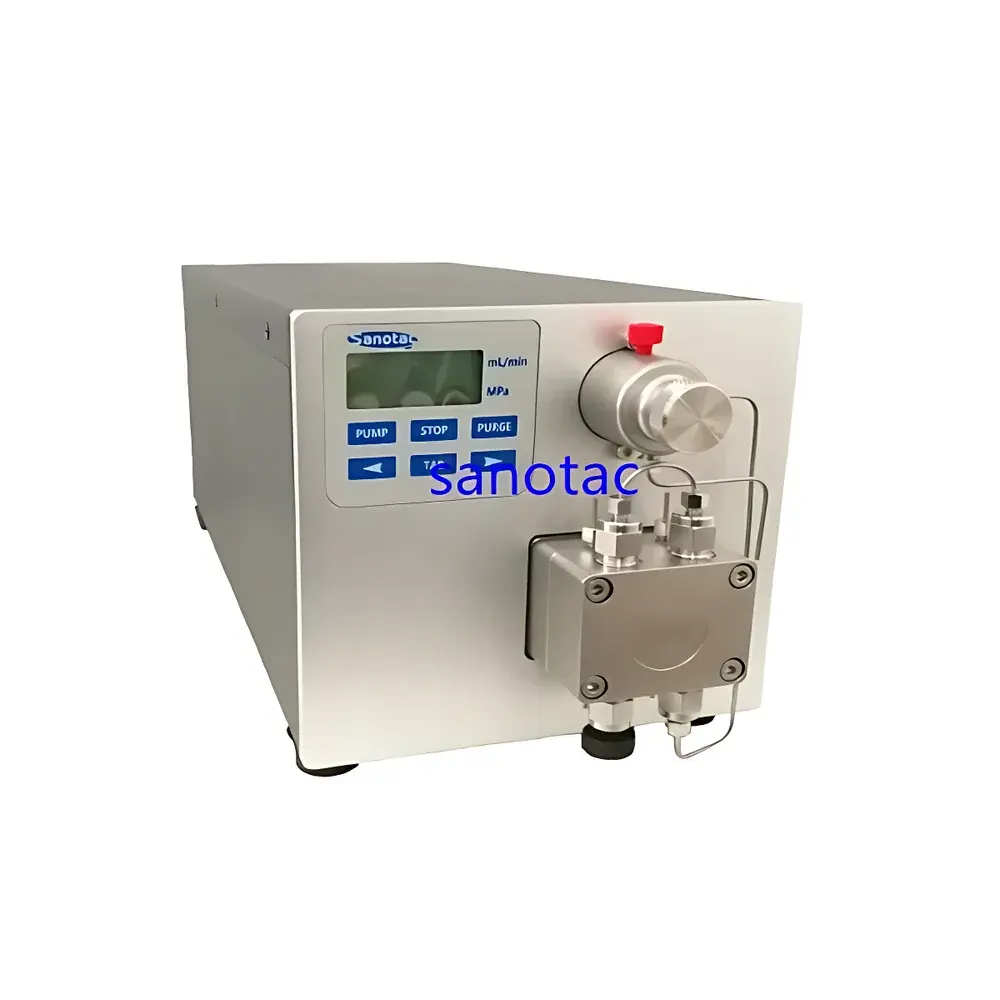
Sanotac WP0530 High-Pressure Dual-Piston Constant Flow Pump for Microreactor Systems
| Brand | Sanotac |
|---|---|
| Origin | Shanghai, China |
| Manufacturer Type | Direct Manufacturer |
| Country of Origin | China |
| Model | WP0530 |
| Flow Rate | 0.01–50.00 mL/min |
| Maximum Pressure | 30 MPa |
| Flow Accuracy | ±0.5% |
| Flow Precision (RSD) | ≤0.1% |
| Pressure Pulsation | ≤0.2 MPa |
| Pump Head Volume | 50 mL |
| Wetted Materials | 316L Stainless Steel, Sapphire, PTFE, Ceramic |
| Tubing Connection | 1/16" Standard Fitting |
| Display | 256×64 Dot Matrix Backlit LCD |
| Control Interface | Front Panel Keypad + RS232/USB Open Protocol for PC Remote Control |
| Power Supply | 85–264 VAC, 50 Hz |
| Dimensions (W×H×D) | 370×145×152 mm |
Overview
The Sanotac WP0530 is a high-precision, dual-piston constant flow pump engineered specifically for integration with microfluidic reactors, continuous-flow chemical synthesis systems, and lab-scale microreaction platforms requiring stable, low-pulsation fluid delivery under elevated pressure. Operating on the principle of parallel dual-piston actuation with floating piston design and real-time solvent compressibility compensation, the WP0530 delivers exceptional volumetric accuracy across a wide dynamic range—from trace-level reagent dosing (0.01 mL/min) to high-throughput process feed (50 mL/min)—while maintaining structural integrity up to 30 MPa (4350 psi). Its architecture aligns with fundamental requirements for microreactor hydraulics: minimal dead volume, chemically inert wetted path, and deterministic flow response essential for residence time control, reaction kinetics studies, and multi-step cascade reactions.
Key Features
- Dual-piston parallel pumping mechanism with floating piston design to reduce seal wear and extend service life under sustained high-pressure operation.
- Microprocessor-based flow control incorporating multi-point flow calibration curves and electronic pulse suppression algorithms, achieving ≤0.1% RSD flow repeatability and ±0.5% absolute accuracy per ISO 5725-2.
- Low-pressure pulsation performance (≤0.2 MPa) enabled by optimized cam profile compensation and active electronic damping—critical for preserving laminar flow profiles in microchannels and avoiding bubble nucleation or sensor interference.
- Chemically resistant fluid path constructed from 316L stainless steel, sapphire check valves, PTFE seals, and ceramic components—compatible with aggressive solvents (e.g., concentrated acids, halogenated organics, supercritical CO₂ co-solvents) and particulate-laden slurries when filtered.
- Open-protocol RS232/USB interface supporting bidirectional communication; compatible with third-party chromatography data systems (CDS), LIMS, and custom Python/LabVIEW automation frameworks without proprietary driver dependencies.
- Intuitive front-panel operation with backlit 256×64 dot-matrix display and ten user-programmable methods—including gradient elution profiles combining isocratic, linear, and step functions—enabling rapid method development for reaction optimization.
Sample Compatibility & Compliance
The WP0530 accommodates a broad spectrum of process fluids relevant to continuous manufacturing and analytical-scale synthesis, including aqueous buffers, organic solvents (THF, DMF, DCM), ionic liquids, polymer solutions, and heterogeneous suspensions (with appropriate inline filtration). All wetted materials comply with USP Class VI and FDA CFR 21 Part 11 readiness guidelines for audit trail logging when integrated with validated software environments. The pump meets CE electromagnetic compatibility (EMC) Directive 2014/30/EU and Low Voltage Directive 2014/35/EU. While not certified for explosive atmospheres, its sealed electronics and non-sparking motor design support safe deployment in general laboratory and pilot-plant settings compliant with NFPA 45 and ISO 15195 standards for analytical equipment.
Software & Data Management
The WP0530 supports both standalone operation and full computer integration via an openly documented ASCII-based command protocol. This enables seamless incorporation into GLP/GMP-aligned workflows: timestamped flow/pressure logs can be exported in CSV format, and parameter changes are recordable within electronic lab notebooks (ELN) or CDS platforms. When paired with Sanotac’s optional PumpControl Suite (v3.2+), users gain access to real-time pressure trend visualization, automatic leak detection thresholds, method validation reporting templates aligned with ICH Q2(R2), and secure user role management (admin/operator/reviewer). Audit trails include operator ID, timestamp, parameter setpoints, and deviation flags—fully traceable for regulatory submissions.
Applications
- Continuous-flow hydrogenation, oxidation, and photoredox catalysis in glass/silicon microreactors (e.g., Corning AFR, Chemtrix BV systems).
- Preparative-scale nanoparticle synthesis (quantum dots, MOFs, liposomes) requiring precise stoichiometric control and narrow residence time distribution.
- In-line reaction calorimetry and FTIR monitoring where flow stability directly impacts signal-to-noise ratio and kinetic model fidelity.
- Automated high-throughput screening of catalyst libraries using segmented flow or droplet-based microfluidics.
- Method transfer from HPLC to preparative SFC or chiral purification systems where pressure and flow consistency dictate enantioselectivity reproducibility.
- On-demand reagent delivery in automated API synthesis platforms compliant with ASTM E2500-13 lifecycle management principles.
FAQ
What is the maximum recommended operating pressure for continuous use?
The WP0530 is rated for continuous operation at ≤30 MPa (4350 psi); short-term excursions up to 32 MPa are permissible but not advised for routine use.
Can the pump handle viscous fluids above 500 cP?
Yes—when paired with appropriately sized tubing (e.g., 1/8″ ID) and pre-heated fluid paths, the WP0530 maintains accuracy with viscosities up to 1000 cP at 25°C; viscosity compensation must be applied manually in method programming.
Is the flow path compatible with sodium hypochlorite or hydrofluoric acid?
HF requires full PCTFE or Hastelloy C-276 wetted parts (custom configuration); standard 316L/PTFE construction supports ≤10% NaOCl solutions at ambient temperature with limited exposure duration.
Does the pump support gradient mixing internally?
No—the WP0530 is a single-solvent high-pressure pump; gradient formation requires external low-pressure quaternary mixing modules or upstream proportioning valves.
How often should the sapphire check valves be inspected?
Under typical organic solvent use at ≤20 MPa, inspection is recommended every 6 months or after 2000 hours of cumulative runtime; replacement intervals extend significantly with aqueous or low-abrasion media.



