
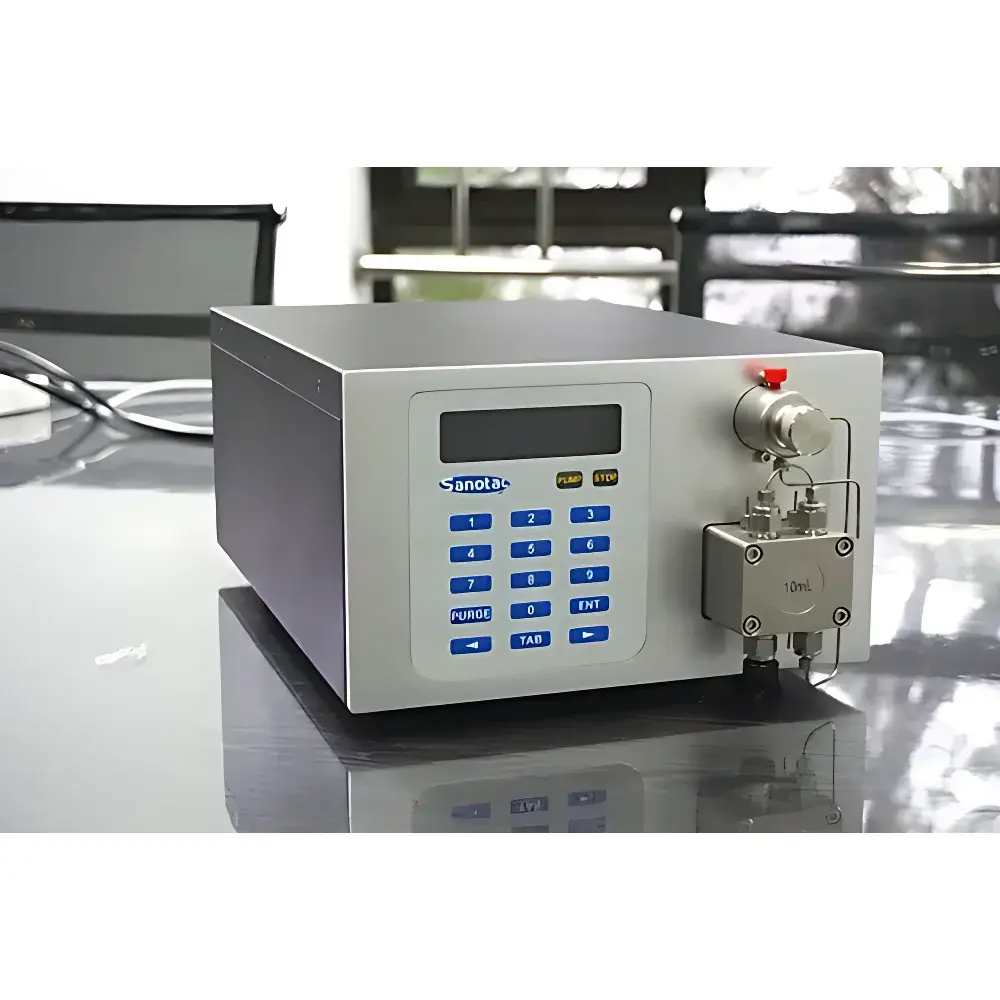
Sanotac N600 Dual High-Pressure Piston Pump System with Impingement Jet Mixer for mRNA-LNP Formulation
| Brand | Sanotac |
|---|---|
| Origin | Shanghai, China |
| Manufacturer Type | Manufacturer |
| Country of Origin | Domestic (China) |
| Model | N600 |
| Flow Rate | 0.01–600.00 mL/min (adjustable in 0.01 mL/min increments) |
| Max Pressure | 15 MPa |
| Flow Accuracy | ±0.5% |
| Flow Precision (RSD) | ≤0.5% |
| Pressure Pulsation | ≤0.2 MPa |
| Wetted Materials | 316L stainless steel, ruby, PTFE, ceramic |
| Communication | RS232, USB (standard) |
| Power Supply | 85–264 VAC, 50 Hz |
Overview
The Sanotac N600 Dual High-Pressure Piston Pump System with Integrated Impingement Jet Mixer is a GMP-aligned, laboratory-scale formulation platform engineered for the reproducible synthesis of lipid nanoparticles (LNPs) used in mRNA vaccine and therapeutic development. This system implements a precisely controlled hydrodynamic mixing principle—specifically, impingement jet mixing—where two independently metered streams (lipid solution and aqueous mRNA buffer) are accelerated to high velocity and collided head-on within a micro-geometry mixer chamber. The resulting turbulent kinetic energy, combined with rapid dilution and supersaturation under controlled pressure and residence time, drives spontaneous self-assembly of uniform, monodisperse LNPs (typically 70–120 nm in diameter). Unlike passive mixing or bulk homogenization, impingement mixing enables sub-millisecond mixing times (<10 ms), critical for achieving narrow polydispersity index (PDI 90%)—key quality attributes defined in ICH Q5A(R2) and referenced in FDA’s Chemistry, Manufacturing, and Controls (CMC) guidance for RNA-based products.
Key Features
- Dual independent high-pressure piston pumps with floating plunger design, enabling true parallel delivery of lipid and nucleic acid streams at matched or programmable flow ratios.
- Real-time pressure monitoring and dual-stage overpressure protection: user-configurable upper/lower pressure limits with automatic pump shutdown and alarm logging.
- Low-pulsation fluid delivery achieved via cam-profile compensation and electronic flow pulse suppression—critical for stable jet formation and consistent particle size distribution.
- Flexible operation modes: constant-flow mode for steady-state LNP synthesis; gradient-flow mode for process optimization (e.g., ramped lipid:mRNA ratio during mixing).
- Integrated pressure and flow curve visualization on backlit LCD display—each pump displays real-time dynamic profiles for operational diagnostics and batch traceability.
- Modular wetted path constructed from 316L stainless steel, sapphire check valves, PTFE seals, and ceramic plungers—compatible with organic solvents (e.g., ethanol, isopropanol) and aqueous buffers across pH 3–11.
- Standard 1/8″ Swagelok-compatible fluidic interfaces and configurable analog/digital I/O (0–10 V, 4–20 mA, discrete TTL) for seamless integration into existing automation architectures.
Sample Compatibility & Compliance
The N600 system supports formulation of ionizable cationic lipids (e.g., DLin-MC3-DMA, SM-102, ALC-0315), phospholipids (DSPC), cholesterol, and PEG-lipids dissolved in ethanol or isopropanol, mixed with Tris- or citrate-buffered mRNA solutions (0.1–2 mg/mL). All contact materials comply with USP Class VI and ISO 10993-1 biocompatibility standards. The control architecture supports audit-trail-enabled operation per FDA 21 CFR Part 11 when integrated with validated SCADA or DCS systems. Data integrity features include timestamped event logs, parameter change history, and password-protected configuration access—aligned with ALCOA+ principles for GLP/GMP environments.
Software & Data Management
The N600 operates as an embedded node within industrial control ecosystems. It natively supports Modbus RTU/TCP, Profibus-DP, and Profinet protocols—enabling direct communication with Siemens S7 PLCs, Rockwell ControlLogix, or Schneider EcoStruxure platforms. Optional PC-based control software provides recipe management, batch export (CSV/Excel), and synchronized multi-pump sequencing. All communication interfaces (RS232, USB, RS485, Ethernet) support deterministic timing for closed-loop feedback control—essential for maintaining constant total flow during gradient runs. Historical pressure/flow datasets are exportable for statistical process control (SPC) analysis per ISO 13485 Annex C.
Applications
- mRNA-LNP formulation for preclinical and Phase I/II clinical supply (supporting scale-up from 1–50 mL/batch).
- Process development studies: DoE-driven optimization of flow ratio, total flow rate, mixing pressure, and temperature effects on PDI, encapsulation efficiency, and cryo-TEM morphology.
- Comparative evaluation of novel ionizable lipids or helper lipids under identical hydrodynamic conditions.
- Integration into continuous manufacturing lines for end-to-end RNA drug product synthesis (e.g., coupled with inline DLS, FFF, or microfluidic QC modules).
- Training and technology transfer for CMO personnel—validated by multiple global pharmaceutical partners in active mRNA vaccine programs.
FAQ
What is the maximum operating pressure and flow range for each pump channel?
Each N600 pump channel delivers 0.01–600.00 mL/min at pressures up to 15 MPa (2175 psi), with flow resolution of 0.01 mL/min and accuracy of ±0.5%.
Can the system be integrated into a Siemens S7-1500 PLC environment?
Yes—the N600 supports native Profinet and Profibus-DP protocols; hardware-level synchronization ensures <10 ms cycle time for coordinated dual-pump operation.
Is the mixer geometry customizable for different LNP size targets?
The standard impingement jet mixer is optimized for 70–100 nm LNPs; custom mixer inserts (e.g., staggered jet, multi-orifice) are available upon request for specific size or encapsulation requirements.
Does the system meet regulatory requirements for clinical-grade manufacturing?
While the N600 is a laboratory-scale unit, its architecture—traceable calibration, electronic audit trails, protocol-controlled operation, and material compliance—supports qualification per ASTM E2500 and alignment with ICH Q7 Annex 19 for early-phase clinical material production.
How is flow calibration performed and documented?
Users perform gravimetric calibration using the built-in calibration utility; all calibration coefficients, timestamps, operator IDs, and reference weights are stored in non-volatile memory and exportable for QA review.



