
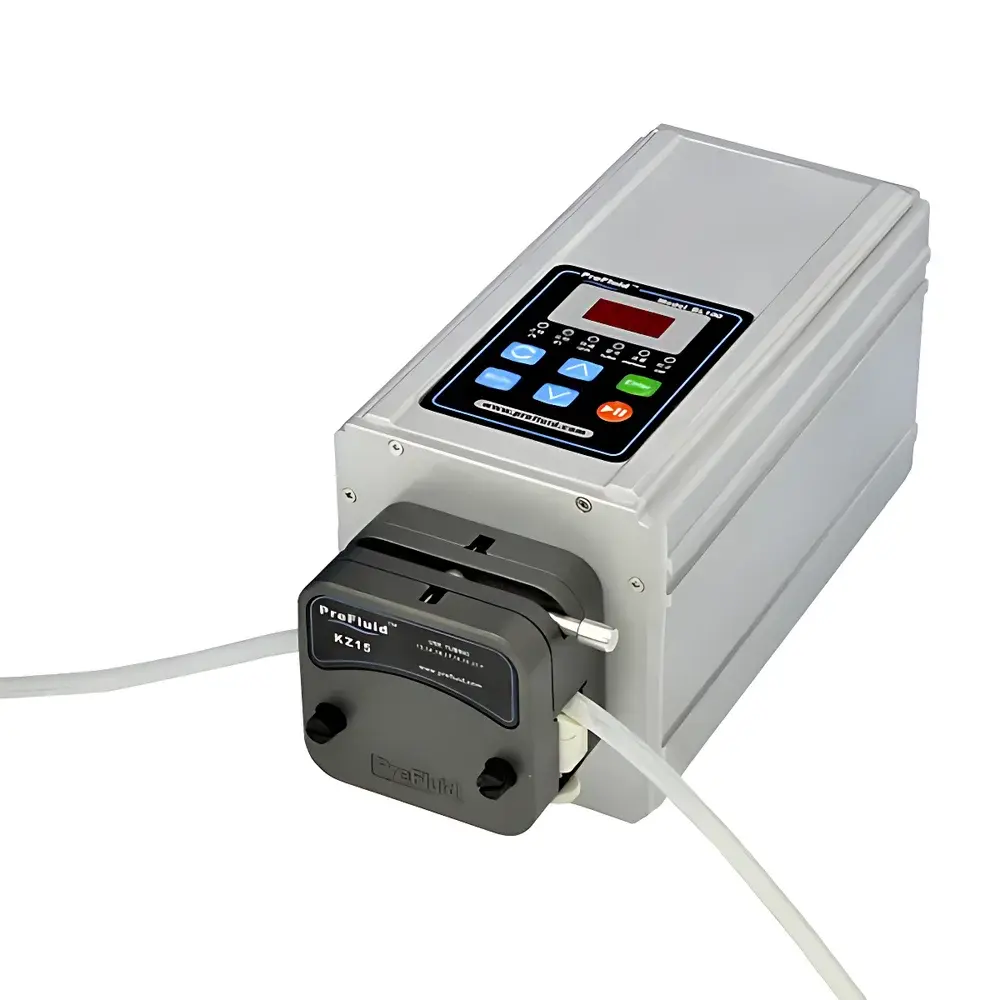
PreFluid BL100-KZ15 Flow-Display Peristaltic Pump
| Brand | PreFluid |
|---|---|
| Origin | Jiangsu, China |
| Model | BL100-KZ15 |
| Flow Rate Range | 0.012–7572 mL/min |
| Speed Range | 0.1–100 rpm |
| Display | 4-digit LED (speed or flow) |
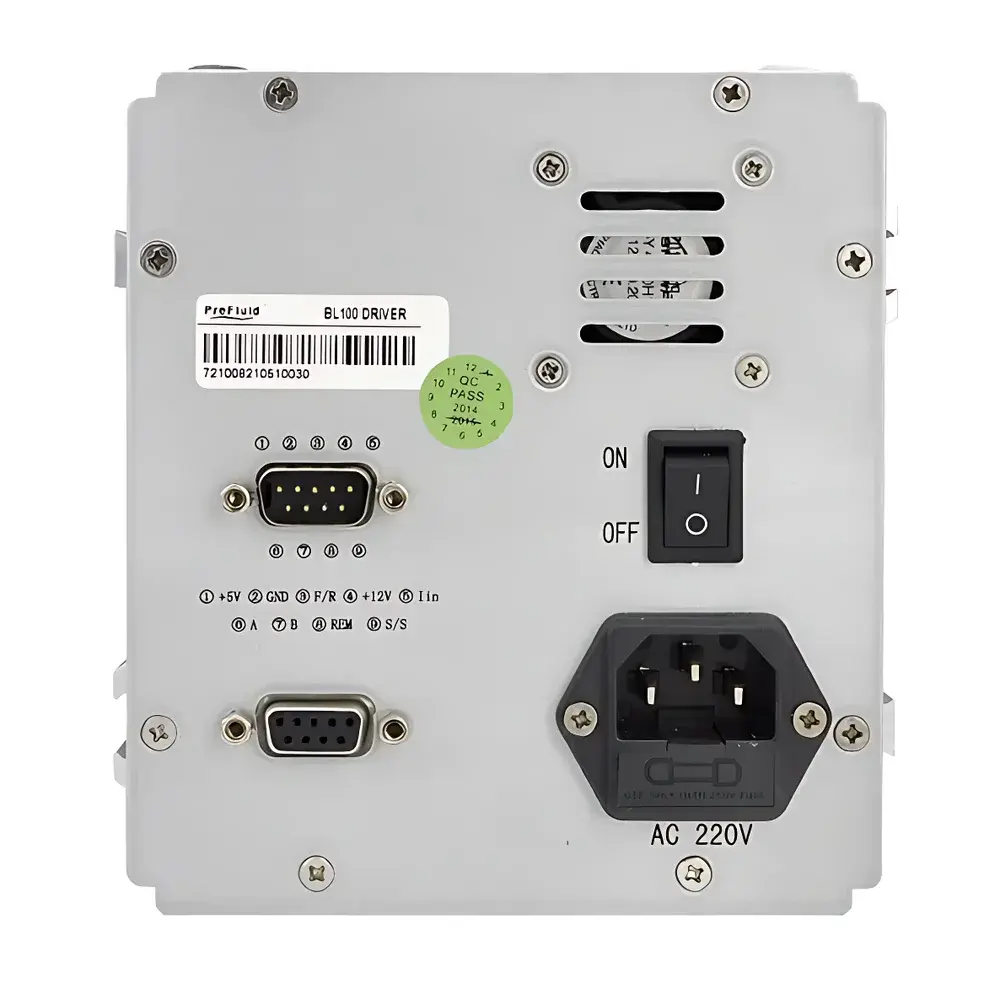
| Control Interface | RS485 (Modbus-compatible free protocol), 4–20 mA analog input |
| Power Supply | AC 220 V ±10%, 50/60 Hz |
| Power Consumption | ≤50 W |
| Resolution | 0.1 rpm |
| Enclosure Material | Anodized aluminum extrusion |
| Dimensions | 245 × 125 × 140 mm |
| Weight | 3.9 kg |
| IP Rating | IP31 |
| Tube Compatibility | #13, #14, #16, #19, #25, #17, and custom tubing (e.g., 1×1 mm, 2×1 mm, 2.4×0.8 mm, 0.5×0.8 mm) |
| Flow Calibration | User-adjustable per tube ID and fluid density |
| Memory Function | Non-volatile parameter retention across power cycles |
| Operating Environment | 0–40 °C, <80% RH |
Overview
The PreFluid BL100-KZ15 Flow-Display Peristaltic Pump is an engineered solution for laboratories requiring traceable, repeatable, and operationally transparent fluid delivery. Unlike conventional speed-controlled peristaltic pumps—where volumetric output must be inferred from rotational speed and empirically derived tube flow coefficients—the BL100-KZ15 integrates real-time, calibrated flow rate display (mL/min) directly into its operational interface. This capability is grounded in a closed-loop control architecture: the pump’s high-resolution stepper motor (0.1 rpm resolution) drives a precision-geared roller assembly, while firmware applies preloaded or user-defined calibration curves based on tubing inner diameter, wall thickness, elasticity, and fluid kinematic viscosity. The result is a pump that delivers not just motion, but metrologically traceable volumetric throughput—critical for applications where dose accuracy, inter-run reproducibility, and audit-ready documentation are required.
Key Features
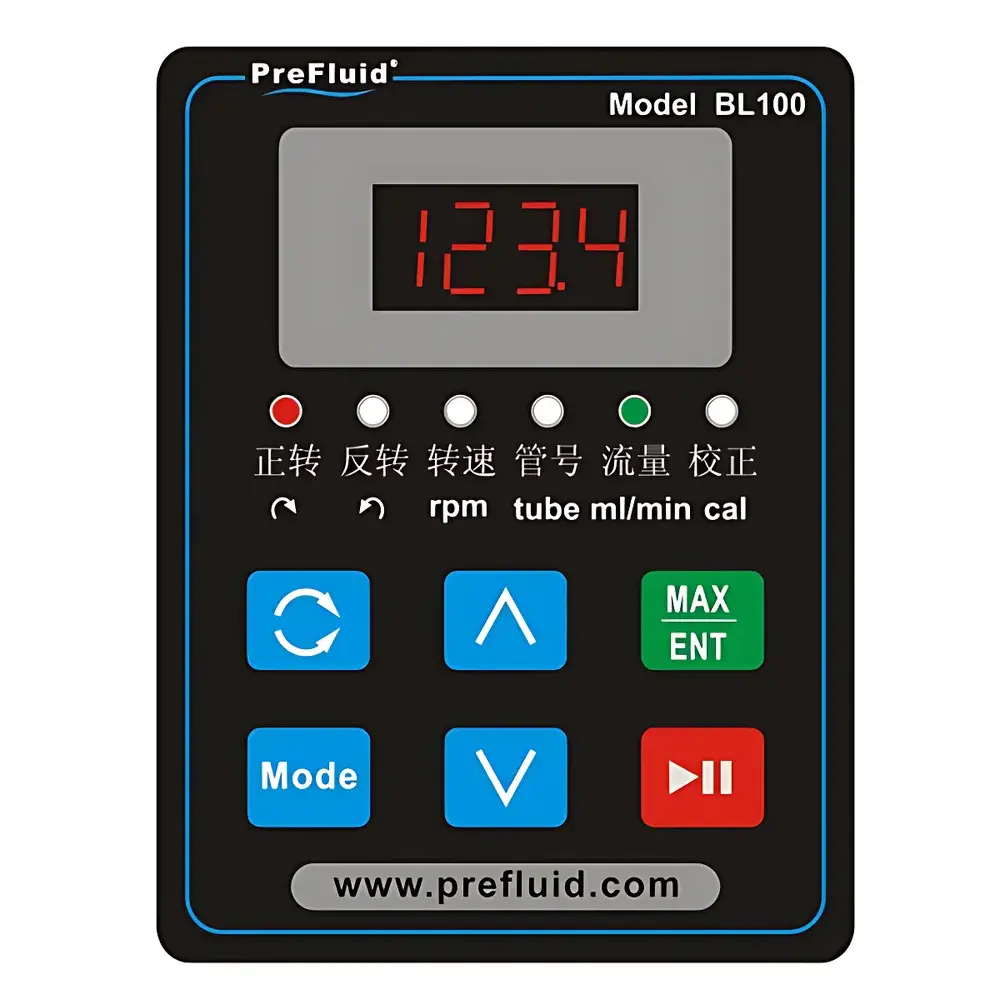
- Real-time dual-mode LED display: switchable between rotational speed (rpm) and calibrated volumetric flow rate (mL/min) with four-digit resolution
- User-configurable flow calibration: supports up to six tube types (e.g., #13, #14, #16, #19, #25, #17) and allows manual correction factors for non-standard or high-density fluids (e.g., glycerol-water mixtures, cell lysates)
- Non-volatile memory: retains all operating parameters—including speed, direction, tube ID selection, and calibration offsets—across power interruptions
- Dual control pathways: local keypad operation with tactile feedback and audible keypress confirmation, plus remote command via RS485 serial interface (free protocol, compatible with Modbus RTU) and 4–20 mA analog input for PLC or SCADA integration
- Robust mechanical design: anodized aluminum chassis provides structural rigidity, thermal stability, and resistance to common lab solvents and cleaning agents; surface coating enhances wipe-down compatibility and corrosion resistance
- Directional indicator LEDs and six functional status lights provide immediate visual feedback of run mode, forward/reverse state, pause, calibration, and communication activity
- Quick-fill/quick-empty mode for rapid system priming or line purging without reprogramming
- Keypad lock function prevents accidental parameter changes during unattended operation
Sample Compatibility & Compliance
The BL100-KZ15 accommodates a broad spectrum of peristaltic tubing materials—including silicone, Viton®, Tygon® LFL, and PharmPure®—across inner diameters from 0.5 mm to 4.8 mm. Its modular pump head design (KZ15 variant) supports single-channel configurations optimized for low-flow precision (e.g., 0.012 mL/min with 0.5×0.8 mm tubing) or high-throughput delivery (up to 7572 mL/min with multi-roller heads and large-bore tubing). While not certified to IEC 61000-6-2/4 or UL 61010-1 out-of-the-box, the pump meets essential electromagnetic compatibility (EMC) and safety thresholds for laboratory use under EN 61326-1 (Class B) and operates within ISO 14644-1 Class 8 cleanroom ambient limits when housed in appropriate enclosures. Its analog and digital interfaces support integration into GLP/GMP workflows requiring 21 CFR Part 11–compliant data logging when paired with validated host software.
Software & Data Management
The BL100-KZ15 operates autonomously but is fully interoperable with third-party control systems. Its RS485 port implements a documented ASCII-based command set supporting read/write access to all runtime registers: target speed, current flow rate, direction flag, tube ID index, calibration factor, and memory status. No proprietary drivers are required; standard serial libraries (e.g., PySerial, LabVIEW VISA, MATLAB Serial) enable direct integration into Python-based automation frameworks, MATLAB instrument control scripts, or LabVIEW DAQ environments. For audit-trail compliance, external software can log timestamped command sequences and response acknowledgments—enabling full traceability of pump state transitions across experimental batches. The 4–20 mA analog input allows seamless connection to distributed control systems (DCS) or programmable logic controllers (PLCs) without signal conditioning.
Applications
This pump is routinely deployed in settings demanding both precision and procedural transparency: continuous feed of inducer solutions in recombinant protein expression bioreactors; metered addition of sodium hypochlorite in pilot-scale water disinfection studies; gradient elution support in preparative HPLC fraction collection; controlled reagent dosing in microfluidic assay development; and sequential sample introduction in multi-pump autosampler configurations. Its ability to display and log actual flow—not inferred speed—directly addresses a documented pain point in molecular biology labs, where inconsistent buffer delivery across replicate runs has been linked to variability in transfection efficiency and chromatographic peak shape. In QC/QA environments, the calibration memory and parameter retention reduce setup time between analytical methods and support method transfer across instruments.
FAQ
Does the BL100-KZ15 measure flow directly using a sensor?
No—it calculates flow algorithmically using motor step count, roller geometry, tubing compression profile, and user-applied calibration factors. No inline flow sensor is integrated, minimizing dead volume and contamination risk.
Can I calibrate the pump for non-aqueous fluids like DMSO or ethanol?
Yes. The flow correction factor field accepts decimal values (±99.9%) to compensate for fluid-specific viscosity and elasticity effects on tubing rebound dynamics.
Is the RS485 interface isolated?
The interface is non-isolated but includes transient voltage suppression and conforms to RS485 electrical standards (±7 V common-mode range, 1.5 kΩ receiver input impedance). For electrically noisy environments, an external isolated RS485 repeater is recommended.
What is the maximum cable length for reliable RS485 communication?
Up to 1200 meters at 9600 bps; shorter distances (<300 m) are advised at higher baud rates (e.g., 38.4 kbps) to maintain signal integrity.
How frequently should flow calibration be verified?
We recommend verification before each critical experiment series and after any tubing replacement or mechanical maintenance. A gravimetric check using a precision balance and timed collection is sufficient for routine validation.
Related Products



