
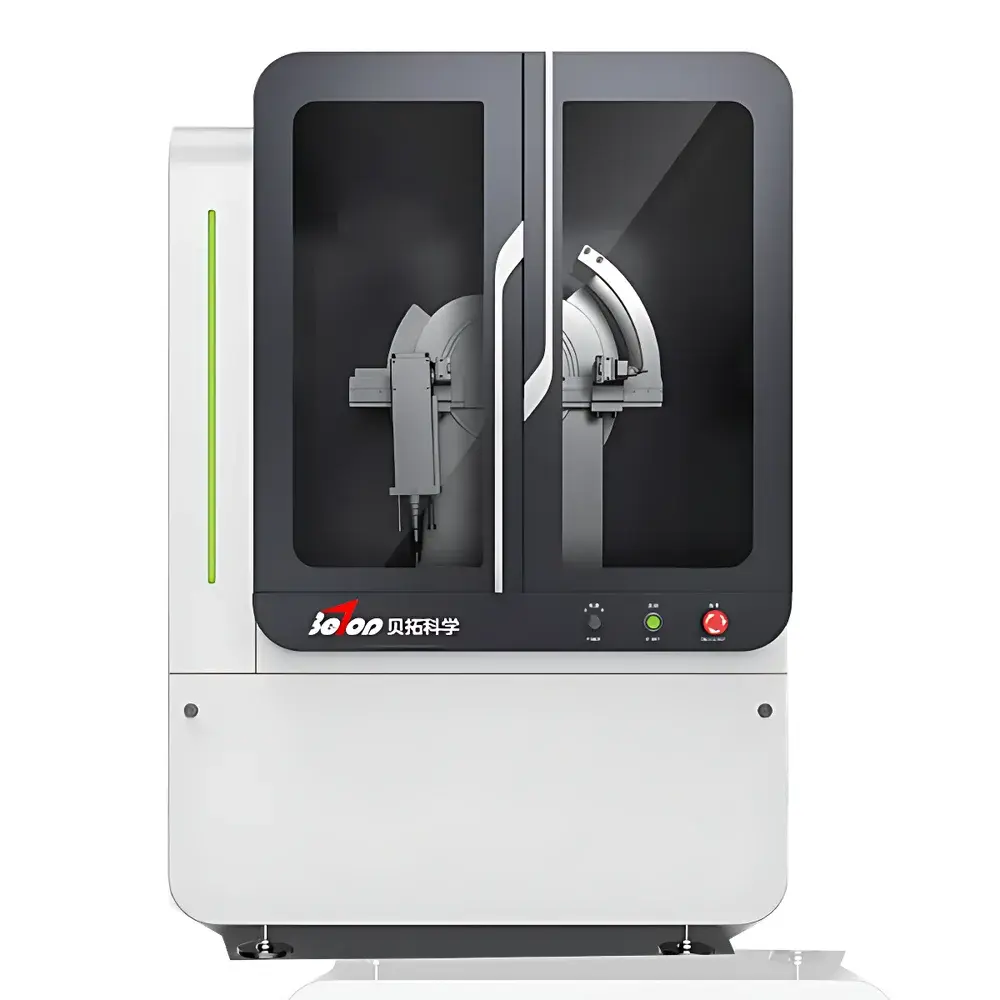
Betop Scientific M-Power In Situ High-Power X-Ray Diffractometer
| Brand | Betop Scientific |
|---|---|
| Origin | Guangdong, China |
| Manufacturer Type | Direct Manufacturer |
| Product Category | Domestic |
| Model | M-Power |
| Price Range | USD 110,000 – 275,000 |
| Instrument Type | Powder X-Ray Diffractometer |
| Configuration | Floor-Standing |
| X-Ray Tube Power | 3 kW |
| X-Ray Source | Ceramic-Core Rotating Anode Tube |
| Goniometer Control | Precision Motorized Theta-Theta Configuration with Real-Time Position Correction |
| Angular Range | 0.5°–160° 2θ (adjustable) |
| Angular Reproducibility | ≤ ±0.0005° (2θ) |
Overview
The Betop Scientific M-Power In Situ High-Power X-Ray Diffractometer is a floor-standing, laboratory-grade powder X-ray diffractometer engineered for rigorous in situ and operando structural characterization of crystalline materials under dynamic thermal, mechanical, or environmental stimuli. It operates on the Bragg diffraction principle, utilizing monochromatic Cu Kα radiation (λ = 1.5418 Å) generated by a high-stability 3 kW ceramic-core rotating anode X-ray tube. The ceramic insulation architecture significantly enhances thermal management and operational longevity compared to conventional glass-envelope tubes, reducing downtime and recalibration frequency. Designed for quantitative phase analysis, lattice parameter refinement, crystallite size and microstrain determination (via Williamson-Hall or Rietveld methods), and time-resolved structural evolution studies, the M-Power supports real-time monitoring of solid-state reactions, battery electrode cycling, catalyst activation, and polymorphic transitions.
Key Features
- 3 kW Ceramic-Core X-Ray Source: Delivers high-intensity, stable X-ray flux essential for rapid data acquisition and low-noise diffraction patterns—critical for weakly scattering samples or time-resolved experiments.
- Precision Theta-Theta Goniometer: Equipped with high-resolution angular encoders and closed-loop servo control, enabling sub-arcsecond positional accuracy and real-time dynamic correction of mechanical drift or thermal expansion-induced errors.
- Synchronized Motion Architecture: Coordinated control of tube, detector, and sample stage ensures strict kinematic consistency during continuous scanning or step-scan modes—even at scan speeds up to 5°/min 2θ—without compromising angular fidelity.
- Extended Angular Coverage: Supports 2θ scans from 0.5° to 160°, accommodating both wide-angle Bragg peaks and low-angle scattering features (e.g., lamellar spacing in layered materials or nanostructured systems).
- In Situ Readiness: Standard mounting interfaces and thermal/vacuum feedthrough compatibility enable integration with heating stages (up to 1200 °C), humidity chambers, electrochemical cells, and gas reaction cells for true operando experimentation.
Sample Compatibility & Compliance
The M-Power accommodates standard powder holders (15 mm and 25 mm diameter), capillary mounts, thin-film substrates, and custom sample environments. Its robust mechanical design meets ISO 17025 calibration traceability requirements when used with NIST-traceable silicon SRM 640e reference standards. System operation adheres to IEC 61000-6-3 (EMC) and IEC 61000-6-4 emission standards. Safety interlocks, beam shutter controls, and radiation shielding comply with national regulatory frameworks aligned with IAEA SSG-46 guidelines for analytical X-ray equipment. Full audit trails and user-access logging support GLP/GMP-aligned workflows where required.
Software & Data Management
Controlled via Betop’s proprietary DiffracSuite v4.x software suite, the M-Power provides intuitive experiment setup, automated alignment routines (including auto-centering and zero-error calibration), and real-time diffraction pattern visualization. Raw data are saved in industry-standard binary formats (.raw, .xye) and fully compatible with third-party Rietveld refinement platforms (TOPAS, GSAS-II, FullProf). The software includes built-in tools for background subtraction, peak search, phase identification (using ICDD PDF-4+ database integration), and quantitative phase analysis (QPA) with internal standard correction. Data export supports CSV, ASCII, and CIF formats; metadata embedding follows NeXus/HDF5 conventions for FAIR (Findable, Accessible, Interoperable, Reusable) data principles. Optional 21 CFR Part 11-compliant modules provide electronic signatures, role-based access control, and immutable audit logs.
Applications
- Real-time monitoring of phase transformations during thermal annealing or rapid quenching
- Operando XRD of Li-ion battery cathodes/anodes during charge-discharge cycling
- Structural evolution of metal-organic frameworks (MOFs) under variable humidity or gas exposure
- Crystallinity assessment and polymorph quantification in pharmaceutical APIs
- Lattice strain mapping in sintered ceramics and additive-manufactured alloys
- In situ catalysis studies under reactive gas atmospheres (e.g., CO₂ hydrogenation, NH₃ synthesis)
FAQ
What is the maximum operating power of the X-ray tube, and is it air-cooled or water-cooled?
The M-Power utilizes a 3 kW rotating anode X-ray tube with integrated recirculating water cooling and redundant temperature monitoring—ensuring stable output during extended acquisitions.
Can the system be upgraded for high-resolution or small-angle measurements?
Yes—optional high-resolution optics (Ge(111) or Si(111) monochromators), incident-beam slits, and a dedicated SAXS/WAXS hybrid detector module are available as factory-installed configurations.
Is remote operation supported for unattended overnight runs?
Yes—DiffracSuite supports secure remote desktop access, scheduled acquisition protocols, and email/SNMP alerting upon job completion or fault detection.
Does the system include factory calibration documentation and traceable standards?
Each unit ships with a full calibration certificate referencing NIST SRM 640e, including angular accuracy, intensity linearity, and detector response verification reports.
What maintenance intervals are recommended for the X-ray tube and goniometer?
Ceramic-core tube lifetime exceeds 15,000 hours under nominal load; goniometer lubrication and encoder verification are recommended annually or after 2,000 hours of operation—both documented in the included service manual.





