
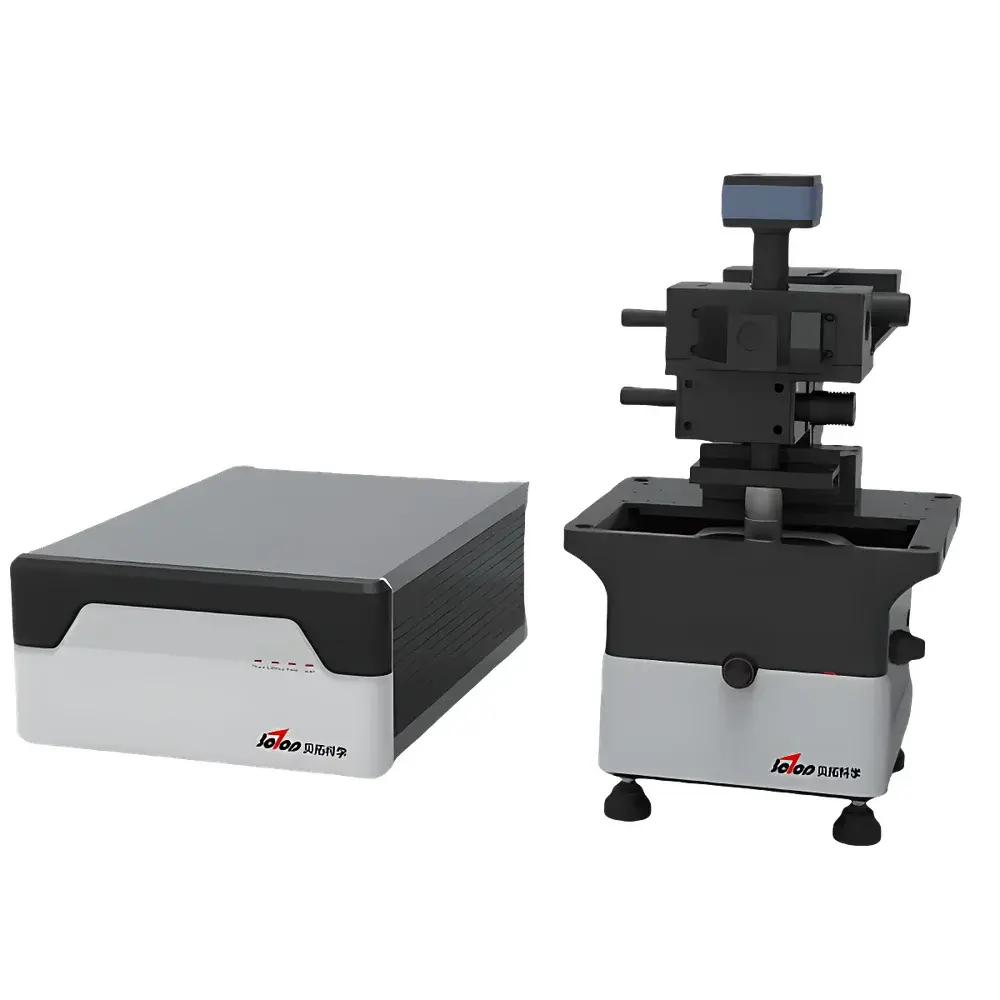
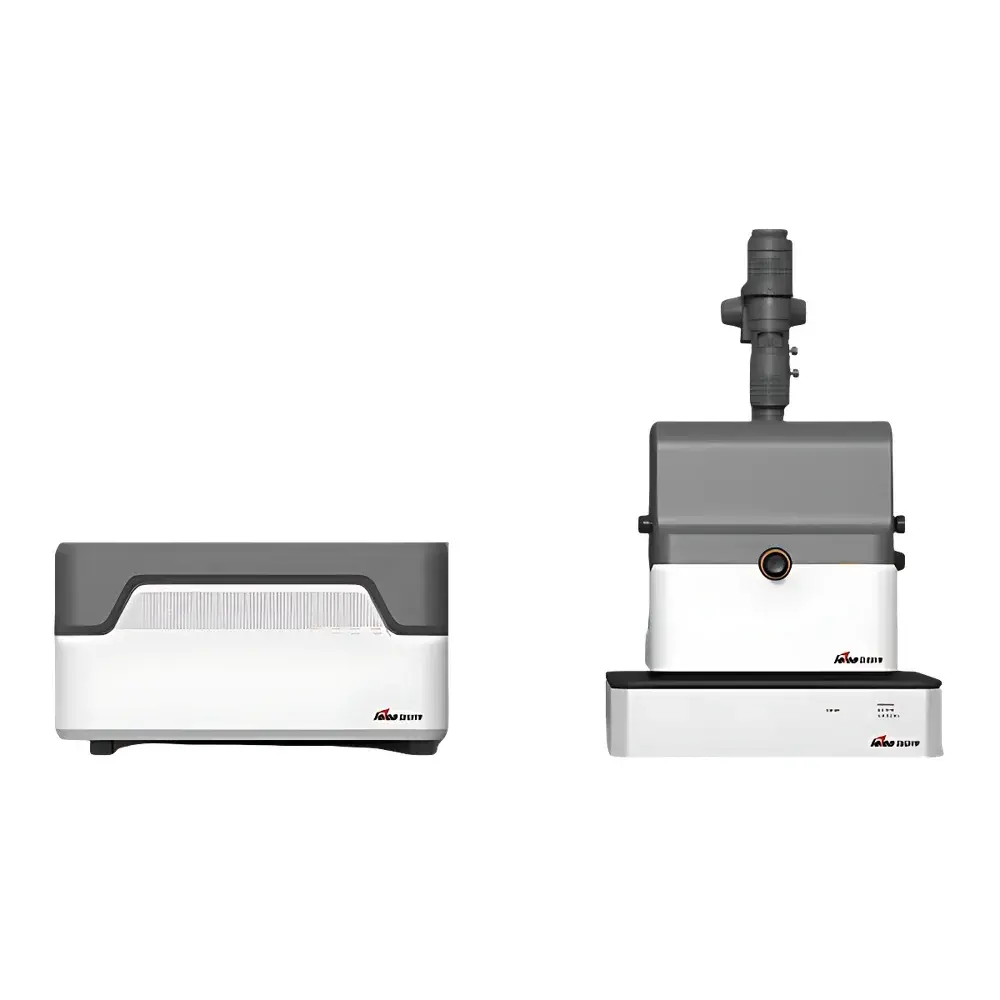
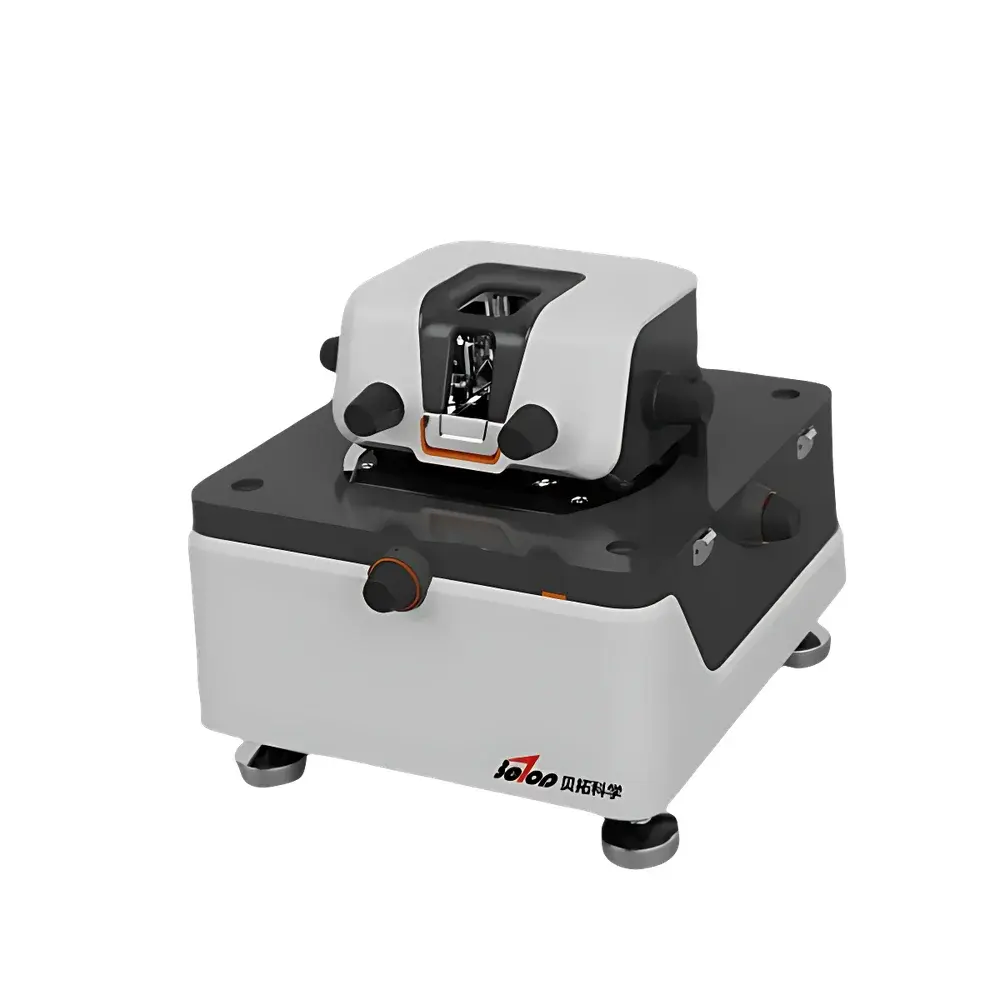
Betop Scientific RamSPM Integrated Raman-AFM Platform
| Brand | Betop Scientific |
|---|---|
| Origin | Guangdong, China |
| Manufacturer Type | Original Equipment Manufacturer (OEM) |
| Country of Origin | China |
| Model | RamSPM |
| Price Range | USD 70,000 – 140,000 |
| Instrument Category | Atomic Force Microscope (AFM) |
| Instrument Class | Materials Science AFM |
| Z-direction RMS System Noise | ≤0.05 nm (calibrated on monolayer step height of HOPG) |
| Maximum Sample Diameter | ≤30 mm |
| Maximum Sample Thickness | ≤20 mm |
| Auto-approach Travel Range | ≥23 mm |
| Minimum Step Resolution | ≤50 nm |
Overview
The Betop Scientific RamSPM is an integrated Raman-AFM platform engineered for correlative nanoscale structural and chemical characterization of solid-state materials. It combines a high-stability atomic force microscope with a confocal Raman spectrometer in a single vacuum-compatible optical-mechanical architecture—designed to eliminate external optical interference during simultaneous acquisition. Unlike conventional hybrid systems requiring sequential measurements or external beam coupling, the RamSPM employs a coaxial optical path design where the Raman excitation laser is precisely aligned through the AFM objective and reflected via a dichroic mirror directly onto the sample surface beneath the scanning probe. This enables true spatially registered, time-synchronized topographic, mechanical, and vibrational spectroscopic data—critical for investigating heterogeneous interfaces, 2D material strain fields, phase-separated polymer blends, and defect-associated phonon modes.
Key Features
- Coaxial Raman-AFM integration with active optical isolation: All optical components—including excitation laser, collection optics, and spectrometer input—are housed within a rigid, vibration-damped enclosure; no external fiber coupling or free-space alignment required.
- Self-sensing piezoelectric cantilever technology: Eliminates need for external optical lever detection, reducing sensitivity to thermal drift and acoustic noise while enabling direct frequency-modulated (FM) AFM operation with intrinsic amplitude and phase feedback.
- High-fidelity closed-loop XY-Z scanner: 30 μm × 30 μm × 8 μm scan range with <1.5 nm lateral resolution and ≤0.05 nm Z-noise (RMS, HOPG-monolayer calibrated), ensuring sub-atomic height fidelity across extended scan areas.
- Automated sample handling: One-touch motorized approach with ≥23 mm linear travel and ≤50 nm minimum step resolution; manual coarse positioning ±8.0 mm for rapid region-of-interest selection.
- Dual-core embedded controller: ARM + DSP architecture running real-time deterministic control firmware; TCP/IP interface ensures seamless integration into lab-wide instrument networks and remote operation protocols.
- Multi-channel synchronized acquisition: Simultaneous recording of ≥5 independent data channels—including topography, error signal, phase, deflection, and Raman intensity—during each line scan at rates from 0.1 to 30 lines/sec.
Sample Compatibility & Compliance
The RamSPM accommodates standard solid samples up to 30 mm in diameter and 20 mm in thickness, compatible with common TEM grid holders, silicon wafers, glass slides, and conductive substrates. Its modular stage design supports optional environmental modules (e.g., temperature-controlled stage: −10 °C to +80 °C; inert gas purging port). The system complies with IEC 61000-6-3 (EMC emission standards) and meets mechanical safety requirements per ISO 13857. While not certified for GMP environments out-of-the-box, its audit-ready software architecture—including full metadata logging, user-access controls, and timestamped raw data export—supports validation under GLP and FDA 21 CFR Part 11 when deployed with appropriate IT infrastructure and SOPs.
Software & Data Management
The RamSPM Control Suite is a native 64-bit Windows application built on Qt and HDF5-based data storage. It provides real-time 3D rendering with OpenGL acceleration, multi-parameter overlay visualization (e.g., Raman peak intensity mapped onto AFM height), and batch-processing pipelines for spectral deconvolution (Voigt fitting), tip convolution correction, and quantitative nanomechanical mapping (DMT/Johnson-Kendall-Roberts modeling). All raw datasets—including time-stamped sensor waveforms, spectrometer CCD frames, and scanner voltage traces—are stored in vendor-neutral HDF5 format with embedded calibration metadata (e.g., scanner sensitivity, laser wavelength, grating dispersion). Export options include ASCII, TIFF, and MATLAB .mat; no proprietary binary lock-in.
Applications
- Correlative analysis of strain distribution and local crystal symmetry in transition metal dichalcogenides (e.g., MoS₂ monolayers) using Raman E²g/Mo–Mo peak shifts overlaid on AFM step-edge topography.
- Nanoscale phase identification in block copolymer thin films: simultaneous mapping of surface modulus (via contact resonance AFM) and chemical composition (via C–H vs. C=O Raman band ratios).
- Defect engineering studies in perovskite solar cell absorbers: locating grain boundaries via frictional contrast (LFM) and correlating trap-state density (from I–Z spectroscopy) with local CH₃NH₃⁺ vibrational mode suppression.
- In situ electrochemical AFM–Raman of battery electrode interfaces: monitoring solid-electrolyte interphase (SEI) growth kinetics and compositional evolution during potentiostatic hold.
- Quantitative nanomechanics of biological scaffolds: combining PeakForce QNM with label-free Raman fingerprinting of collagen crosslinking states in decellularized tissue matrices.
FAQ
Does the RamSPM support true simultaneous acquisition—or is it alternating-mode operation?
Yes. The system performs fully concurrent data capture: the AFM controller and Raman spectrometer operate on independent hardware clocks synchronized via PPS (pulse-per-second) signals, with all timestamps referenced to a shared UTC epoch. No multiplexing or interleaving is applied.
Can third-party Raman spectrometers be integrated?
Only via OEM-level customization. The standard RamSPM includes a fixed-focal-length, 785 nm excitation module with 2 cm⁻¹ spectral resolution and back-illuminated CCD detection. Retrofitting external spectrometers voids calibration traceability and compromises optical co-registration.
What probe types are compatible with the self-sensing cantilevers?
The system ships with Si-based FM-mode probes (resonance: 250–320 kHz, k ≈ 25 N/m). Custom probes must maintain impedance-matched piezoresistive readout geometry and undergo factory recalibration for Z-sensitivity and Q-factor compensation.
Is offline spectral processing included in the base license?
Yes. Full spectral preprocessing (cosmic ray removal, baseline correction, peak integration) and multivariate analysis (PCA, cluster mapping) are included without subscription. Advanced machine learning modules (e.g., neural network–based phase classification) require optional add-on licensing.




