
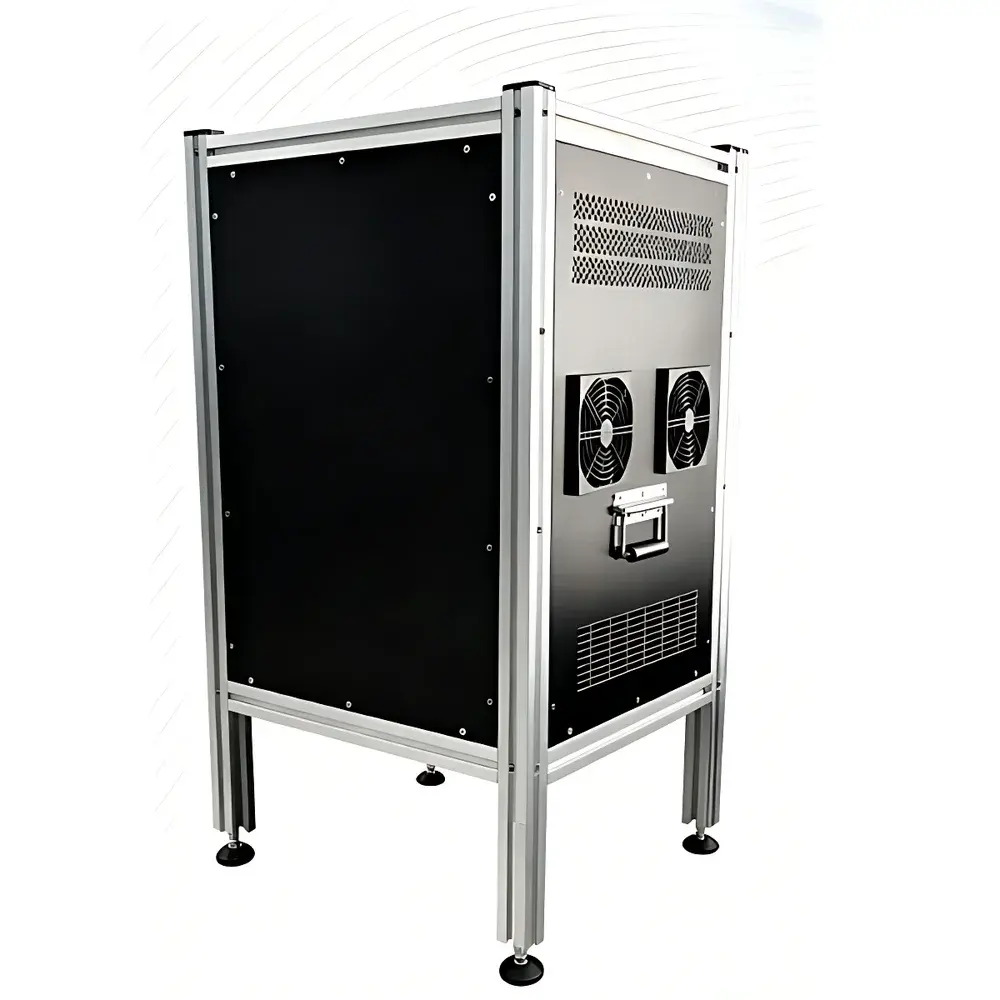
Laman Optics 71S0503A-LED Class AAA Solar Simulator
| Brand | Laman Optics |
|---|---|
| Origin | Guangdong, China |
| Manufacturer Type | Authorized Distributor |
| Origin Category | Domestic (China) |
| Model | 71S0503A-LED |
| Price Range | USD $14,000 – $35,000 (FOB Guangdong) |
| Illumination Mode | Steady-State Operation |
| Spectral Range | 400–1100 nm |
| Spectral Match Class | A+ (0.875–1.125 per IEC 60904-9 Ed. 3) |
| Spatial Uniformity | ≤ ±2% (Class A) |
| Temporal Stability | ≤ ±2% over 1 h (Class A) |
| Beam Diameter | Ø70 mm |
| Light Source Lifetime | ≥100,000 h (at rated output) |
| Rated Power Consumption | 650 W |
| Warm-up Time to Stability | ≤15 min |
Overview
The Laman Optics 71S0503A-LED Solar Simulator is a high-fidelity, steady-state illumination system engineered for photovoltaic (PV) device characterization, photoelectrochemical research, and accelerated material aging studies. It employs an array of spectrally optimized LEDs spanning 400–1100 nm—covering the full AM1.5G reference spectrum (IEC 60904-3)—and integrates proprietary optical homogenization and spectral blending algorithms to achieve Class AAA performance per IEC 60904-9:2020 Ed. 3. Unlike xenon-based or metal-halide simulators, this LED-driven platform eliminates UV-induced degradation of optical components, eliminates ozone generation, and delivers intrinsic temporal stability without active feedback loops. Its design prioritizes metrological traceability, reproducibility across laboratories, and long-term operational consistency—critical for ISO/IEC 17025-accredited PV testing labs and R&D facilities conducting comparative efficiency measurements under standardized irradiance conditions.
Key Features
- Triple-A certified performance: Spectral match (A+), spatial uniformity (A), and temporal stability (A) — fully compliant with IEC 60904-9:2020 Ed. 3 requirements for Class AAA classification.
- LED-based architecture delivering >100,000 hours of operational lifetime at nominal irradiance (1000 W/m² equivalent), eliminating lamp replacement cycles and associated calibration drift.
- Optical homogenization system ensuring ≤±2% spatial non-uniformity across a Ø70 mm circular test area — validated via calibrated CCD-based radiometric mapping.
- Steady-state output stability ≤±2% over 60 minutes, verified using NIST-traceable thermopile sensors with 0.5% uncertainty (k=2).
- Low thermal load and minimal IR emission: LED spectral output is intrinsically confined to 400–1100 nm, avoiding unnecessary heating of temperature-sensitive samples such as perovskite solar cells or organic semiconductors.
- Energy-efficient operation: Total system power draw capped at 650 W — significantly lower than equivalent xenon arc systems (>2 kW typical) — reducing facility cooling demands and total cost of ownership.
Sample Compatibility & Compliance
The 71S0503A-LED is compatible with standard PV test fixtures including Keithley 2400/2450 source-measure units, quantum efficiency (QE) measurement stages, and environmental chambers equipped with quartz viewport windows. Its spectral output meets the spectral mismatch correction requirements defined in IEC 60904-7 for reference cell calibration and is suitable for use with silicon, GaAs, CIGS, perovskite, and organic photovoltaic devices. The system conforms to ISO/IEC 17025:2017 general requirements for competence of testing and calibration laboratories, and supports GLP-compliant data acquisition when paired with audit-trail-enabled software (see Software & Data Management). All optical components are RoHS-compliant and CE-marked per Directive 2014/30/EU (EMC) and 2014/35/EU (LVD).
Software & Data Management
The simulator is controlled via RS-232/USB serial interface using Laman Optics’ proprietary SolarSim Control Suite v3.2. The software enables precise irradiance adjustment (0–1.2 suns in 0.01-sun increments), real-time monitoring of LED driver currents and thermal sensor readings, and automated logging of irradiance history with timestamping. Export formats include CSV and HDF5 for integration into MATLAB, Python (NumPy/Pandas), or LabVIEW environments. Audit trail functionality records all parameter changes, user logins, and system events — satisfying FDA 21 CFR Part 11 requirements for electronic records and signatures when deployed in regulated R&D settings. Firmware updates are delivered via secure HTTPS channel with SHA-256 signature verification.
Applications
- Current–voltage (I–V) characterization of single-junction and multi-junction solar cells under standard test conditions (STC: 25°C, 1000 W/m², AM1.5G).
- Photoelectrochemical (PEC) water-splitting efficiency quantification using calibrated reference electrodes and potentiostats.
- UV–vis–NIR photoresponse mapping of thin-film absorbers and tandem device stacks.
- Accelerated photostability testing of encapsulation materials, anti-reflective coatings, and perovskite thin films under controlled irradiance and ambient temperature.
- Calibration of reference solar cells and pyranometers against primary standards traceable to NREL or PTB.
- Teaching laboratories for semiconductor physics, renewable energy engineering, and optoelectronics curricula requiring repeatable, safe, and low-maintenance light sources.
FAQ
What international standards does the 71S0503A-LED comply with?
It meets IEC 60904-9:2020 Ed. 3 for Class AAA solar simulation, and its electrical safety and EMC performance conform to CE directives 2014/35/EU and 2014/30/EU.
Is spectral recalibration required after shipment or installation?
No factory recalibration is needed; the system ships with a NIST-traceable spectral irradiance certificate valid for 12 months. Optional annual recalibration services are available through Laman Optics’ ISO/IEC 17025-accredited calibration lab.
Can the simulator be integrated into an automated IV-test station?
Yes — it supports TTL-triggered start/stop commands and provides analog voltage output (0–5 V) proportional to irradiance level for closed-loop control with SMUs or PLCs.
Does the system support variable-angle illumination for oblique incidence studies?
The base configuration features normal-incidence collimated output. An optional motorized goniometer stage (Model GON-LED-70) enables ±45° angular adjustment with encoder feedback and software synchronization.
What maintenance is required during routine operation?
None beyond periodic cleaning of the output window with spectroscopic-grade isopropanol and lint-free wipes. LED drivers and thermal management subsystems are solid-state with no consumables.





