
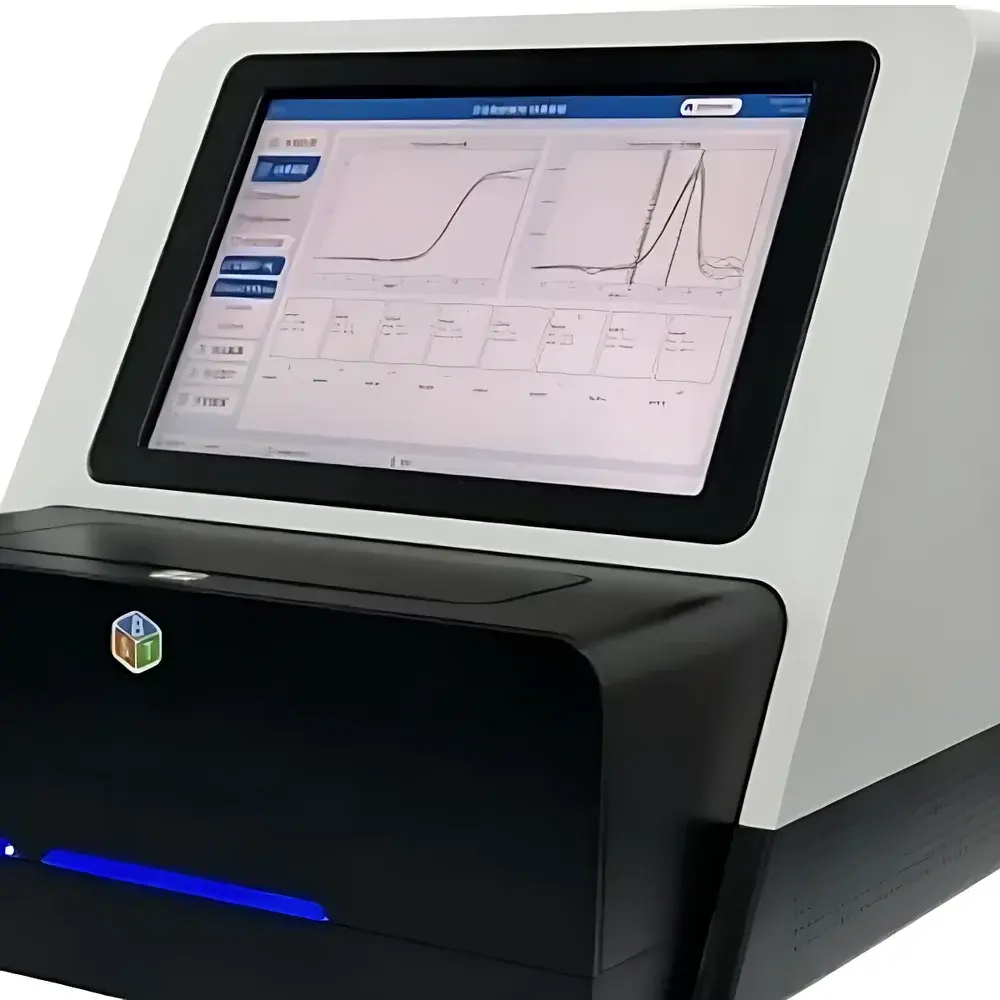
Lingguang Biotech Protein Stability Analyzer
| Brand | Lingguang Biotech |
|---|---|
| Origin | Beijing, China |
| Manufacturer Type | Authorized Distributor |
| Product Origin | Domestic (China) |
| Model | Protein Stability Analyzer |
| Pricing | Available Upon Request |
Overview
The Lingguang Biotech Protein Stability Analyzer is a dedicated benchtop instrument engineered for label-free, high-throughput assessment of protein conformational stability using intrinsic tryptophan fluorescence. It operates on the physical principle of temperature- or denaturant-induced unfolding, monitored in real time via dual-wavelength UV fluorescence detection (emission at 330 nm and 350 nm). As proteins unfold, buried tryptophan residues become increasingly solvent-exposed, resulting in a quantifiable red shift of the fluorescence emission maximum—from ~330 nm (native state) toward ~350 nm (denatured state). The analyzer computes the inflection point of the normalized 350/330 nm fluorescence ratio curve to determine the thermal melting temperature (Tm) or chemical denaturation midpoint (Cm), providing thermodynamically rigorous metrics for comparative stability profiling across variants, formulations, or buffer conditions.
Key Features
- Label-free detection leveraging native tryptophan and tyrosine fluorescence—no extrinsic dyes, no labeling artifacts, no interference from excipients or additives
- Real-time thermal ramping with precise Peltier-controlled temperature gradients (range: 20–95 °C; accuracy ±0.1 °C; ramp rate 0.1–5.0 °C/min)
- Dual-channel fluorescence acquisition synchronized with temperature modulation, enabling robust ratiometric analysis (F350/F330) to minimize pathlength and concentration variability effects
- Low sample consumption: compatible with standard PCR tubes or 96-well microplates; typical assay volume: 10–25 µL per well
- Integrated optical path design optimized for UV transmission (280 nm excitation; 330/350 nm bandpass emission filters); calibrated photodetector with linear dynamic range spanning three orders of magnitude
- Robust mechanical architecture with vibration-dampened optics platform and sealed optical chamber to ensure signal reproducibility across repeated runs
Sample Compatibility & Compliance
The analyzer supports a broad range of purified protein samples—including monoclonal antibodies, enzyme variants, recombinant domains, and fusion proteins—provided they contain at least one accessible tryptophan residue. Samples may be prepared in aqueous buffers (e.g., PBS, Tris-HCl, acetate) with common stabilizers (sucrose, trehalose, arginine) or denaturants (urea, guanidine HCl). No fluorescent contaminants (e.g., imidazole above 20 mM, certain reducing agents) are permitted. The system complies with general laboratory safety standards (IEC 61010-1) and supports GLP/GMP-aligned workflows through audit-trail-enabled software logging. While not certified to FDA 21 CFR Part 11 out-of-the-box, its data export format (CSV, PDF reports) and metadata-rich output facilitate validation under regulated environments per ICH Q5C and USP .
Software & Data Management
Control and analysis are performed via Lingguang’s proprietary StabilityView™ software (Windows 10/11 compatible), which provides guided experimental setup, real-time curve visualization, automated Tm/Cm calculation with confidence interval estimation, and batch processing for multi-condition comparisons. Raw fluorescence and temperature time-series data are stored in HDF5 format, preserving full traceability. Export options include publication-ready SVG/PNG plots, tabular CSV summaries with derivative analysis (dF/dT), and structured JSON metadata compliant with MIAME-like annotation conventions. Software updates are delivered via secure HTTPS portal; version history and change logs are maintained for internal validation documentation.
Applications
- High-throughput screening of protein engineering libraries (e.g., directed evolution, rational design) for improved thermal resilience
- Formulation development: evaluating buffer pH, ionic strength, excipient type/concentration, and lyophilization protectants
- Comparative biosimilarity assessment between innovator and biosimilar mAbs
- Stability-indicating method development for QC release testing under ICH Q5C guidelines
- Monitoring structural integrity during storage, shipping, or freeze-thaw cycling studies
- Binding affinity proxy assays (e.g., ligand-induced stabilization shifts in Tm) when combined with orthogonal biophysical methods
FAQ
Does this instrument require fluorescent dye labeling?
No—detection relies exclusively on intrinsic tryptophan fluorescence; no covalent modification or exogenous dyes are needed.
Can it analyze proteins lacking tryptophan?
Proteins without tryptophan (or with fully quenched/occluded residues) yield insufficient signal-to-noise; tyrosine contribution is secondary and generally inadequate for reliable Tm determination.
What is the minimum protein concentration required?
Typical working range is 0.05–1.0 mg/mL, depending on extinction coefficient and quantum yield; optimization is recommended for each new target.
Is the system compatible with 384-well plates?
Currently validated for 96-well PCR plates and individual capillary tubes; 384-well support is under evaluation and not yet enabled in firmware v2.3.
How is data integrity ensured during long-duration assays?
The system logs timestamped environmental parameters (ambient temperature, humidity), instrument status flags, and raw detector voltage traces—enabling full forensic reconstruction of any run.



