
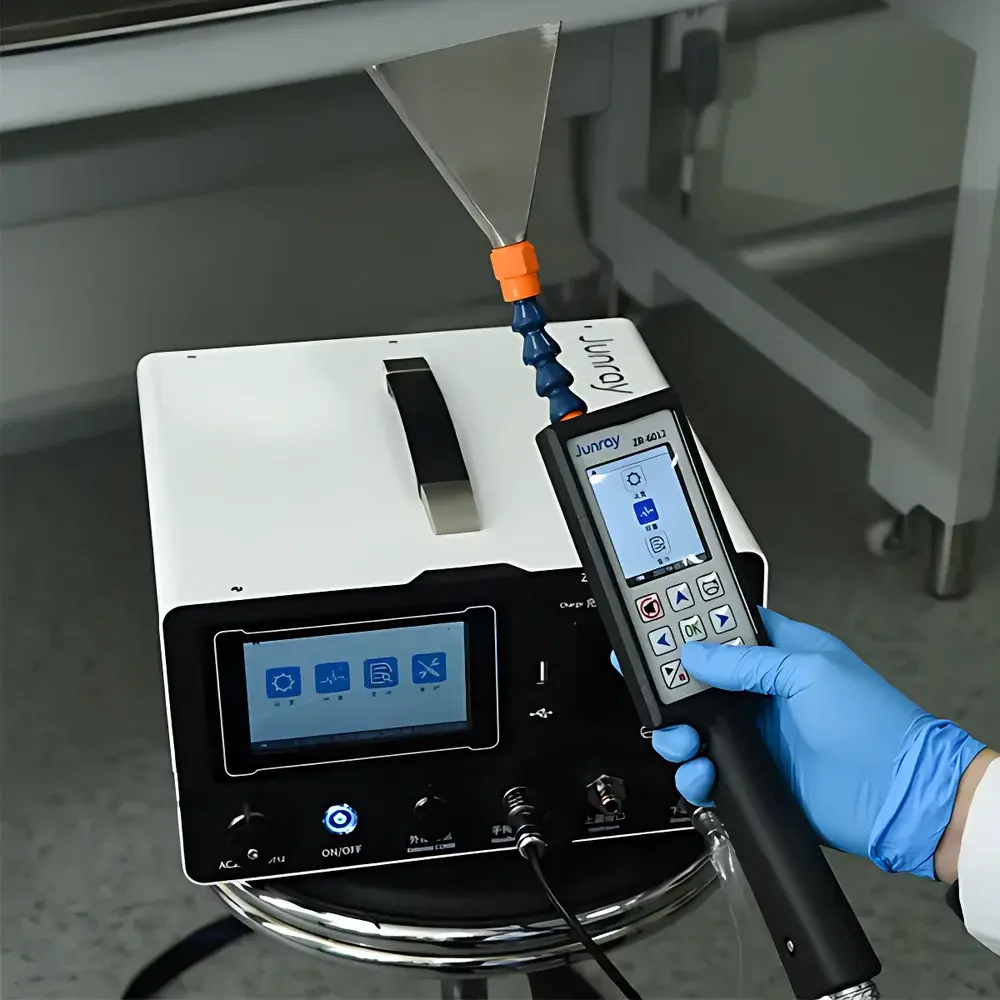
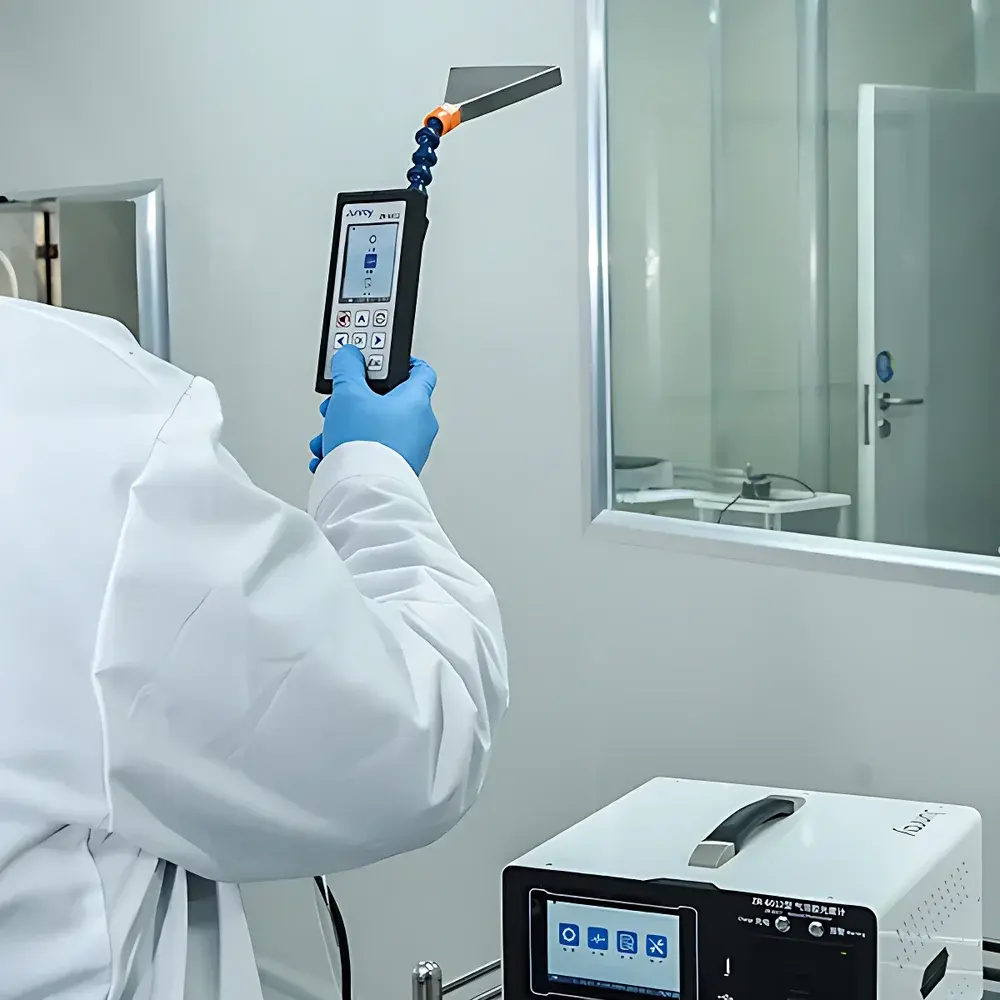
Junray ZR-6012 Aerosol Photometer for HEPA/ULPA Filter Leak Testing in Cleanrooms and GMP-Compliant Facilities
| Brand | Junray |
|---|---|
| Origin | Shandong, China |
| Manufacturer Type | Direct Manufacturer |
| Country of Origin | China |
| Model | ZR-6012 (Built-in Thermal Printer) |
| Instrument Type | Aerosol Photometer |
| Sampling Flow Rate | 28.3 L/min ±2.5% |
| Concentration Range | 0.01–125 µg/L (extendable to 0.0001 µg/L low-end and 700 µg/L high-end) |
| Leak Detection Range | 0.0001%–100% |
| Accuracy | ±1% of reading (0.01%–100%) |
| Repeatability | ±0.5% of reading (0.01%–100%) |
| Data Storage Capacity | 100,000 records |
| Dimensions (L×W×H) | 300 × 330 × 184 mm |
| Weight (unit only) | 8.9 kg |
| Power Input | AC 220 V ±10%, 50 Hz |
| Max Power Consumption | <150 W |
| Operating Temperature | 10–35 °C |
| Operating Humidity | 5–85% RH (non-condensing) |
| Storage Conditions | −10–40 °C, <85% RH (non-condensing) |
| Noise Level | <65 dB(A) |
| Aerosol Types Supported | DOP, PAO, and other polyalphaolefin-based challenge agents |
Overview
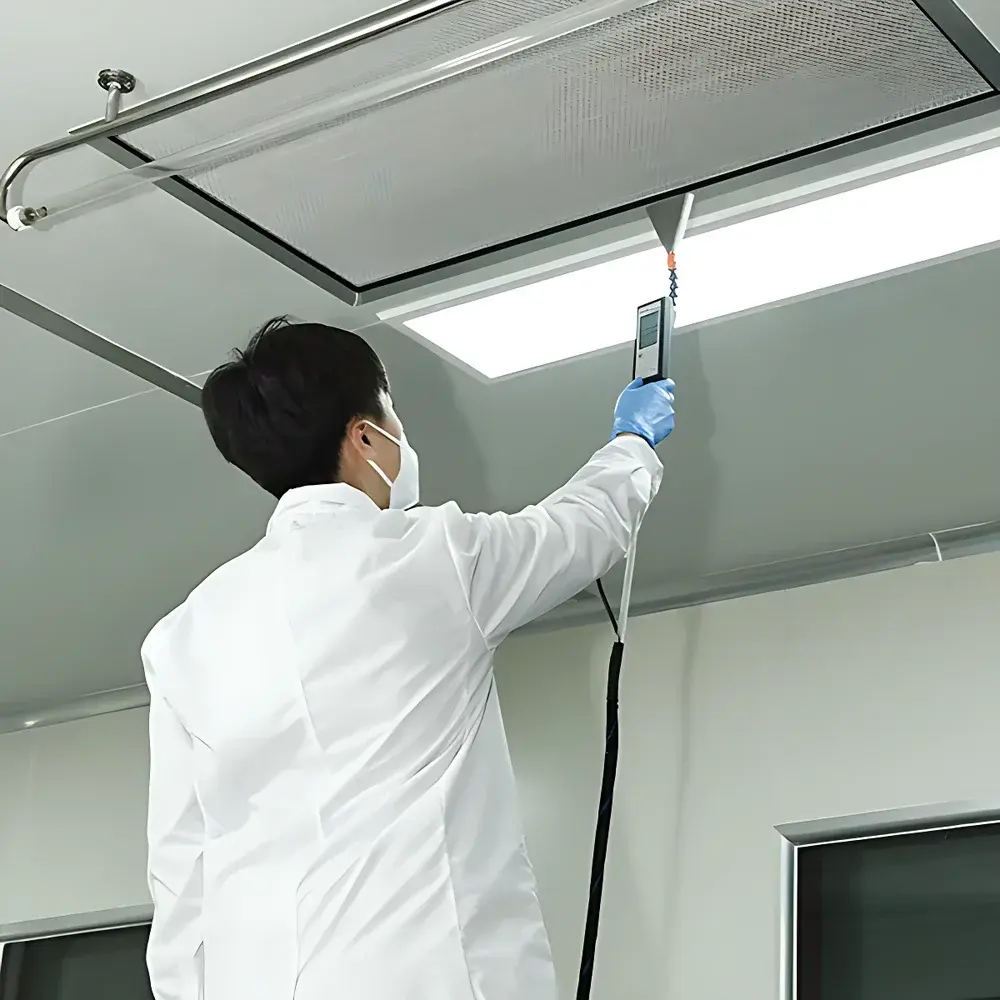
The Junray ZR-6012 Aerosol Photometer is a precision-engineered instrument designed for on-site leak testing of high-efficiency particulate air (HEPA) and ultra-low penetration air (ULPA) filters in controlled environments. Based on Mie scattering theory, the device quantifies aerosol concentration by measuring the intensity of light scattered by suspended particles when illuminated by a calibrated light source—typically a near-infrared or visible LED. This principle enables real-time, quantitative assessment of filter integrity during upstream/downstream scanning protocols required under ISO 14644-3:2019, EU GMP Annex 1 (2022), and USP . The ZR-6012 operates at a fixed sampling flow rate of 28.3 L/min—standardized to match the volumetric flow used in aerosol challenge tests per IEST-RP-CC034.3 and NSF/ANSI 49-2020—ensuring compatibility with regulatory-grade validation workflows in pharmaceutical cleanrooms, biotech manufacturing suites, and Class II biosafety cabinets.
Key Features
- High-resolution color touchscreen interface with intuitive navigation and multi-language support (English default)
- Real-time leak rate calculation and display, compliant with ISO 14644-3 leakage threshold criteria (e.g., ≤0.01% for HEPA, ≤0.005% for ULPA)
- Built-in thermal printer for immediate hardcopy generation of test reports—including timestamp, location ID, operator name, and pass/fail status
- Integrated rechargeable lithium battery supporting up to 4 hours of continuous operation—ideal for mobile validation teams conducting multi-point surveys across large facilities
- Triple-tier user access control (Administrator / Supervisor / Operator) with full audit trail logging per FDA 21 CFR Part 11 and EU Annex 11 requirements
- Configurable aerosol agent selection (DOP, PAO, DOS, or custom-defined agents) with automatic calibration factor application
- Robust data integrity architecture: internal storage for ≥100,000 measurement records; USB port for firmware updates and secure export of CSV-formatted datasets
- Automatic fault detection and self-diagnostic routines—including flow sensor verification, photodetector linearity check, and lamp intensity monitoring
- Compact form factor (300 × 330 × 184 mm) and lightweight design (8.9 kg net) enabling single-operator handling during ceiling-mounted filter scanning
- Extended dynamic range: validated performance from 0.0001 µg/L (for background subtraction and ultra-low baseline verification) to 700 µg/L (for high-concentration challenge scenarios)
Sample Compatibility & Compliance
The ZR-6012 is validated for use with standardized polydisperse aerosols including Di-Octyl Phthalate (DOP), Polyalphaolefin (PAO-4, PAO-6), and Di-Ethyl-Hexyl Sebacate (DEHS). Its optical detection system meets the spectral response requirements outlined in JJF 1800–2020 (Calibration Specification for Aerosol Photometers) and aligns with ISO 21501-4 for particle counter traceability. Regulatory compliance includes full adherence to GB 50591–2010 (Code for Construction and Acceptance of Clean Rooms), GB 50073–2013 (Design Code for Cleanrooms), YY 0569–2011 (Performance Requirements for Class II Biological Safety Cabinets), and the 2010 Pharmaceutical GMP Guidelines (Chapter 3: Premises and Equipment). All factory calibrations are NIST-traceable via accredited metrology laboratories, and the instrument supports GLP/GMP-compliant documentation through its embedded electronic record system.
Software & Data Management
Data acquisition, analysis, and reporting are managed through the embedded firmware—not external PC software—ensuring deterministic timing, reduced cybersecurity exposure, and simplified qualification (IQ/OQ/PQ). Each measurement event captures: date/time stamp, operator ID, sampling location tag, upstream/downstream concentration values, calculated leak percentage, and environmental parameters (temperature/humidity). Audit logs record all configuration changes, user logins, and report generation events with immutable timestamps. Exported data files include digital signatures and checksums to prevent tampering. Optional RS-232 or Ethernet interfaces (via expansion module) enable integration into centralized facility monitoring systems (FMS) or MES platforms supporting Modbus TCP or OPC UA protocols.
Applications
- Qualification and routine requalification of HEPA/ULPA filters in ISO Class 5–8 cleanrooms per EU GMP Annex 1 and FDA guidance
- Leak testing of supply and exhaust filters in Class II A2/B2 biosafety cabinets per NSF/ANSI 49-2020
- Validation of laminar airflow workstations, isolators, and restricted access barrier systems (RABS)
- Supporting risk-based monitoring strategies under ICH Q9 and Q10 frameworks
- Third-party certification services conducted by accredited testing laboratories (CNAS, UKAS, A2LA)
- Pre-commissioning and post-maintenance verification following filter replacement or ductwork modification
FAQ
Does the ZR-6012 comply with FDA 21 CFR Part 11 for electronic records and signatures?
Yes—the instrument implements role-based authentication, time-stamped audit trails, and electronic signature capture for report approval, meeting core technical requirements for Part 11 compliance.
Can the ZR-6012 be used with alternative challenge agents such as DEHS or Ondina Oil?
Yes—user-definable calibration factors allow accurate quantification across multiple aerosol types, provided the agent’s refractive index and particle size distribution fall within the instrument’s validated Mie scattering model assumptions.
Is external calibration required before each use?
No—daily operational verification using zero-air and reference aerosol checks is sufficient; full calibration is recommended annually or after repair, traceable to national standards per JJF 1800–2020.
What is the minimum detectable leak rate under standard test conditions?
At 28.3 L/min flow and typical upstream challenge concentrations (≥10–50 µg/L), the lower limit of quantitation (LLOQ) is 0.0001%, validated per ISO 14644-3 Annex B.
How does the ZR-6012 handle condensation or high-humidity environments?
The unit incorporates humidity-compensated optical path design and non-condensing operating limits (5–85% RH); optional heated sample line accessory available for environments approaching dew point.
Related Products







