
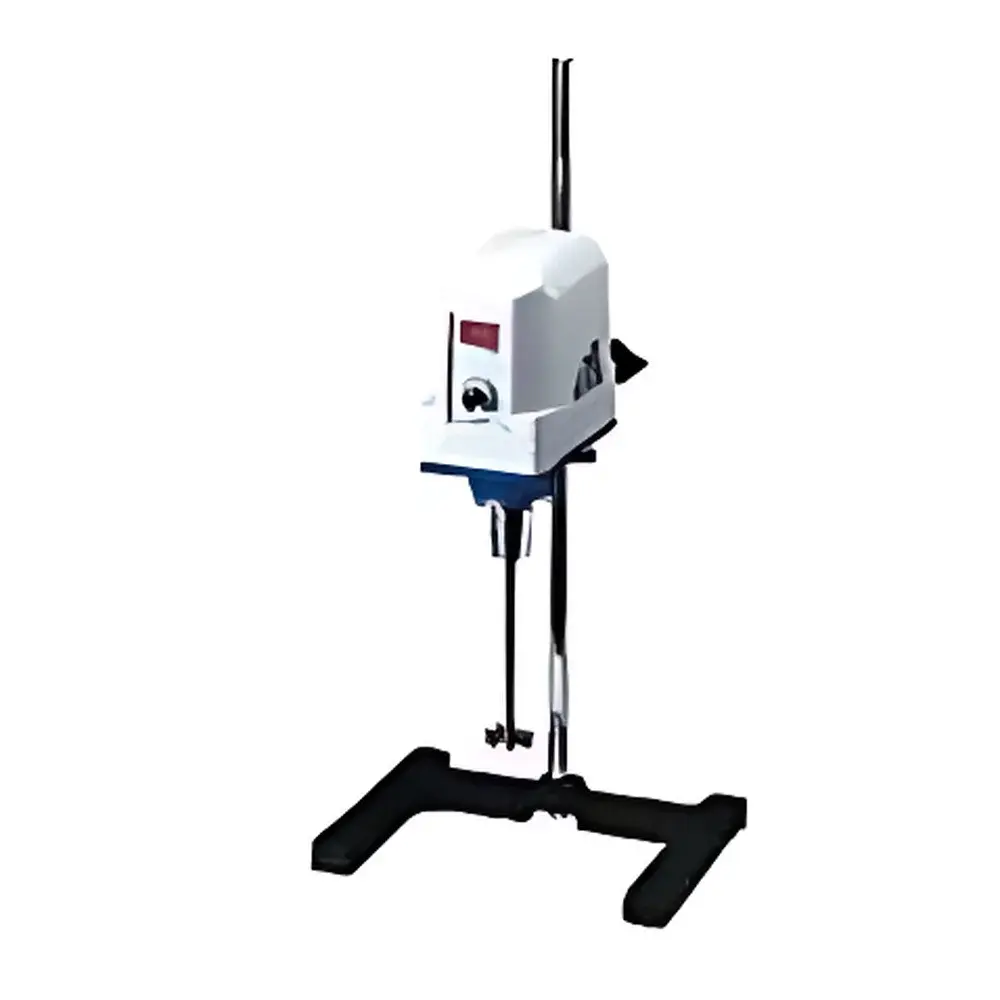
Prema HM400 High-Shear Probe Homogenizer
| Brand | Prema |
|---|---|
| Origin | Taiwan |
| Model | HM400 |
| Instrument Type | Probe-type Rotational Homogenizer |
| Speed Range | 0–7,000 rpm |
| Motor Power | DC 350 W |
| Torque | 5.4 kg·cm |
| Dimensions (W×D×H) | 399 × 376 × 840 mm |
| Housing Material | Chemical-Resistant Polymer |
| Shaft & Chuck | Stainless Steel |
| Safety Features | Thermal Cut-off, Overload Protection, Fuse Integration |
| Display | Digital LED Speed Readout |
| Speed Control | Continuously Variable Rotary Knob |
| Compliance | Designed for GLP-compliant lab environments |
Overview
The Prema HM400 High-Shear Probe Homogenizer is an engineered laboratory-scale mixing and dispersion system designed for reproducible, high-intensity mechanical homogenization of liquid and semi-liquid samples. Operating on the principle of rotor-stator shear, the HM400 utilizes a rotating probe tip immersed directly into the sample vessel to generate controlled hydrodynamic forces—including laminar and turbulent flow, cavitation, and high-velocity micro-jetting—enabling efficient particle size reduction, emulsion stabilization, and uniform phase dispersion. Its 350 W DC motor delivers consistent torque output up to 5.4 kg·cm across the full 0–7,000 rpm speed range, supporting scalable process development from small-volume (10 mL) benchtop trials to intermediate batches (up to 2 L), depending on probe geometry and container configuration. The system is purpose-built for applications requiring physical destabilization of aggregates, breakdown of viscous suspensions, or formation of kinetically stable oil-in-water or water-in-oil emulsions without thermal degradation or solvent addition.
Key Features
- Continuously variable speed control via precision rotary potentiometer, enabling fine-tuned adjustment in 1 rpm increments for method optimization and process repeatability
- Digital LED display with real-time rpm readout—calibrated against internal tachometric feedback for long-term accuracy stability
- Chemical-resistant polymer housing rated for exposure to common organic solvents, dilute acids/bases, and food-grade processing agents
- Stainless steel probe shaft and collet chuck (AISI 316-compatible interface) ensuring corrosion resistance and mechanical rigidity under sustained high-shear loads
- Integrated dual-layer safety architecture: thermal cut-off switch activated at ≥75 °C motor winding temperature, plus electronic overload detection that interrupts power within 200 ms upon current surge exceeding 120% nominal rating
- Standard 10 mm diameter probe included; optional probes (6 mm, 12 mm, 20 mm) available for viscosity- and volume-matched operation per ASTM D1209 and ISO 787-13 guidelines
Sample Compatibility & Compliance
The HM400 accommodates a broad spectrum of Newtonian and non-Newtonian fluids, including dairy emulsions (e.g., cream, whey protein suspensions), fruit juice pulps, vinegar-based dressings, plant-derived oils, polymeric coatings, pharmaceutical suspensions, and agrochemical concentrates. Its probe immersion design avoids cross-contamination between runs and eliminates dead-volume retention typical of fixed-chamber systems. All wetted components comply with USP Class VI biocompatibility requirements. The instrument’s electrical design conforms to IEC 61010-1:2010 (Safety Requirements for Electrical Equipment for Measurement, Control, and Laboratory Use), and its operational documentation supports audit readiness for GLP and GMP-aligned quality systems. While not inherently 21 CFR Part 11 compliant, data export via external logging devices enables traceable recordkeeping when paired with validated third-party software.
Software & Data Management
The HM400 operates as a standalone analog-controlled device with no embedded firmware or network interface. Speed setpoints and runtime are manually configured; however, its analog output signal (0–10 V DC proportional to actual rpm) permits integration with external data acquisition systems (e.g., LabVIEW, DIAdem, or PLC-based SCADA) for time-stamped parameter logging. Users may implement SOP-driven protocols using printed run sheets or digital lab notebooks (e.g., Benchling, LabArchives) to document probe type, speed profile, duration, sample mass/volume, ambient temperature, and post-processing observations—ensuring full traceability in regulated environments.
Applications
- Food science: Standardization of fat globule size distribution in milk homogenates; stabilization of citrus oil emulsions in beverage bases; dispersion of cocoa solids in chocolate slurries
- Pharmaceutical R&D: Wet milling of nanosuspensions for oral solid dosage forms; preparation of topical nanoemulsions containing lipophilic actives
- Materials chemistry: Exfoliation of graphene oxide dispersions in aqueous media; deagglomeration of pigment nanoparticles in acrylic resin carriers
- Quality control labs: Reproducible sample preparation prior to particle size analysis (e.g., laser diffraction per ISO 13320) or rheological characterization (ASTM D445)
- Academic research: Shear-induced structural transitions in biopolymer gels; mechanistic studies of emulsion inversion kinetics
FAQ
What probe sizes are compatible with the HM400?
The standard configuration includes a 10 mm diameter probe. Optional probes—6 mm (for low-volume, high-viscosity samples), 12 mm (general-purpose), and 20 mm (high-throughput dispersion)—are mechanically interchangeable using the same collet system.
Is the HM400 suitable for temperature-sensitive samples?
Yes—its brushless DC motor generates minimal conductive heat, and short-duration operation (< 2 min at max speed) typically limits sample temperature rise to < 5 °C in well-insulated vessels. For extended runs, ice-jacketed beakers or recirculating chillers are recommended.
Can the HM400 be used with corrosive solvents like chloroform or THF?
The housing and control electronics are resistant to incidental splashes of such solvents, but prolonged exposure is not advised. Probes must be rinsed immediately after use, and stainless steel components should be inspected regularly for pitting.
Does the HM400 support programmable speed ramping?
No—it features manual analog speed control only. For automated multi-step protocols, external programmable power supplies with analog input capability may be employed.
What maintenance is required for long-term reliability?
Monthly visual inspection of probe threads and chuck integrity; quarterly lubrication of motor bearings per manufacturer’s technical bulletin; annual calibration verification of the digital tachometer against a certified optical tachometer.



