
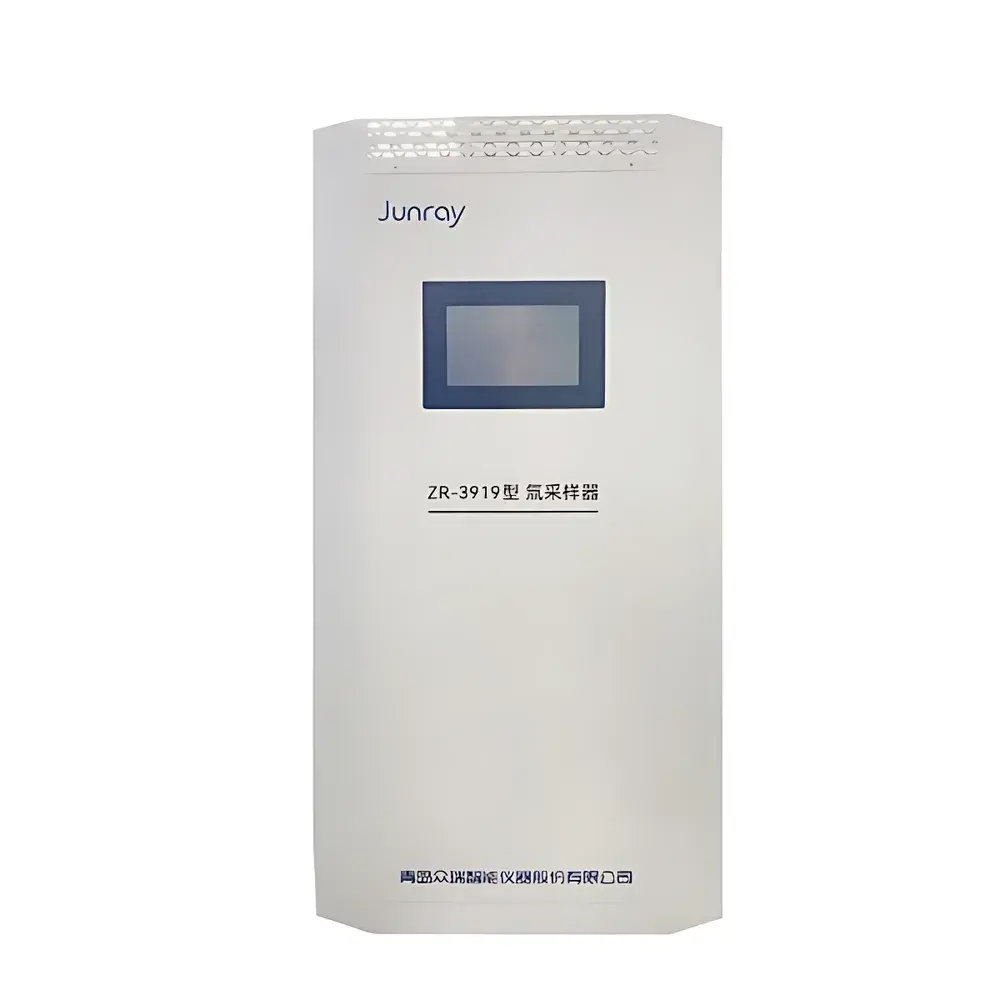
Junray ZR-3919 Tritium Air Sampler
| Brand | Junray |
|---|---|
| Origin | Shandong, China |
| Manufacturer Type | Direct Manufacturer |
| Country of Origin | China |
| Model | ZR-3919 |
| Pricing | Available Upon Request |
Overview
The Junray ZR-3919 Tritium Air Sampler is a purpose-built, field-deployable instrumentation system engineered for the quantitative collection of tritiated water vapor (HTO) from ambient air. It operates on the principle of cryogenic condensation and/or silica-gel adsorption—depending on configuration—followed by gravimetric or liquid scintillation counting (LSC) analysis of the collected condensate. Designed in strict alignment with Chinese national environmental radiation monitoring standards—including HJ 61–2021, HJ 1128–2020, and HJ 1155–2020—the ZR-3919 supports routine surveillance, emergency response, and research-grade atmospheric tritium assessment. Its architecture integrates flow control, real-time environmental parameter logging, and fail-safe operational logic to ensure data integrity under variable field conditions typical of nuclear facility perimeters, environmental monitoring networks, and R&D laboratories.
Key Features
- High-resolution capacitive touchscreen interface with intuitive navigation and multilingual UI support (English & Chinese firmware options)
- Programmable sampling modes: time-based (e.g., 1–720 min), volume-based (e.g., 1–10,000 L), and interval-based (e.g., 30-min on / 30-min off cycles)
- Integrated flow control system with ±2% full-scale accuracy; real-time display of instantaneous flow rate and dynamic flow trend curve
- Power failure recovery: retains all active sampling parameters, elapsed time, and cumulative volume upon restart
- Intelligent liquid management: dual-sensor detection for condensate reservoir presence and fill-level verification; automatic shutdown and audible/visual alarm upon overflow or improper placement
- Onboard non-volatile memory storing ≥10,000 timestamped records (date, start/stop time, total volume, average flow, temperature, battery voltage)
- Ruggedized aluminum alloy chassis rated IP54 for dust and splash resistance; operating temperature range: −10 °C to +45 °C
Sample Compatibility & Compliance
The ZR-3919 is optimized for collection of tritiated water vapor (HTO) across a wide range of ambient humidity (10–95% RH) and temperature conditions. It accommodates standard 100 mL or 250 mL polyethylene or borosilicate glass collection vials, compatible with subsequent LSC analysis per ISO 9698:2019 and ASTM D7283–18. All internal wetted materials (PTFE tubing, stainless-steel cold trap, silicone-free seals) are selected to minimize HTO adsorption/desorption hysteresis and cross-contamination. The device meets electromagnetic compatibility (EMC) requirements per GB/T 18268.1–2010 (equivalent to IEC 61326-1) and conforms to safety specifications outlined in GB 4793.1–2007 (IEC 61010-1). Documentation packages support GLP-compliant audit trails when paired with Junray’s optional calibration certificate and maintenance log templates.
Software & Data Management
Data export is supported via USB 2.0 interface in CSV and XML formats—structured to align with national radiation monitoring database schemas. Optional PC software (Junray DataLink v3.x) enables remote configuration, batch report generation, and synchronization with laboratory information management systems (LIMS). Audit-trail functionality logs all user-initiated changes (e.g., parameter edits, calibration events) with timestamps and operator IDs—facilitating compliance with China’s CNCA/CL01:2018 (equivalent to ISO/IEC 17025) and internal QA/QC protocols. Firmware updates are delivered via signed binary packages to ensure integrity and traceability.
Applications
- Continuous tritium monitoring around nuclear power plants, research reactors, and tritium-handling facilities
- Environmental baseline studies and long-term trend analysis in regulatory radiation monitoring networks
- Emergency response deployment during radiological incidents involving HTO release (per HJ 1155–2020 guidance)
- Method validation and inter-laboratory comparison studies supporting accreditation under CMA or CNAS
- Academic research on atmospheric transport, deposition, and isotopic fractionation of tritiated water
FAQ
What is the recommended calibration frequency for the ZR-3919?
Calibration of flow sensors and temperature/humidity probes is recommended annually or after 500 operating hours—whichever occurs first—using NIST-traceable reference instruments.
Can the ZR-3919 operate unattended for extended periods?
Yes; with external 12 V DC power and proper thermal shielding, it supports continuous operation up to 30 days. Internal rechargeable Li-ion battery provides ≥8 hours backup runtime.
Is the device compatible with international reporting formats such as IAEA TRS-457?
Raw data fields (timestamp, volume, T/RH, battery status) map directly to IAEA TRS-457 Annex II metadata requirements; custom export templates are available upon request.
Does Junray provide method validation documentation for HTO sampling?
Yes—application notes covering recovery efficiency (>95% at 20 °C, 50% RH), blank levels (<0.3 Bq/L), and detection limit estimation (based on LSC counting statistics) are included with each unit.
How is firmware updated, and is version history maintained?
Firmware updates are performed via USB using Junray-signed binaries; the device stores the last five firmware versions with timestamps and changelogs accessible through the service menu.
Related Products







