
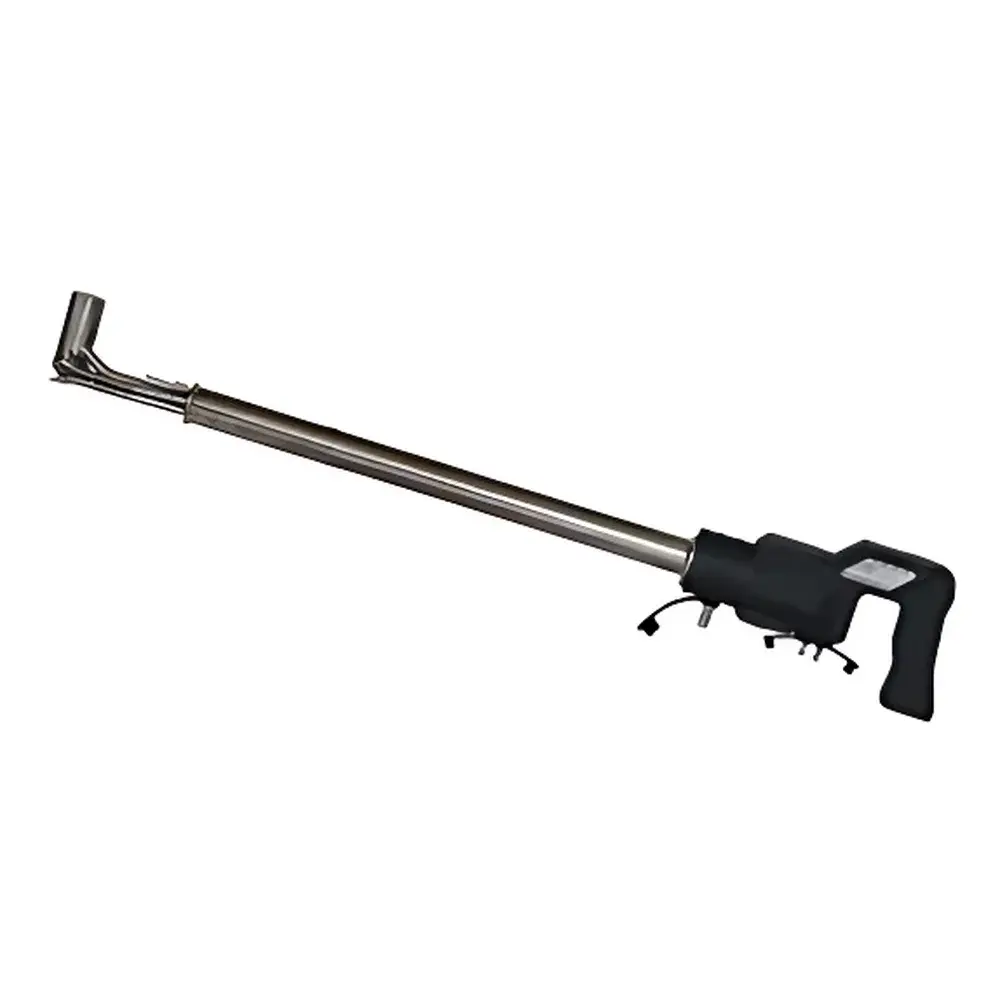
Junray ZR-D12A Portable Oil Fume Sampling Probe
| Brand | Junray |
|---|---|
| Origin | Shandong, China |
| Manufacturer Type | Direct Manufacturer |
| Country of Origin | China |
| Model | ZR-D12A |
| Price Range | USD 7,000–14,000 (FOB) |
| Detection Principle | Multi-stage Physical Capture (Adsorption, Centrifugal Separation, Impingement) |
| Portability | Handheld Portable |
| Application Domain | Commercial Food Service Establishments (Restaurants, Cafeterias, Street Vendors) |
| Compliance Standard | GB 18483–2001 “Emission Standard of Cooking Fume from Catering Industry” |
| Structural Integration | Integrated S-type Pitot Tube + Pt100 Temperature Sensor + Sampling Nozzle Assembly |
| Material | 316L Stainless Steel (Entire Probe Body & Nozzles) |
| Cleaning Method | Disassemblable, Solvent-Rinsable Components |
| Nozzle Options | Interchangeable Series (4–12 mm ID) for Flow Rate Adaptation (5–30 m/s) |
Overview
The Junray ZR-D12A Portable Oil Fume Sampling Probe is an engineered field instrument designed specifically for regulatory-compliant collection of cooking oil fume aerosols in exhaust ducts and hoods of commercial food service facilities. It operates on a multi-stage physical capture principle—combining inertial impingement, centrifugal separation, and surface adsorption—to retain submicron to coarse particulate-phase oil droplets (typically 0.1–10 µm aerodynamic diameter) without reliance on thermal or chemical reaction mechanisms. Unlike optical or electrochemical sensors, the ZR-D12A functions as a primary sampling interface upstream of gravimetric or solvent-extraction analysis (e.g., infrared spectrophotometry per GB/T 18483–2001 Annex A). Its core function is not real-time concentration readout but standardized, isokinetic sample acquisition under variable flue gas conditions—ensuring representative mass loading onto stainless-steel filter cartridges for subsequent laboratory quantification.
Key Features
- Integrated multi-parameter probe head: Co-located S-type Pitot tube (for velocity pressure differential measurement), Pt100 resistance thermometer (±0.5 °C accuracy, 0–200 °C range), and precision-machined sampling nozzle—enabling simultaneous isokinetic flow adjustment, flue gas temperature logging, and aerosol capture in a single insertion.
- Multi-stage capture chamber: Combines axial impingement plates, helical centrifugal vanes, and high-surface-area stainless-steel mesh—optimized to retain >92% of cooking oil aerosol mass across 0.3–5 µm particle sizes under typical exhaust velocities (8–25 m/s), validated per GB 18483–2001 test protocols.
- Modular, field-serviceable design: All wetted components—including nozzle, impactor plates, and filter holder—are fully disassemblable using standard hex tools; no adhesives or welded joints impede cleaning with acetone or isopropanol rinse followed by nitrogen drying.
- Corrosion-resistant construction: Entire probe body, nozzle set, and internal flow path fabricated from passivated 316L stainless steel (ASTM A240), certified for continuous exposure to acidic condensates (pH 3.5–5.0) and organic vapors typical of kitchen exhaust streams.
- Isokinetic adaptability: Supplied with seven calibrated nozzles (4.0, 5.0, 6.0, 7.0, 8.0, 10.0, and 12.0 mm inner diameter), allowing precise nozzle selection to match duct velocity profiles and maintain ±5% isokinetic sampling error across flow ranges from 5 to 30 m/s.
Sample Compatibility & Compliance
The ZR-D12A is validated exclusively for use with standardized stainless-steel filter cartridges (e.g., 47 mm diameter, 0.45 µm pore size, pre-weighed per GB/T 18483–2001 Section 6.2) and compatible quartz fiber filters for infrared analysis. It meets all mechanical and dimensional requirements specified in GB 18483–2001 Clause 5.2 for “sampling probe assembly”, including maximum allowable pressure drop (<1.2 kPa at 20 m/s), minimum nozzle wall thickness (≥1.5 mm), and thermal stability up to 200 °C. While not certified to ISO/IEC 17025 or EPA Method 202, its design aligns with fundamental principles of isokinetic sampling outlined in ISO 9096 and ASTM D6331–21 (Standard Practice for Sampling Particulate Matter from Stationary Sources). It is intended for use in GLP-aligned environmental monitoring workflows where chain-of-custody documentation and procedural traceability are maintained.
Software & Data Management
The ZR-D12A is a hardware-only sampling tool and does not incorporate embedded firmware, wireless transmission, or onboard data storage. Field measurements—flue gas temperature (°C) and differential pressure (kPa)—are recorded manually or via external handheld manometers and digital thermometers compliant with NIST-traceable calibration. Users integrate collected data into standardized reporting templates aligned with Chinese provincial EPB requirements. For laboratories performing gravimetric analysis, the probe’s consistent geometry and material composition ensure minimal blank contribution (<0.02 mg/filter), supporting compliance with QA/QC criteria in GB/T 18483–2001 Annex B (recovery rate ≥95%, precision CV ≤8%).
Applications
- Regulatory emissions testing at restaurant exhaust stacks, food court ventilation shafts, and institutional kitchen hoods.
- Pre-compliance verification prior to installation of electrostatic precipitators or UV-photolysis abatement systems.
- Source apportionment studies correlating cooking methods (deep-frying, stir-frying, grilling) with aerosol mass emission factors.
- Longitudinal monitoring of filtration system efficiency degradation over maintenance intervals.
- Field validation of CFD modeling assumptions regarding local velocity gradients and aerosol transport behavior in complex duct geometries.
FAQ
Does the ZR-D12A provide real-time oil fume concentration readings?
No. It is a passive sampling probe—not an analyzer. Concentration is determined post-collection via laboratory-based gravimetric or infrared analysis of captured mass.
Can it be used for stack testing beyond catering industry applications?
It is dimensionally and functionally optimized for low-to-medium temperature (≤200 °C), high-humidity, organic-rich exhaust streams typical of food preparation. Use in industrial combustion or chemical process stacks is not validated.
What calibration documentation is supplied?
Each unit includes a manufacturer’s dimensional inspection report and material certification (316L SS mill test report). Pitot tube and temperature sensor calibration must be performed externally using accredited metrology labs.
Is the probe compatible with international sampling standards such as EPA Method 5 or ISO 10155?
No. Its design and validation are specific to GB 18483–2001. Adaptation to other standards would require re-engineering of nozzle geometry, capture efficiency validation, and pressure-drop characterization.
How often must the internal components be cleaned?
After each sampling event involving visible oil deposition—or at minimum, before reuse—per GB 18483–2001 Section 7.3. Residual oil film must be removed with volatile organic solvents and verified by visual inspection and weight stability of rinsed components.







