
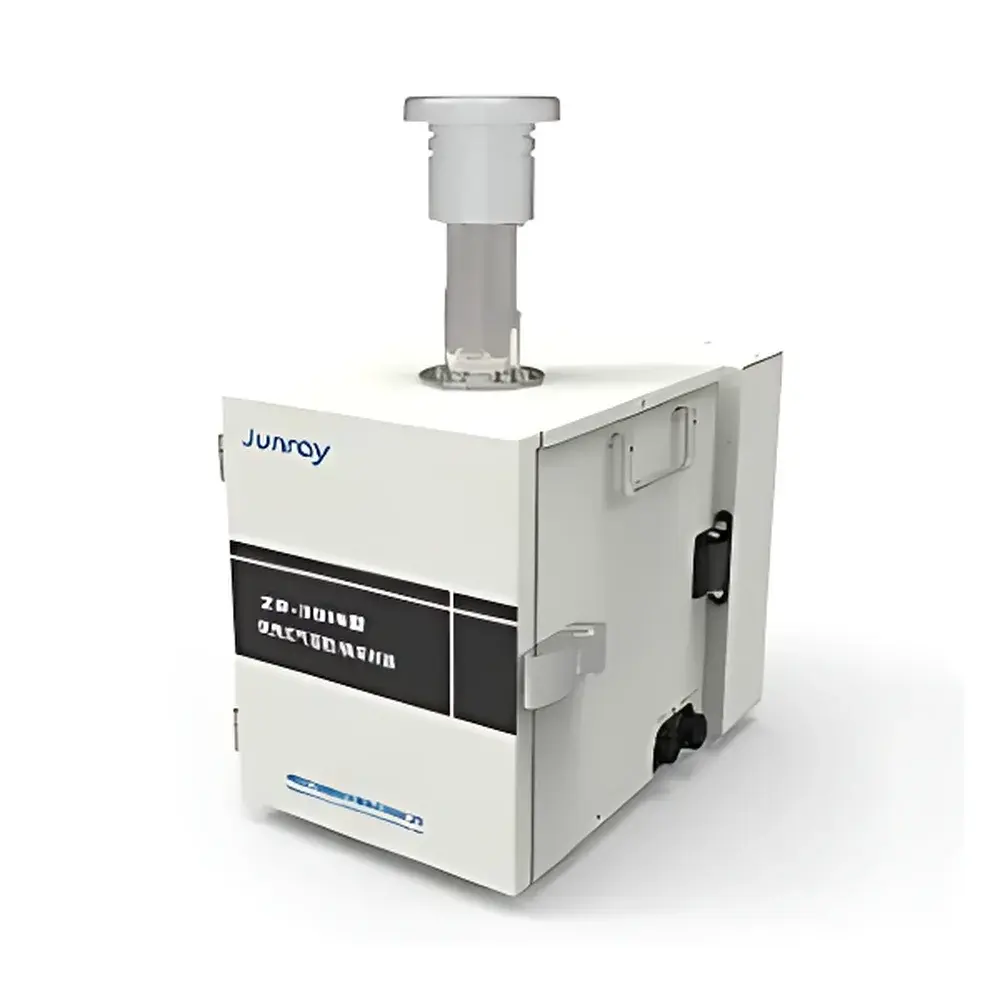
Junray ZR-3914 Portable Aerosol and Radioiodine Sampler
| Brand | Junray |
|---|---|
| Model | ZR-3914 |
| Origin | Shandong, China |
| Manufacturer Type | Direct Manufacturer |
| Country of Origin | China |
| Price Range | USD 14,000 – 42,000 |
| Operating Temperature Range | −20 °C to +50 °C |
| Display | High-brightness TFT touchscreen (graphical Chinese interface) |
| Power Supply | Integrated rechargeable Li-ion battery (supports full operation without external power) |
| Data Storage Capacity | >100,000 sample records |
| Flow Monitoring | Real-time instantaneous flow curve display with minute-interval data logging |
| Sampling Modes | Timed, volumetric, and interval sampling |
| Data Export | USB mass storage mode |
| Compliance | GB/T 14584–1993, HJ 61–2021, HJ 1009–2019, HJ 1149–2020 |
Overview
The Junray ZR-3914 Portable Aerosol and Radioiodine Sampler is a field-deployable, dual-mode environmental sampling instrument engineered for quantitative collection of airborne radioactive iodine species—including elemental iodine (I₂), inorganic iodides (e.g., HI, I⁻), and organic iodine compounds—as well as general-purpose radioactive aerosols. It operates on the principle of controlled isokinetic aspiration through interchangeable sampling heads, enabling selective capture via impingers, charcoal cartridges, or membrane filters depending on target analyte chemistry and regulatory requirements. Designed for deployment in radiation-prone environments—such as nuclear power plant perimeters, decommissioning sites, emergency response zones, and environmental monitoring networks—the ZR-3914 meets the functional and metrological demands of radiological surveillance programs under ISO/IEC 17025-aligned quality systems. Its compact form factor (≤4.5 kg), extended battery autonomy (>8 h continuous sampling at 20 L/min), and ruggedized enclosure (IP54-rated) ensure operational reliability across diverse climatic conditions—from arctic field campaigns to desert-based monitoring stations.
Key Features
- Interchangeable sampling head architecture supporting dual-path configuration: iodine-specific collection (e.g., KI-impregnated charcoal or silver zeolite cartridges) and aerosol particulate capture (e.g., 47 mm PTFE or mixed-cellulose ester filters)
- High-contrast, wide-temperature TFT touchscreen display (−20 °C to +50 °C operational range) with intuitive graphical Chinese UI and real-time flow visualization
- Integrated rechargeable lithium-ion battery enabling full instrument functionality—including system startup, data review, USB export, and thermal printing—without AC mains connection
- Real-time volumetric flow monitoring with second-level resolution; automatic compensation for ambient temperature and pressure deviations per ISO 7708 and IEC 61543
- Non-volatile flash memory storing ≥100,000 timestamped records, each containing flow rate, sampled volume, duration, battery status, and error flags
- Robust sampling control logic: programmable start/stop times, fixed-volume termination, multi-cycle interval scheduling, and seamless resumption after power interruption (with audit-trail timestamping)
- Onboard thermal printer supporting direct hardcopy output of sampling logs, calibration certificates, and QA/QC summaries
Sample Compatibility & Compliance
The ZR-3914 accommodates standard 47 mm filter cassettes and 100 mm × 13 mm cylindrical sorbent tubes compliant with ANSI N13.1 and ISO 2889. For radioiodine speciation, it supports validated chemisorption media including silver-exchanged molecular sieves (AgX), activated carbon impregnated with potassium iodide, and triethylenediamine (TEDA)-treated charcoal. All sampling configurations adhere to the methodological requirements of GB/T 14584–1993 for 131I determination and HJ 1149–2020 for γ-emitting radionuclides in aerosol filters. Instrument performance validation follows HJ 61–2021 protocols for radiation environment monitoring equipment, including flow accuracy verification (±2% of setpoint, traceable to NIM standards), pressure drop characterization, and long-term stability assessment over 1000-hour operational cycles.
Software & Data Management
Data are stored in a structured binary format with embedded CRC-32 checksums and encrypted metadata headers. USB mass storage mode enables drag-and-drop access to CSV-formatted logs compatible with LIMS platforms (e.g., LabWare, STARLIMS) and statistical analysis tools (MATLAB, R). Each record includes ISO 8601 timestamps, GPS-derived location tags (when paired with optional GNSS module), operator ID, and calibration validity windows. Audit trail functionality complies with GLP/GMP principles: all parameter modifications, firmware updates, and sampling session initiations are logged with immutable timestamps and user authentication tokens. Optional PC software provides automated report generation aligned with IAEA Safety Guide RS-G-1.8 and facilitates integration into national radiation monitoring networks operating under HJ 1009–2019 infrastructure standards.
Applications
- Regulatory compliance monitoring around nuclear facilities, fuel cycle installations, and medical isotope production centers
- Emergency response screening during radiological incidents involving volatile iodine release (e.g., reactor accidents, spent fuel handling events)
- Long-term environmental surveillance of atmospheric 129I and 131I background levels in proximity to reprocessing plants
- Validation of containment integrity and filtration efficiency in ventilation exhaust streams
- Field-based intercomparison studies supporting harmonization of radioiodine measurement practices across national laboratories
- Research applications in atmospheric chemistry, including iodine speciation dynamics and aerosol–gas partitioning behavior
FAQ
Does the ZR-3914 support remote telemetry or wireless data transmission?
No. The instrument relies on wired USB data transfer and local thermal printing to maintain electromagnetic compatibility (EMC) integrity in high-radiation or RF-noise-sensitive environments. Wireless modules are omitted to preserve intrinsic safety certification and avoid signal interference with gamma spectrometry workflows.
Can the device be calibrated using traceable primary standards?
Yes. Flow calibration is performed using NIST-traceable dry calibrators (e.g., Brooks 5850E or Mesa Labs DryCal DC-Lite) following ISO 4031 and HJ 61–2021 Annex B procedures. Calibration certificates include uncertainty budgets conforming to GUM (JCGM 100:2008).
Is the ZR-3914 suitable for use in classified or defense-related nuclear facilities?
It meets mechanical and electrical design criteria for unclassified radiological monitoring but does not carry TEMPEST or DoD-specific cybersecurity certifications. Deployment in sensitive facilities requires site-specific authorization and may necessitate firmware lockdown per facility information assurance policies.
What maintenance intervals are recommended for sustained field operation?
Battery health verification every 6 months; flow sensor cleaning and leak testing prior to each campaign; annual recalibration traceable to provincial metrology institutes (e.g., SDIM). Filter housing O-rings should be replaced after 500 operational hours or visible compression set.
How is data integrity ensured during extended unattended sampling?
All data writes are atomic and journaled. Power-loss recovery routines validate sector integrity before committing new records. A dedicated watchdog timer monitors CPU responsiveness and triggers safe shutdown if application-level hangs exceed 120 seconds.







