
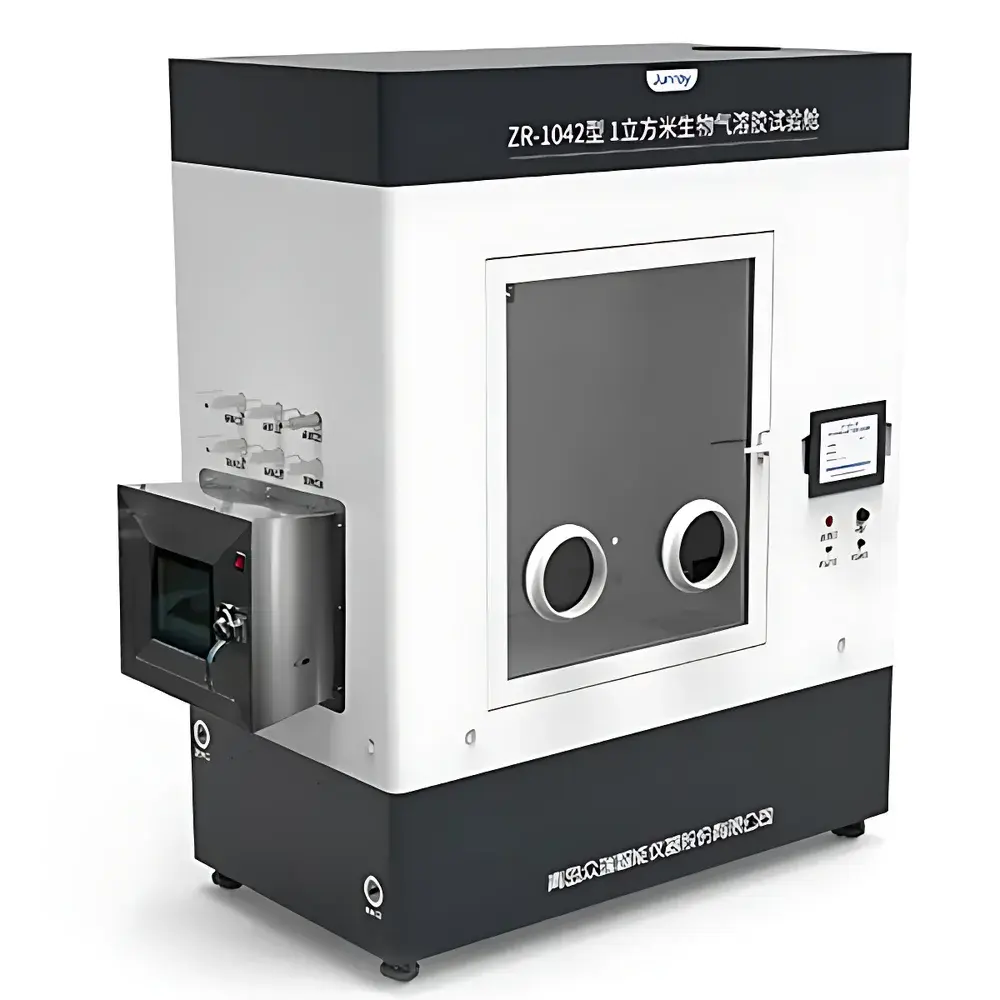
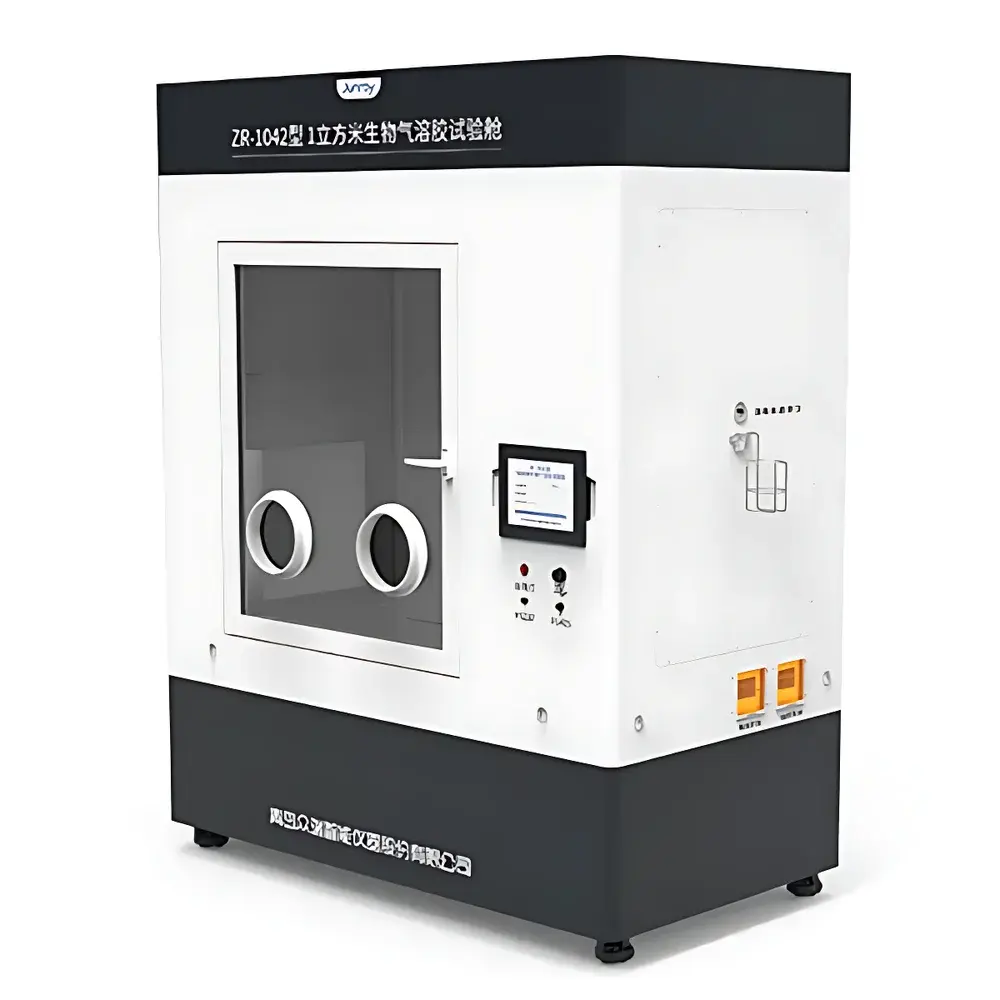
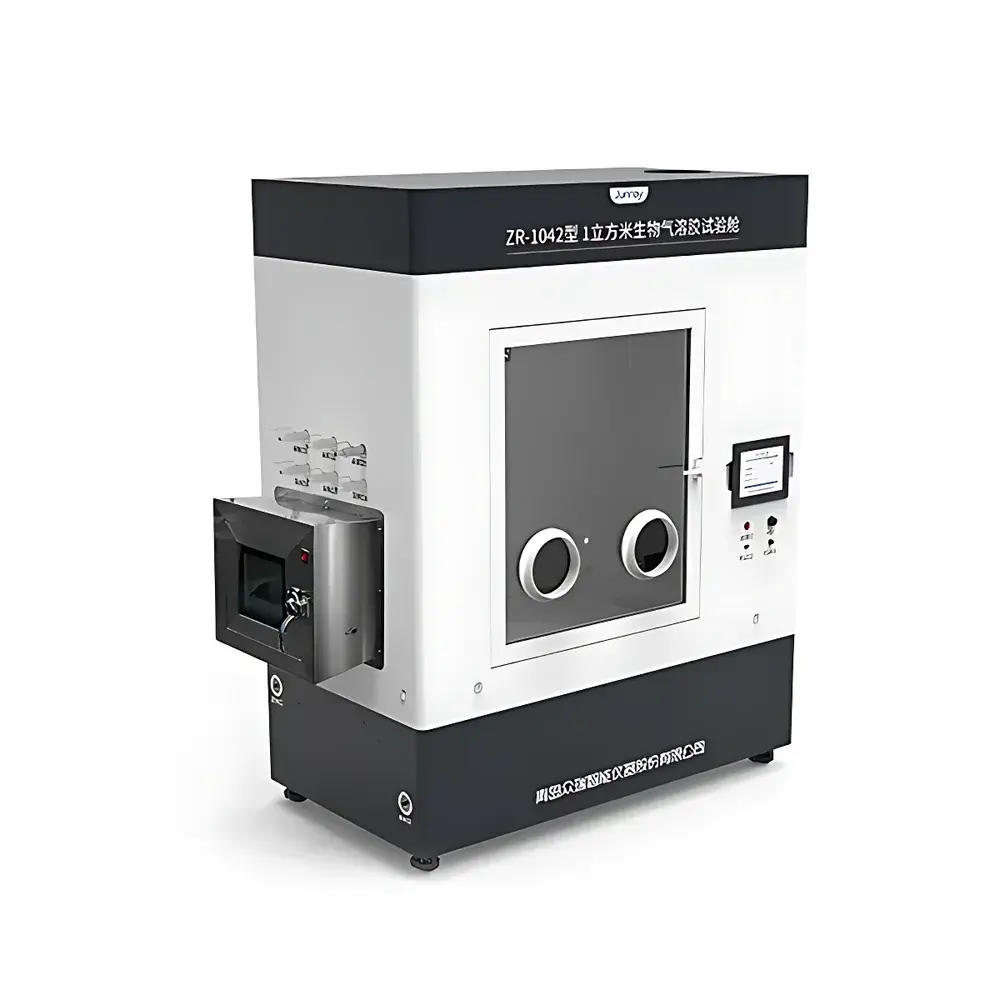
Junray ZR-1042 1 m³ Bioaerosol Test Chamber
| Brand | Junray |
|---|---|
| Origin | Shandong, China |
| Manufacturer Type | Direct Manufacturer |
| Product Category | Domestic |
| Model | ZR-1042 |
| Instrument Type | Bioaerosol Testing System |
| Chamber Volume | 1 m³ |
| External Dimensions (L×W×H) | 1658 mm × 860 mm × 1962 mm (including transfer port) |
| Net Weight | ~350 kg |
| Power Supply | AC (220 ± 22) V, (50 ± 1) Hz |
| Max Power Consumption | < 2000 W |
| Temperature & Humidity Control | Adjustable Constant-Temperature/Constant-Humidity System |
| Pressure Control | Active Cabin Pressure Regulation |
| Internal Material | Stainless Steel (AISI 304) |
| Air Cleanliness Class | ISO Class 7 (10,000-grade) after Purification |
| Sampling Ports | 6 standardized ports |
| Communication Interfaces | RS232, RS485 |
| Data Storage & Export | Embedded logging with USB export capability |
| User Management | Three-tier role-based access control with audit trail compliant with ALCOA+ principles |
Overview
The Junray ZR-1042 1 m³ Bioaerosol Test Chamber is a purpose-built, fully enclosed environmental simulation platform engineered for controlled generation, dispersion, and evaluation of biological aerosols under reproducible and traceable conditions. It operates on the principle of dynamic aerosol containment—maintaining precise thermodynamic and aerodynamic stability within a sealed stainless-steel chamber while enabling real-time monitoring and intervention. Designed to support method validation, disinfection efficacy testing, and aerosolized pathogen behavior studies, the system complies with key regulatory frameworks governing airborne biocide assessment and microbial aerosol characterization in laboratory settings. Its architecture integrates HVAC-level environmental control, integrated bioaerosol generation, multi-point sampling readiness, and GxP-aligned data governance—making it suitable for GLP-compliant research laboratories, national institutes of public health, and industrial R&D centers engaged in air disinfection technology development.
Key Features
- ISO Class 7 (10,000-grade) cleanroom-rated internal environment achieved via an integrated HEPA + activated carbon filtration system with continuous recirculation.
- Dual-mode decontamination: programmable UV-C irradiation (254 nm) combined with chemical fogging compatibility through dedicated inlet/outlet pathways.
- Integrated, calibrated microbial aerosol generator with adjustable liquid flow rate (0.1–5 mL/min), supporting standardized nebulization of bacterial spores (e.g., Bacillus atrophaeus), viruses (e.g., MS2 bacteriophage), or inert tracer particles.
- Precision environmental regulation: independent PID-controlled temperature range (10–35 °C ± 0.5 °C) and relative humidity control (30–80 %RH ± 3 %RH), with real-time cabin pressure monitoring (±1 Pa resolution).
- Six standardized 1/4″ NPT sampling ports positioned to minimize flow disturbance—compatible with cascade impactors, filter samplers, optical particle sizers, and real-time bioaerosol monitors (e.g., UV-APS, BioTrak).
- Embedded industrial-grade controller with 10.1″ high-brightness capacitive touchscreen, supporting intuitive workflow scripting, parameter scheduling, and alarm-triggered event logging.
- Three-tier user authentication (Operator / Supervisor / Administrator) with time-stamped, immutable audit trail meeting FDA 21 CFR Part 11 and EU Annex 11 requirements for electronic records integrity.
- Front-access glovebox interface and side-mounted pass-through chamber eliminate need for front-door opening during sample exchange—preserving cabin integrity and minimizing external contamination ingress.
Sample Compatibility & Compliance
The ZR-1042 accommodates a broad spectrum of test agents including vegetative bacteria (Staphylococcus aureus, Pseudomonas aeruginosa), bacterial spores (Bacillus subtilis, Geobacillus stearothermophilus), fungal conidia (Aspergillus niger), and non-enveloped viruses (e.g., Phi6, MS2). All operational protocols align with internationally recognized standards: GB/T 38504–2020 (Evaluation Method for Fogging Disinfection), GB 27948–2020 (General Requirements for Air Disinfectants), GB/T 38498–2020 (Corrosivity Assessment of Disinfectants), and JJF 1826–2020 (Calibration Specification for Air Microbial Samplers). The chamber’s design facilitates full traceability from aerosol generation to collection—enabling compliance with ISO 14644-1, ISO 14698-1, and USP for controlled environments used in microbiological risk assessment.
Software & Data Management
The embedded control software provides synchronized acquisition of chamber temperature, humidity, differential pressure, UV lamp status, generator runtime, and alarm events. All parameters are timestamped with microsecond precision and stored locally in encrypted binary format. Data export is supported via USB 2.0 interface in CSV and PDF report formats—with configurable metadata fields (operator ID, protocol version, batch number). Audit logs retain all user actions—including parameter modifications, login/logout sequences, and calibration interventions—for ≥18 months without manual archiving. Firmware updates are validated via SHA-256 checksum verification prior to installation, ensuring system integrity throughout lifecycle maintenance.
Applications
- Validation of fogging, spraying, and UV-based air disinfection devices per GB/T 38504–2020 and EN 14885.
- Assessment of aerosol deposition kinetics and spatial distribution patterns using multi-port sampling strategies.
- Testing of respirator filtration efficiency against bioaerosol challenges under controlled RH and temperature gradients.
- Development and verification of rapid bioaerosol detection methods—including fluorescence-based, PCR-coupled, and mass spectrometry workflows.
- Corrosion and material compatibility studies of disinfectants on medical equipment surfaces under prolonged aerosol exposure.
- Training and proficiency testing for biosafety level 2 (BSL-2) laboratory personnel in aerosol handling and containment procedures.
FAQ
What biosafety level is the ZR-1042 rated for?
The chamber is designed for BSL-2 equivalence when operated with appropriate PPE and procedural controls; it is not certified as a primary containment device but serves as a secondary engineering control for aerosol challenge studies.
Can the chamber be integrated with third-party particle counters or microbial samplers?
Yes—via its six standardized sampling ports and RS232/RS485 interfaces, the system supports hardware synchronization with commercial aerosol spectrometers, impingers, and cyclone samplers.
Is remote monitoring or network connectivity supported?
Local Ethernet connectivity is available as an optional module (not standard); however, all data logging and configuration remain offline by default to ensure cybersecurity compliance in regulated environments.
Does the system include validation documentation for IQ/OQ/PQ?
Factory-issued Installation Qualification (IQ) and Operational Qualification (OQ) templates are provided; Performance Qualification (PQ) protocols must be developed per site-specific use cases and approved by internal QA units.
What maintenance intervals are recommended for filters and UV lamps?
HEPA filters require replacement every 12 months or after 500 operational hours; UV-C lamps are rated for 8,000 hours and should be intensity-calibrated quarterly using a NIST-traceable radiometer.
Related Products







